The End of Diesel Dominance?
By Aditya Kondejkar, Senior Research Analyst – India Power Systems Research

For decades, diesel has been the undisputed backbone of India’s commercial vehicle (CV) industry, powering everything from last-mile delivery vans to long-haul freight carriers. Today, however, the sector is entering one of the most significant transitions in its history.
Driven by sustainability goals, energy security concerns, evolving regulations, and changing fleet economics, India’s CV market is gradually moving towards a multi-fuel future powered by CNG, LNG, battery electric vehicles (EVs), and hydrogen.
Unlike passenger vehicles, commercial vehicle purchase decisions are driven by business economics. Fleet operators evaluate every investment based on total cost of ownership (TCO), operating costs, uptime, payload, and profitability. As a result, alternate fuels will succeed not because they are cleaner, but because they deliver measurable value to transport operators.
One Industry, Multiple Realities
India’s transition to cleaner mobility is unlikely to produce a single winning technology. Instead, the industry is expected to adopt a “horses for courses” approach, where multiple fuel technologies coexist, each serving applications best suited to its operational characteristics.
Factors such as driving range, payload sensitivity, duty cycles, infrastructure availability, and lifecycle economics will determine which fuel is most suitable for a particular application. Recognizing this, OEM strategies increasingly reflect a technology-agnostic approach.
Tata Motors has expanded its portfolio across CNG, LNG, battery-electric, hydrogen fuel-cell and hydrogen internal combustion engine (H2-ICE) platforms. Ashok Leyland has similarly invested in CNG, LNG, battery-electric buses and hydrogen technologies, while Blue Energy Motors has focused on LNG-powered heavy-duty trucks. Companies such as Switch Mobility and EKA Mobility are driving innovation in the electric commercial vehicle segment. Rather than betting on a single technology, manufacturers are building diverse product portfolios that allow fleet operators to choose the most appropriate solution for their operating requirements and duty cycles.
Government initiatives such as PM E-Drive, the National Green Hydrogen Mission, Production Linked Incentive (PLI) schemes, and various state EV policies are further accelerating investments in alternate fuel technologies.
The Emerging Fuel Hierarchy
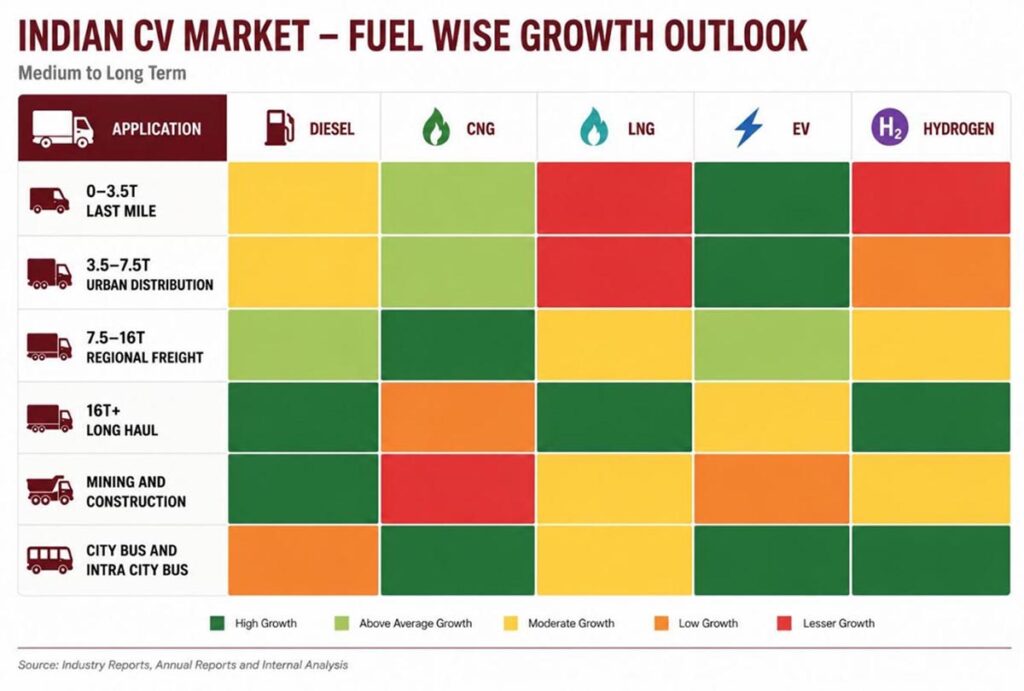
Clear application trends are already beginning to emerge. Battery electric vehicles are expected to see the fastest adoption in urban applications such as last-mile delivery, municipal fleets, and city buses, where predictable duty cycles and lower operating costs provide a compelling business case.
CNG is likely to remain an important transition fuel for light and medium commercial vehicles, supported by India’s expanding CNG network and lower running costs compared to diesel. For heavy-duty and long-haul operations, LNG offers longer driving range, faster refuelling, and minimal payload compromise, making it a practical bridge technology for interstate freight movement.
Hydrogen represents the industry’s long-term opportunity for decarbonising heavy-duty transport. Whether through fuel-cell technology or hydrogen internal combustion engines (H2-ICE), it offers the potential to combine long range, rapid refuelling, and high payload capability. However, mass adoption will depend on technology maturity, infrastructure development, and favourable total cost of ownership.
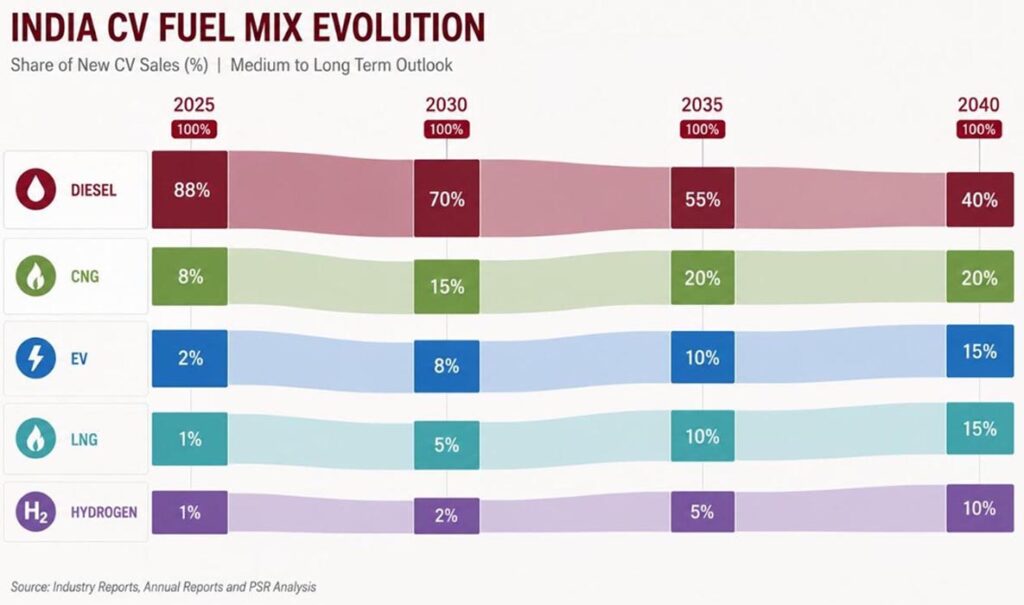
Taken together, these application-specific trends point towards a gradual diversification of India’s commercial vehicle market rather than an abrupt replacement of diesel.
Why the Transition Matters Beyond Sustainability
The shift towards alternate fuels extends far beyond reducing emissions. It is increasingly becoming a strategic necessity for India’s economy.
One of the biggest drivers is energy security. India’s heavy dependence on imported crude oil leaves the transportation sector vulnerable to geopolitical disruptions and volatile fuel prices. Recent developments in West Asia have again highlighted how global events can quickly influence freight costs, inflation, and overall economic stability.
Diversifying the country’s transportation energy mix through electricity, natural gas, LNG, biofuels, and hydrogen can reduce dependence on imported oil while strengthening long-term energy resilience.
At the same time, India is working towards lowering logistics costs, currently estimated at around 13–14% of GDP, significantly higher than the 8–10% seen in many developed economies. Supported by initiatives such as the National Logistics Policy and PM Gati Shakti, improving freight efficiency has become a national priority.
Commercial vehicles sit at the centre of this ambition. Along with connected vehicle technologies, route optimisation, and digital fleet management, alternate fuels have the potential to reduce operating costs, improve fleet productivity, and enhance the competitiveness of India’s logistics sector.
The Roadblocks Ahead
Challenges. Despite growing momentum, the transition will not be without challenges. Each alternate fuel comes with its own ecosystem constraints. EV adoption depends on widespread charging infrastructure, shorter charging times, and lower battery costs.
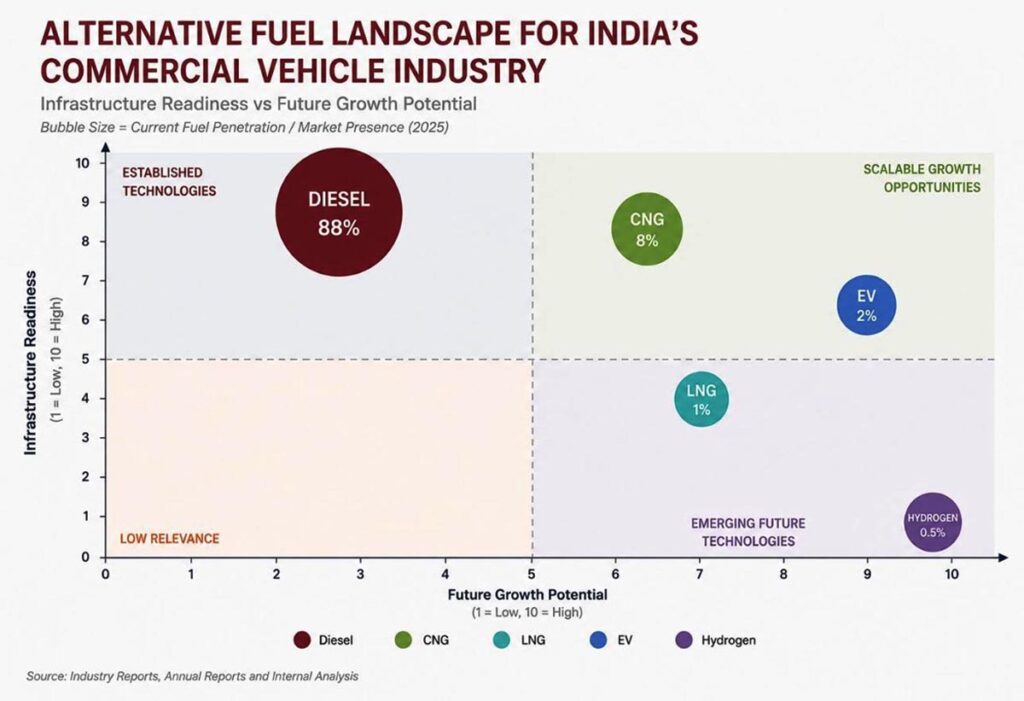
CNG and LNG require continued expansion of refuelling networks to support broader commercial operations, while hydrogen still faces challenges related to green hydrogen production, storage, transportation, and overall ecosystem readiness. These realities suggest that diesel will continue to play an important role in India’s commercial vehicle market for years to come, even as its overall share gradually declines.
The Real Test. Creating value for the end customer is the real test as India moves towards a multi-fuel commercial vehicle ecosystem, and execution will matter as much as ambition.
Governments must ensure policy consistency and infrastructure development, while OEMs need to focus on developing cleaner technologies and on affordability, reliability, serviceability, and lifecycle economics. A transition without adequate ecosystem readiness risks increasing costs for transport operators and slowing adoption.
Ultimately, the pace of this transition will be decided by fleet operators rather than policymakers or manufacturers. In one of the world’s most price-sensitive commercial vehicle markets, alternate fuels will gain acceptance only if they improve profitability through lower operating costs, higher uptime, greater productivity, or regulatory advantages.
In the end, every alternate fuel solution must answer one simple question for the customer: “What’s in it for me?”
Conclusion: A multi-fuel future is not easily attainable. India’s commercial vehicle industry is unlikely to be defined by a single fuel. Instead, the future will be characterised by a portfolio of technologies, each serving the applications where it delivers the greatest operational and economic value.
The transition is not merely a technology challenge—it is an ecosystem challenge. Governments can create enabling policies, OEMs can develop innovative products, and infrastructure providers can build networks, but widespread adoption will ultimately depend on customer confidence and commercial viability.
The companies that succeed in this transformation will not simply offer cleaner vehicles—they will offer better business economics. In a market where every kilometre directly impacts profitability, the future belongs to solutions that balance sustainability with affordability, innovation with practicality, and environmental goals with measurable value for the people who keep India’s economy moving
About Power Systems Research
Power Systems Research (PSR) is the leading supplier of global production data and forecasts to the engine, power products and components industries. Based in St. Paul, Minnesota, USA, it also has operations in Europe, South America, India, China, the Middle East and Japan. We have partnered with the world’s most important vehicle and components suppliers since 1976.