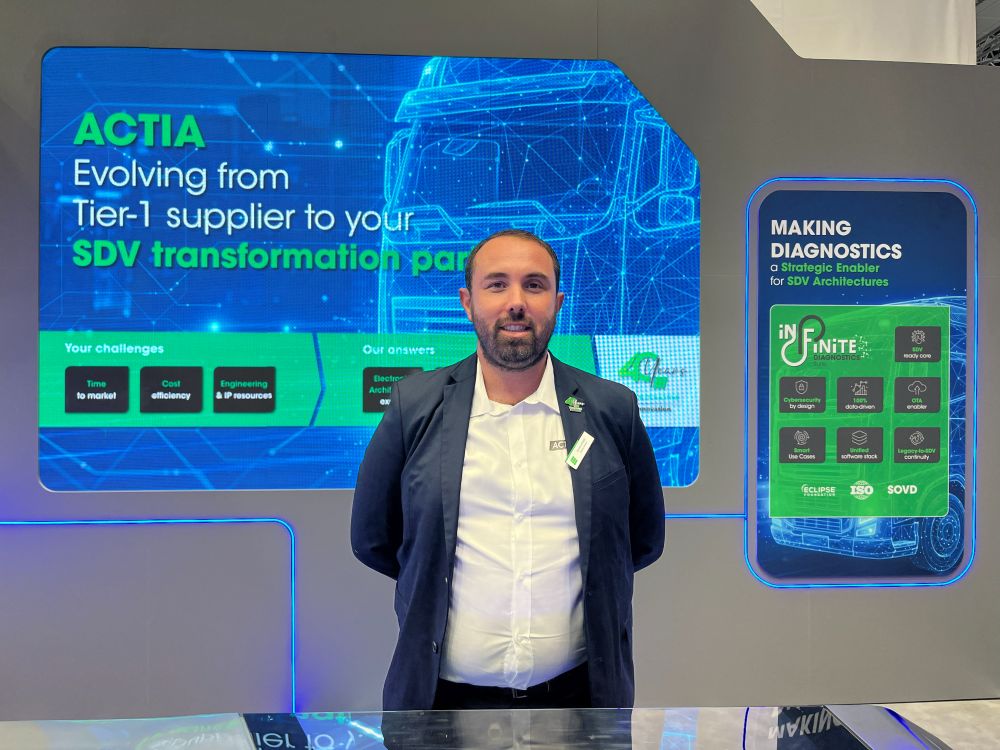
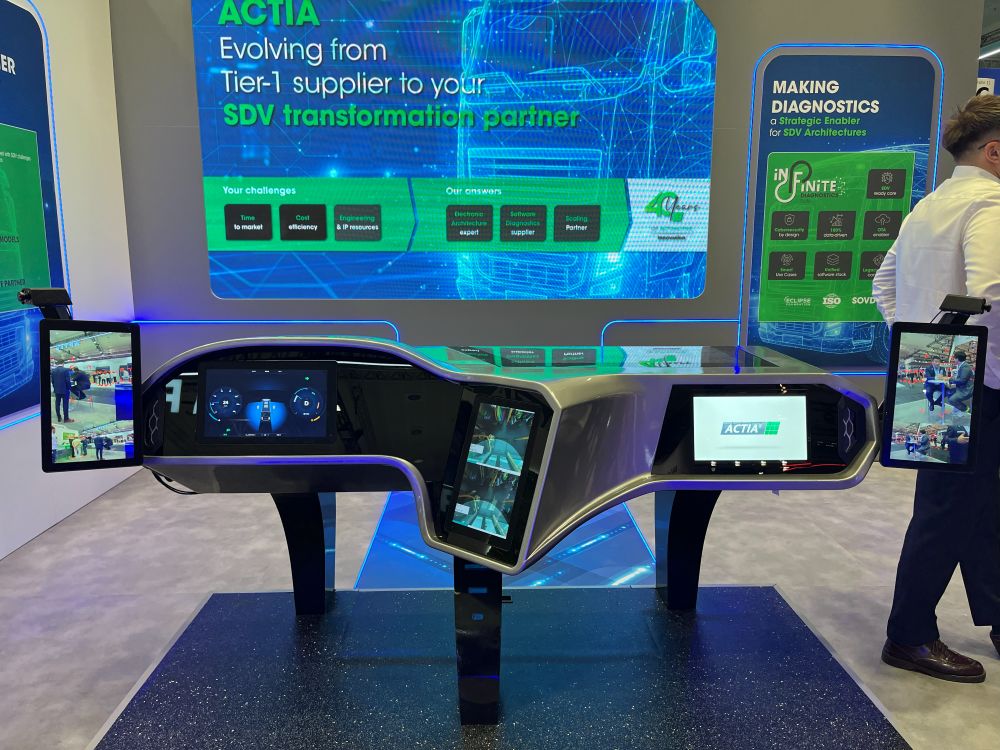
At IAA Transportation 2026, one of the quieter exhibits on ACTIA’s stand was also among its most telling. The French electronics specialist, known for four decades of work in vehicle diagnostics, presented a truck cockpit powered by a high-performance computer (HPC) that runs without active cooling, with neither fans nor liquid cooling. It anchored a line-up aimed at helping commercial vehicle makers move towards the software-defined vehicle (SDV).
Having built both software expertise and its own electronic architecture, from design through production, ACTIA sees itself as more than a typical Tier 1 supplier. It positions itself instead as a dedicated SDV transformation partner for major OEMs, including Volvo Trucks and Iveco.
According to Damien Lacage, Truck Market Manager, Sales & Marketing, ACTIA Automotive, the company has identified three pain points OEMs face as vehicles move to centralised, software-heavy architectures. They are slower time to market, rising costs from growing software complexity, and mounting pressure on the engineering resources needed to manage it.
ACTIA’s response rests on three pillars. The first is its own technology platform, spanning the HPC, zonal ECUs and telematics systems, which lets OEMs build customised solutions faster rather than developing everything from scratch. The second is software flexibility. Rather than locking customers into a single fixed solution, ACTIA takes a modular approach, letting OEMs select specific software layers, diagnostic features or hardware components to build cost-effective solutions suited to their needs. The third is engineering support, offered through models ranging from offshore development teams to on-premises engineers. With it, a customer can stand up a fully staffed software team in under a year, compared with the roughly five years it typically takes to recruit and build that expertise independently.
One Platform, Many Vehicles
The same flexibility extends to over-the-air (OTA) updates, a defining feature of the SDV. ACTIA offers a complete OTA solution, from cloud servers through to the vehicle’s ECUs, designed to keep hardware and software interoperable whichever hardware platform an OEM chooses. Customers can adopt the full stack or integrate selected components into their existing systems. The company takes the same approach to middleware, either supplying a complete integrated system or fitting its components into an OEM’s own software architecture.
Underpinning all of this is reuse. The architecture ACTIA presented can be deployed across a broad span of commercial and public transport vehicles, so manufacturers can serve several product lines, configurations and market segments from the same hardware and software foundation. In practice, software developed for one programme need not be rebuilt for the next, since components can be carried over and adapted instead. For OEMs, the benefits add up in terms of less integration effort, shorter development and validation cycles, and a faster route from new feature to vehicle on the road. The fan-less design plays its part too. With no moving parts to cool the processor, the unit is expected to be more reliable, need less maintenance and fit more easily into the harsh conditions of automotive use.
Seeing More of the Road
The cockpit management system at the heart of the showcase shows how much a single HPC can take on. It runs multiple in-cabin functions at once, all through one cloud-connected system. On the driver’s side, these include digital mirrors, full instrument cluster displays and ADAS features such as pedestrian detection and a surround bird’s-eye view. Around the cabin, it also handles body controls such as air conditioning and lighting, passenger monitoring for buses, and even infotainment such as video playback.

That computing headroom also enables AI-driven vision. By processing feeds from cameras and sensors, the platform builds a picture of the vehicle’s surroundings. This supports safety functions required under international regulations, such as blind spot monitoring and moving-off information systems, which help drivers detect vulnerable road users around large vehicles.
Mr. Lacage confirmed that ACTIA manufactures the system itself, offering it either off the shelf or as a base platform that can be customised into a dedicated solution for individual manufacturers. Bringing these functions together on a single, centralised platform also makes it easier to combine data from multiple sources. In doing so, it lays the groundwork for what comes next – vehicle architectures ready for increasingly intelligent and automated driving.