India’s commercial vehicle market closed FY2025-26 with record domestic sales of 10.8 lakh units, up 12.6% from the previous year. As buses, light commercial vehicles (LCVs) and heavy-duty trucks become increasingly dependent on integrated electronics, thermal management and complex structural systems, the role of automotive suppliers is changing.

OEMs are under constant pressure to shorten development cycles, localise critical sourcing and manage supply-chain volatility. This is driving a shift from conventional build-to-print component supply towards integrated, multidisciplinary programme execution.
Founded in 2006, Yeemak has evolved in step with this transformation. Starting with precision sheet-metal fabrication and machining, the company has progressively added plastic moulding, copper and aluminium extrusion, precision toolrooms and electronics assembly. The convergence of these capabilities has enabled Yeemak to move beyond standalone component manufacturing towards integrated subsystem development and supply.
“The question is not why automobiles; the question is why not – and what’s next?” – said Mr. Vanchinathan T., Founder and Chairman, Yeemak.
From Component Supplier to Programme Partner
Traditional sourcing models require commercial vehicle OEMs to coordinate multiple suppliers for PCB assemblies, structural stampings, moulded enclosures and other components. While this approach remains effective for conventional programmes, it can create coordination challenges, fragmented quality ownership and longer lead times as products evolve.
With commercial vehicles becoming more electronically dense and software-defined, suppliers capable of bringing multiple manufacturing disciplines under one programme structure are gaining importance.
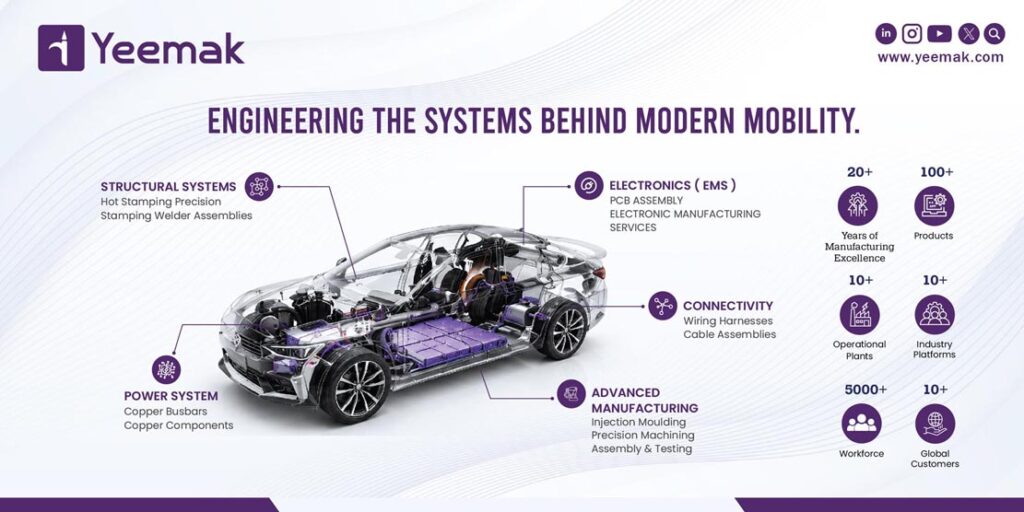
Yeemak operates across component manufacturing, subsystem integration and original design manufacturing (ODM). Its portfolio for truck, bus and heavy-vehicle OEMs includes thermal and HVAC components, structural chassis parts, electronic assemblies and wire harnesses. Depending on programme requirements, the company can support customers from component and subsystem manufacturing through co-development, New Product Introduction (NPI) and serial production.
“Our objective is not simply to manufacture a component. It is to bring multiple capabilities together so that customers can move from design and development to production with fewer interfaces and greater accountability,” he stated.
The value of this model extends beyond vendor consolidation. Bringing electronic design, forging, extrusion, machining and enclosure tooling into a coordinated manufacturing ecosystem enables concurrent engineering. Mechanical housing changes, PCB revisions and harness modifications can be addressed together, reducing hand-offs and improving quality ownership from design for manufacturing (DFM) through serial production.
Electrification Reshapes Commercial Mobility
The transition to electric buses, LCVs and heavy-duty EVs is fundamentally changing subsystem requirements, particularly in thermal management and power electronics.
In conventional internal combustion engine (ICE) vehicles, thermal management is largely centred around the engine and cabin. In electric commercial vehicles, it becomes a more interconnected system affecting battery life, charging performance, power-electronics reliability and vehicle range under heavy-duty operating conditions.
Yeemak’s capabilities address three key areas –
Thermal Management
As commercial vehicles electrify, localisation of thermal-management hardware is becoming increasingly important. Yeemak manufactures electronic expansion valves (EEVs) for precise refrigerant metering, along with copper capillaries and oil-return tubes used in commercial HVAC and cooling architectures.
Electronics and Interconnects
Electric commercial vehicles place greater demands on power electronics, circuit design and thermal performance. Yeemak’s Surface Mount Technology (SMT) capabilities include assembly on aluminium PCBs for power-electronics applications, as well as multilayer flexible PCBs for telematics and sensor systems.
These assemblies are complemented by in-house wire harnesses designed to withstand continuous vibration and demanding heavy-duty operating cycles.
“Electrification is not just about replacing the engine with a battery. It changes the architecture of the vehicle, and that creates opportunities for suppliers who can combine electronics, thermal management and mechanical manufacturing,” he explained.
- Structural Systems
Battery packs require robust structural protection in addition to thermal management. Yeemak manufactures lightweight-alloy EV battery enclosures, module housings, structural cell spacers and internal dividers.
The company is also pursuing technology-transfer initiatives in hot stamping to support the manufacture of ultra-high-strength structural members and contribute to lightweighting in heavy commercial vehicles.
Integration, Engineering and Localisation
Speed of New Product Introduction is a critical factor in commercial vehicle development. Engineering revisions can be delayed when plastics, metals, circuit boards and validation activities are handled by separate external suppliers.
Yeemak’s integrated manufacturing model brings SMT assembly together with internal toolrooms, forging presses, aluminium extrusion lines and CNC machining centres. This enables changes to sensor housings, PCB layouts and wire harnesses to be coordinated within the same manufacturing ecosystem, reducing external coordination loops during prototype and development stages.
“When engineering and manufacturing capabilities are available within the same ecosystem, the response to a design change becomes much faster. That is critical when OEMs are working towards increasingly compressed NPI timelines,” he added.
The company is also expanding its manufacturing footprint closer to customers. Of its 27-unit manufacturing footprint, 10 units are currently operational across major industrial clusters in Tamil Nadu, Andhra Pradesh and Maharashtra, including Kanchipuram, Singadivakkam, Sri City, Chakan and Ranjangaon.
This distributed presence supports localisation, faster programme ramp-up, shorter logistics distances and closer interaction between manufacturing teams and customers.
Quality systems across the organisation are supported by IATF 16949 compliance, Hyundai Motors’ SQ Mark certification and recognition through Samsung’s Best Supplier Award. These credentials reflect the process discipline, traceability and quality-management systems required for high-volume automotive programmes.
Engineering at the Core
Yeemak works with OEM and Tier-1 engineering teams from the early stages of product development, participating in design reviews, DFM, prototyping, testing and NPI.
Its engineering approach is also strengthened by systems-engineering practices drawn from the aerospace and defence activities of sister entity Jeanuvs. These include rigorous testing, process controls and failure-mode analysis, which can be applied to automotive component validation.
“The future belongs to companies that are willing to take ownership of complexity. We want to build the engineering depth that allows us to participate much earlier in a customer’s product-development journey,” he said.
What the Next Five Years Will Demand
Over the next five years, the commercial vehicle industry is likely to be shaped not by electrification alone, but by the convergence of mechanical, electronic and thermal systems.
As heavy vehicles incorporate advanced driver assistance systems (ADAS), telematics, power electronics and multiple thermal-management loops, supplier expectations will increasingly extend beyond process execution to system-level engineering participation.
For Yeemak, this represents an opportunity to use complex mobility programmes to deepen domestic engineering and manufacturing capabilities. Its roadmap focuses on expanding engineering-led ODM contributions, strengthening power-electronics integration for heavy EVs and scaling lightweight structural manufacturing.
“We see the next phase as a move from being a capable manufacturer to becoming a deeper technology and engineering partner. The complexity of future mobility platforms demands that transition,” he stated.
As commercial vehicle platforms become more integrated, the competitive advantage is likely to move towards suppliers capable of connecting engineering design, subsystem integration and serial production. Yeemak’s integrated manufacturing strategy positions it to participate in this transition – from supplying individual components to taking greater responsibility for complete subsystems and development programmes.