By Kinjal Shah, Senior Vice President and Co-Group Head, Corporate Ratings, ICRA Limited

Over the years, the Indian commercial vehicle (CV) industry has transformed across multiple dimensions, driven by regulatory interventions, evolving customer needs and the growing policy thrust on cleaner mobility. Regulatory changes, ranging from emission norms and axle load revisions to requirements related to driver safety and comfort, have significantly influenced product development and fleet economics. At the same time, the increasing focus on alternative fuels has encouraged original equipment manufacturers (OEMs) to progressively channel their investments towards alternative powertrain technologies. Over the past decade, OEMs have also moved beyond conventional vehicle manufacturing to offer broader mobility solutions, including fleet management services and charging solutions. While these shifts are taking place across different fronts, they are broadly aligned towards creating a more efficient, ecofriendly and integrated CV ecosystem. Several of these new technologies and platforms are currently in the formative stage of customer adoption but carry the promise of becoming more pervasive over the next 4-5 years.
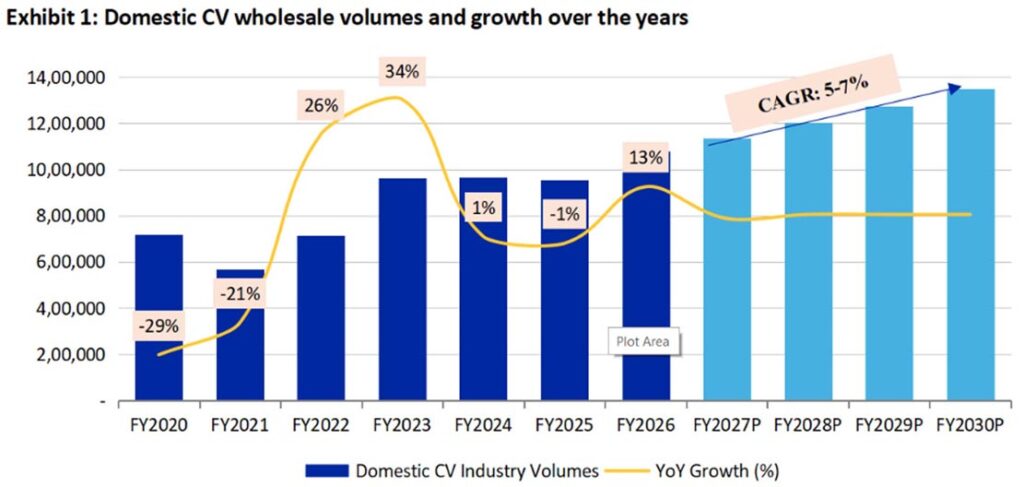
The trend in domestic CV wholesale volumes highlights the inherent cyclicality of the industry. After a sharp demand contraction during the Covid-19 pandemic (FY2020-FY2021), domestic CV wholesale volumes recovered strongly during FY2022-FY2023, supported by pent-up demand and the low base. This was followed by broadly range-bound volumes in FY2024 and FY2025, as the implementation of the Model Code of Conduct around the 2024 General Elections and the subsequent slowdown in infrastructure project rollouts weighed on demand. FY2026 also began on a subdued note, with the early onset of monsoons affecting demand in the initial months. However, the rationalisation of the goods & services tax (GST) rates for the industry from September 2025 provided a demand stimulus across CV sub-segments, enabling the year to close with a robust 13% growth in volumes. ICRA expects domestic CV wholesale volumes to expand by 4-6% year-on-year (YoY) in FY2027, with commodity inflation, elevated fuel prices and the high base of FY2026 likely to have some bearing on the growth momentum. Domestic wholesale CV volumes, which increased at a compound annual growth rate (CAGR) of 7% during FY2020-FY2026, are projected to rise at a CAGR of 5-7% until FY2030.
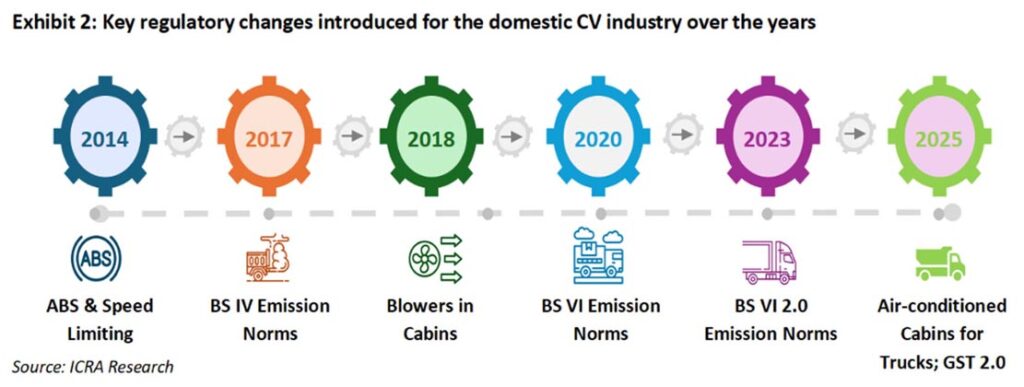
Regulatory interventions have played a key role in shaping the domestic CV ecosystem. The industry has progressively moved towards stricter emission standards, beginning with the implementation of BS IV norms from April 2017, followed by BS VI norms from April 2020. BS VI Phase 2.0, introduced in April 2023, further strengthened the regulatory framework through real-world emission monitoring and onboard diagnostics. More recently, the mandatory installation of air-conditioned cabins for N2 and N3 category CVs and GST rate reductions were among the main regulatory developments affecting the sector. Looking ahead to 2030, regulatory interventions are expected to remain focussed on tighter nitrogen oxide/particulate matter (NOx/PM) limits, enhanced onboard monitoring and the mandatory installation of advanced driver assistance systems (ADAS) in select CV categories. Over the longer term, these measures will be aligned with India’s economy-wide net-zero emissions target for 2070, with freight transport and CVs expected to play an important role in this transition.
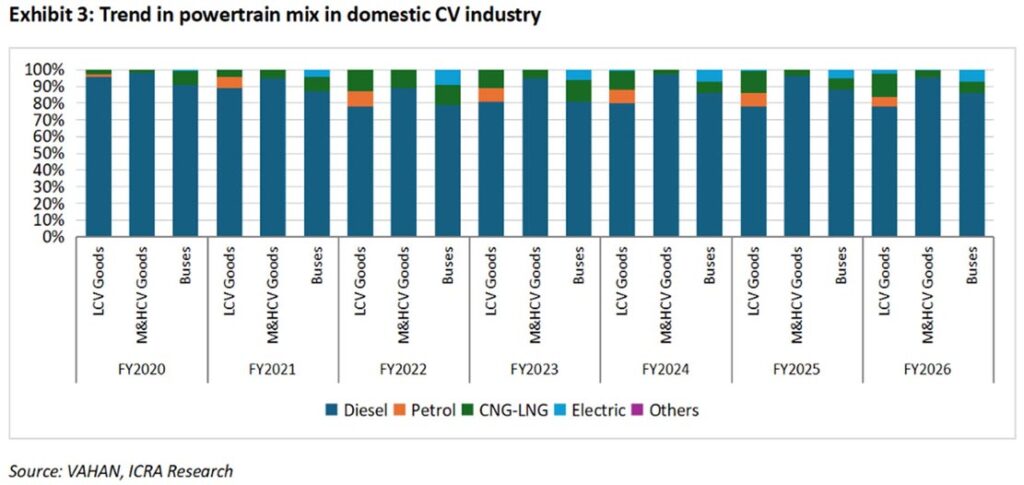
The seamless and time-bound adoption of alternative fuels across CV sub-segments will be critical for aligning the industry with India’s long-term net-zero goals. The Government of India has introduced several schemes to promote the adoption of alternative fuels. Schemes like Faster Adoption and Manufacturing of Electric Vehicles in India (FAME) (I-II) and PM Electric Drive Revolution in Innovative Vehicle Enhancement (PM E-DRIVE) aim to accelerate electric vehicle (EV) adoption and strengthen the EV ecosystem, while initiatives such as the National Green Hydrogen Mission (NGHM) and Sustainable Alternative Towards Affordable Transportation (SATAT) seek to promote alternative fuels such as hydrogen and biofuels. Although India’s alternative fuels strategy is currently largely EV-centric, it is expected to broaden into a multi-fuel approach by 2030. Alternative fuels, like CNG/LNG[ CNG: Compressed natural gas; LNG: Liquified natural gas], and EVs are likely to witness meaningful penetration in medium and heavy commercial vehicle (M&HCV) buses and light commercial vehicle (LCV) trucks. CNG/LNG penetration in CVs is expected to gradually increase to 30-35% by FY2030 from 25% in FY2026, whereas EV penetration is likely to reach 10-15% by FY2030 from 2% in FY2026, driven primarily by the M&HCV bus segment.
In summary, India’s CV industry is set to continue its journey of transformation across multiple fronts, with 2030 serving as a key milestone to assess the tangible progress achieved, particularly in the adoption of alternative fuels. The role of primary stakeholders, including OEMs, fleet operators and regulatory authorities, will remain crucial for enabling a meaningful transition towards a more efficient, ecofriendly and integrated CV ecosystem.