By Mr. Anand Kumar, Business Head – Aftermarket, Uno Minda Ltd.
The future isn’t physical versus digital, but digitally enabled physical networks combining reach, speed, transparency and intelligence.

India’s automotive aftermarket is at an interesting inflection point. For decades, the sector has largely been defined by replacement demand, vehicle parc, price competitiveness and the reach of distribution networks. While these fundamentals continue to remain important, the forces shaping the next phase of the industry are considerably different.
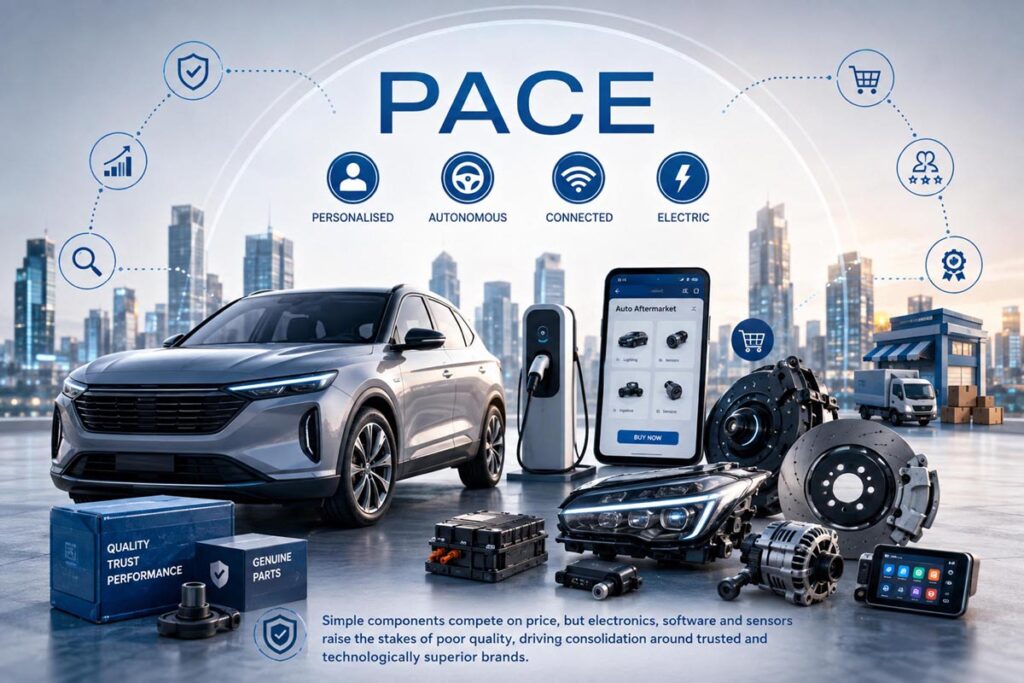
According to ACMA, India’s automotive aftermarket, valued at ~₹99,500 crore in FY2025, is projected to reach ~₹1.38 lakh crore by FY2030, driven by an ageing vehicle parc, higher utilisation, and rising demand for organised aftermarket products. Vehicles are growing smarter, consumers more discerning, distribution more digital, and lines between replacement, upgrade, and personalisation are blurring — mirroring the broader shift toward PACE (Personalised, Autonomous, Connected, Electric) mobility, whose impact extends well beyond manufacturing into the aftermarket.
PACE Will Reshape Aftermarket
PACE marks a major shift in global automotive. Personalisation reshapes consumer interaction. Connected technologies enable new diagnostics, infotainment and intelligence. Autonomous/ADAS features add electronic sophistication and Electrification transforms architecture. Though OEM-driven, these trends inevitably flow into the aftermarket as newer vehicles enter the parc — demanding support for far more advanced vehicles, with opportunity shifting towards electronics, sensors, connected solutions, intelligent lighting, safety products, and charging solutions.
Premiumisation Changes Value Equation
The Indian aftermarket is gradually premiumising. While price once dominated replacement-part decisions, consumers now access more information and prioritise quality, reliability, safety and performance. As vehicles grow more premium and advanced, buyers are more selective — shifting the conversation from “cost” to “value delivered.” Quality assurance, technology, warranty, performance and brand credibility are emerging as key differentiators, favouring companies with strong engineering and manufacturing capabilities.
Electrification Creates New Aftermarket Architecture
Electrification is often narrowly seen as reducing demand for engine-related components, but the bigger picture is different: EVs aren’t eliminating the aftermarket, they’re reshaping it. As electric mobility grows, traditional mechanical categories may shrink while electrical/electronic systems, charging infrastructure, thermal management, braking, lighting, sensors, controls and accessories expand. With ICE, CNG, hybrid and EVs coexisting, companies must operate across platforms — anticipating this shift as a key competitive advantage.
Electronics Content per Vehicle Will Continue to Rise
Electrification is just one facet of vehicle technology transformation. Even ICE vehicles now carry far more electronics — lighting, switches, sensors, cameras, infotainment, controllers and safety systems — across segments and price points. Rising electronic content demands aftermarket capabilities beyond traditional manufacturing: product engineering, electronics expertise, testing, and translating OE technologies into reliable solutions — a major long-term opportunity for technology-led component manufacturers.
Distribution Is Becoming Digital
India’s aftermarket has long relied on physical distribution, which remains vital given the market’s scale. However, digital platforms are transforming operations — enabling demand forecasting, inventory visibility, ordering, discovery, loyalty management, warranty and communication. Digitalisation also brings market intelligence, making supply chains more responsive. The future isn’t physical versus digital, but digitally enabled physical networks combining reach, speed, transparency and intelligence.
DIY and Accessories
A parallel shift is happening among consumers, especially younger ones, who increasingly upgrade, accessorise and personalise vehicles — dash cameras, infotainment, lighting, charging solutions and convenience products. Digital content lets consumers research, compare and review before buying, fuelling this trend. This differs from conventional replacement demand: consumers now enter the aftermarket to upgrade, not just when something fails.
E-commerce and Omnichannel Will Coexist
The digitally informed consumer is accelerating aftermarket e-commerce, offering convenience, comparison, reviews and category access. Yet automotive products need compatibility, installation, technical understanding and after-sales support, making pure online or offline models unlikely. The winning model is omnichannel — discovery, purchase and support seamlessly blending online and offline — better serving next-generation consumers.
Technology and Trust Will Drive Consolidation
As products grow more sophisticated, competitive parameters shift. Simple components compete on price, but electronics, software and sensors raise the stakes of poor quality, driving consolidation around trusted, technologically superior brands. Consumers will seek engineering capability, testing standards, warranties, traceability and credibility. Lowest price becomes less sustainable; consistently trustworthy technology becomes the real differentiator.
From Replacement to Mobility Solutions
Together, these trends signal a fundamental evolution: from replacing worn components to enabling upgradation, personalisation, connectivity, safety and convenience. PACE will accelerate this shift; electrification will reshape portfolios; rising electronic content will raise technological barriers; premiumisation will change expectations; digitalisation and e-commerce will create new consumer routes.
The next decade demands more than scale — continuous investment in technology, product development, digital capabilities and brand trust. For companies like UNO Minda, with deep OE and aftermarket expertise, the opportunity lies in making advanced automotive technology accessible across India. Tomorrow’s aftermarket won’t just replace what’s worn out — it will enhance what a vehicle can do, marking perhaps the most exciting transformation in decades.
“Simple components compete on price, but electronics, software and sensors raise the stakes of poor quality, driving consolidation around trusted and technologically superior brands.”