$1.5 trillion in 2026; $2.18 trillion by 2031, growing at nearly 8% a year. Mordor Intelligence’s latest research makes it clear — green logistics has arrived, and it is not slowing down.
For much of the last decade, green logistics sat comfortably in the background — acknowledged but rarely acted upon. Today, it is a business imperative. The global green logistics market, valued at an estimated $ 1.5 trillion in 2026, is on course to reach $2.18 trillion by 2031, growing at a steady annual rate of nearly 8%. For an industry this large, growth at this pace points to something more than incremental change.
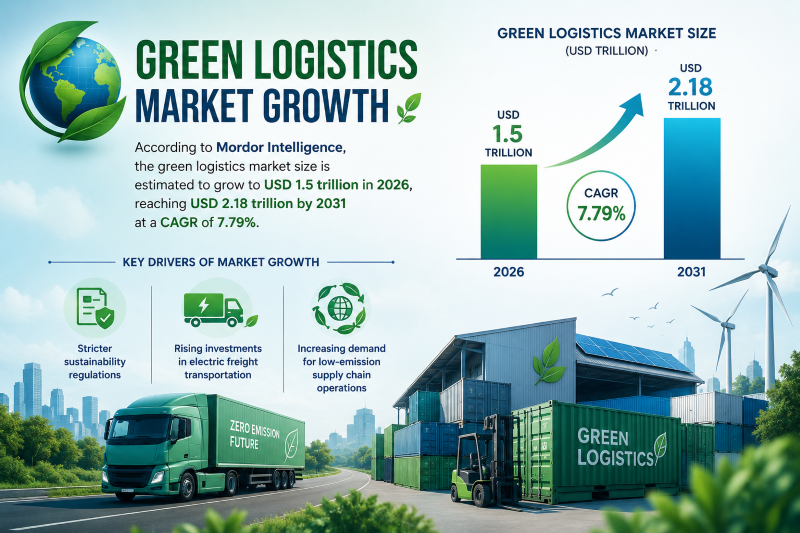
The forces driving this growth are not hard to identify. Governments are tightening environmental regulations. Businesses are setting net-zero targets and actually being held to them. And customers — both individual consumers and large corporations — are increasingly choosing suppliers who can show a credible plan for reducing their carbon footprint. Together, these pressures are pushing logistics companies to rethink everything from the trucks they run to the routes they choose to the energy that powers their warehouses.
What Green Logistics Actually Means
At its core, green logistics is about moving goods from one place to another with the least possible impact on the environment. In practice, that means electric freight vehicles instead of diesel trucks, renewable energy powering logistics facilities, AI-driven route optimisation to cut unnecessary mileage, and transparent systems that track and report carbon emissions at every step of the supply chain. It sounds complex, and in many ways it is. But the tools to make it happen are improving rapidly — and the cost of not acting is rising even faster.
E-commerce is pushing the pace
One of the biggest drivers of green logistics is something most of us do every day — online shopping. As parcel volumes continue to climb across the world’s cities, the pressure on last-mile delivery networks is intensifying. More deliveries mean more vehicles on the road, more emissions, and more urban congestion. The response from logistics companies has been to invest heavily in electric delivery vehicles, smarter routing software, and greener fulfillment strategies. Governments are helping too, with stricter urban emission zones and clean mobility incentives pushing businesses to modernise their fleets faster than they might otherwise have done. The result is that sustainable last-mile delivery is no longer a premium option — it is fast becoming the baseline expectation, the report stated.
Regulations Are Changing The Rules
Beyond e-commerce, stricter environmental regulations are reshaping how businesses across industries choose their logistics partners. Carbon reporting is no longer voluntary in many markets. Net-zero commitments are being built into procurement decisions. And logistics providers that can demonstrate transparent emissions tracking and a clear decarbonisation roadmap are winning contracts over those that cannot. In short, sustainability has moved from the marketing department to the boardroom — and the logistics industry is feeling that shift acutely. Companies that have invested early in green infrastructure are gaining a competitive edge. Those that have not are finding themselves on the wrong side of supplier selection decisions.
Regional Momentum
North America is seeing strong momentum, with the United States, Canada, and Mexico all advancing programmes to electrify freight, expand charging infrastructure, and improve emissions transparency across cross-border trade networks. Asia-Pacific, however, is where the pace of change is perhaps most striking. China, India, Japan, and several Southeast Asian economies are investing heavily in cleaner freight corridors, rail modernisation, EV charging networks, and greener port infrastructure. The region’s sheer scale of industrial activity means that even incremental improvements in logistics efficiency translate into significant environmental gains.
Mr. Jayveer V, Senior Research Manager, Mordor Intelligence, said, “As the Green Logistics Market evolves, decision-makers increasingly need visibility into how sustainability requirements, operational investments, and customer expectations are influencing logistics strategies across regions and service segments. Mordor Intelligence applies a structured blend of primary research, secondary data validation, and transparent analytical frameworks to deliver market insights that are grounded in observable industry developments and practical business realities.”
The Road Ahead
The green logistics market is not growing because businesses have suddenly become more environmentally conscious. It is growing because the economics are changing, the regulations are tightening, and the customers are demanding it. Technology providers, fleet operators, and infrastructure developers who can help logistics companies reduce emissions, track their carbon footprint, and operate more efficiently are sitting at the centre of one of the most significant industrial transitions of this decade. The market is moving. The question for every logistics business is not whether to go green — it is how fast.