By Naynish Kulkarni, Senior Director, Mobility Growth Advisory Practice, Frost & Sullivan

India’s heavy-duty truck (HDT) sector, serving cement, steel, ports, iron ore, coal, and container logistics, is entering a transformation phase. While the sector has historically been diesel-dominated, many industrial applications run on defined routes, predictable duty cycles, and fixed loading points, making them strong candidates for battery-electric conversion. The Government’s Zero Emission Truck (ZET) initiative reinforces this shift, moving the debate from whether HDTs can be electrified, to which applications should lead and which operating models make them commercially viable.
As per SIAM data, HCV sales peaked in FY2018-19 at 274,768 units, declined following the COVID-19 disruption and BS-VI transition and had nearly recovered by FY2023-24 with 257,933 units. Higher-tonnage vehicles are gaining share (e.g., 48T rigids outpacing 28T), even as the category mix stays stable: roughly 40-45% rigids, 25-30% tippers, and 30% tractor-trailers. HCV sales are projected to reach approximately 320,000 units by FY2030, with new energy vehicles making up about 10% of that market. Tractor-trailers alone represent 65,000-70,000 new units annually, a meaningful pool for future electric prime movers.
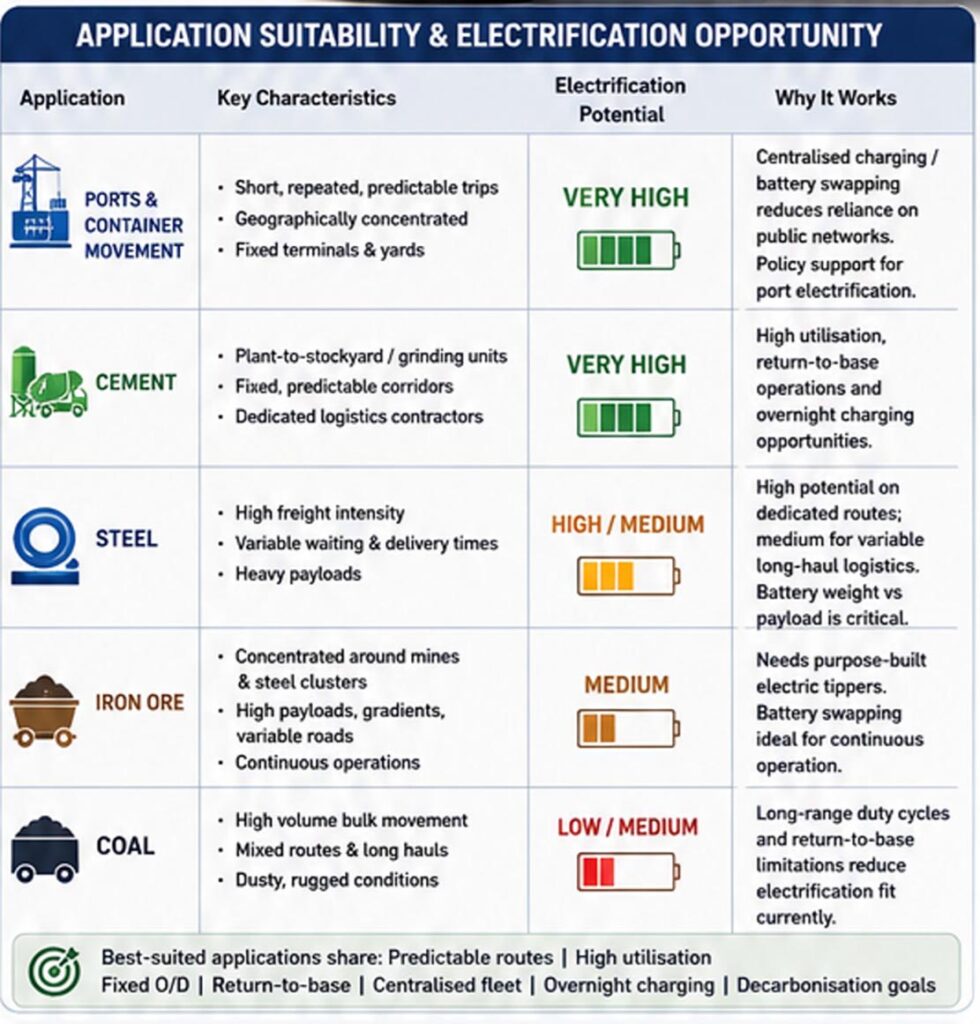
Not all applications are equally suited to electrification. A truck running 500-700 km across states differs significantly from one shuttling 100-250 km between a cement plant and a stockyard. The best-suited applications share several traits: predictable routes, high utilization, fixed origin/destination, return-to-base operation, centralized fleet management, overnight charging opportunities, and corporate decarbonization commitments.
Where Electrification Can Scale First
- Ports & Container Movement: One of the most compelling use cases, since port operations are geographically concentrated with short, repeatable, and predictable trips between terminals, container yards, and nearby facilities. Centralized charging or battery-swapping infrastructure can reduce reliance on public charging networks, and government policy already favours port electrification.
- Cement: Among the strongest early candidates. Plant-to-stockyard and plant-to-grinding-unit movements often run on fixed, predictable corridors with dedicated logistics contractors.
- Steel: High freight intensity but complicated by heavy payloads, variable waiting times, and tight delivery schedules, meaning battery weight and payload trade-offs matter more. Electrification potential is high for dedicated routes more moderate for variable long-haul steel logistics, even as some OEMs begin deploying electric prime movers here.
- Iron Ore: Geographically concentrated around mining and steel clusters, which favours electrification, but the operating environment, high payloads, gradients, variable roads, continuous operation, may call for purpose-built electric tippers, rather than conventional highway tractors. Battery swapping could suit continuous-operation vehicles that can’t afford long charging stops.
Commercial Viability Remains the Primary Adoption Driver
Suitability depends less on truck segment and more on route, payload, utilization, and charging strategy. The primary driver for fleet operators will not be sustainability alone but total cost of ownership (TCO). Electric HD trucks currently cost two to three times more than diesel equivalents in India, but savings on electricity and maintenance can narrow the lifetime cost gap significantly for highly utilized vehicles. This favours adoption by large industrial fleets over small owner-operators. Mobility-as-a-Service/Truck-as-a-Service models are likely to become important, given India’s fragmented trucking market where many operators can’t afford to finance electric trucks outright.
Charging Infrastructure Becomes the Next Competitive Frontier
The future of electric HD trucking depends as much on infrastructure as on the vehicles themselves. Fleets will need a mix of:
- Depot charging: Best for cement/steel plants, warehouses, and port terminals
- Destination charging: Useful where vehicles have long loading/unloading dwell times
- Corridor fast charging: Necessary for longer intercity routes without return-to-base options
- Battery swapping: Attractive for ports, mining, and high-utilization captive fleets
Battery performance sits at the center of the business case of electrification; energy density, cost, charging speed, thermal safety, and residual value all matter, since battery weight directly cuts into payload capacity. This is especially critical for cement, steel, iron ore, and coal, where reduced payload could force more trips to move the same volume. India’s vehicle-weight regulations will therefore shape the pace of electrification.
Electrification Creates New Opportunities Across the Value Chain
Electrification is creating opportunities beyond truck OEMs, drawing in battery manufacturers, charging infrastructure providers, battery-swapping operators, energy companies, fleet operators, e-Mobility-as-a-Service providers, financiers, lessors, and battery recycling/second-life firms. The competition is shifting from “who builds the best electric truck” to “who delivers the lowest cost per tonne-kilometre with guaranteed uptime.” Success will not hinge on the biggest battery or longest range, but on the platform offering the lowest TCO matched to customer duty cycles.
A Three-Stage Pathway to Scaled Adoption: India’s HD truck electrification is likely to develop in three broad stages.
- Pilots and Captive Routes: Focus on ports, cement, steel clusters, mining, and short-haul container movement to prove TCO, reliability, and charging models.
- Corridor Expansion: Move from isolated pilots to dedicated freight corridors (port-to-ICD, cement/steel corridors), with charging infrastructure built around freight clusters rather than individual vehicles.
- Scaled Zero-Emission Freight: As battery economics mature, electric HD trucks expand into broader regional and long-haul use, with operators evaluating trucks purely on cost per tonne-km and uptime rather than propulsion type.
Strategic Imperative India’s HD truck electrification opportunity extends well beyond simple diesel replacement. The opportunity lies in identifying high-utilization, high-fuel-consumption, predictable industrial duty cycles where EVs can deliver attractive TCO. The strategic questions ahead are not whether electrification happens, but which applications lead, who finances the transition, where charging infrastructure gets built, and who ultimately delivers the lowest cost per tonne-kilometre; combining vehicle technology with energy, infrastructure, financing, and fleet operations into one commercial proposition.