By Kaushik Narayan, CEO & Founder, Leaptrucks & MD, PSN Group

India’s commercial vehicle industry opened FY27 with the strongest quarter in its history. Retail volumes for April to June 2026 came in at 2,62,481 units — a 20% surge over Q1 FY26 — with every single month posting double-digit growth. June alone delivered 95,000+ units, up 30% year-on-year. All four segments are in expansion: SCVs grew 24%, I&LCVs 22%, M&HCVs 19%, and buses 6%.
The OEM scorecards confirm the breadth. Tata Motors CV reported 1,08,488 units in Q1, up 27%, with June surging 35%. Ashok Leyland posted a 25% rise in June, its M&HCV trucks leading. VECV delivered 9,519 units in June, up 29%. Mahindra’s volumes rose 37%, consolidating its number two position. This is not a tide lifting one or two boats — the entire fleet is sailing strong.
Macro factors looking strong
The macro foundation continues to remain firm. The IMF & World Bank recent outlook projects FY27 GDP to grow at 6.4%. E-way bill generation in June rose 14.5% year-on-year to 137 million — the fourth-highest monthly tally since GST rollout — while FASTag toll collections have continued their steady upward trajectory, corroborating the freight activity picture. June GST collections touched Rs 1.95 lakh crore, up 13.9%. The government’s Rs12.2 lakh crore infrastructure capex for FY27 — a record 4.4% of GDP, with highways alone at Rs 3.1 lakh crore — continues to drive tipper and haulage demand. The structural drivers that powered FY26’s record 10.6 lakh units remain intact.
Challenges in the horizon
However, two risks have materialized that the industry cannot walk away from.
The monsoon is faltering. IMD forecasts the 2026 southwest monsoon at 90% of the long-period average — below normal — with El Nino conditions developing. June 2026 is the driest in 146 years of recorded observation. Madhya Pradesh is running a (58%) rainfall deficit, Maharashtra (85%), Gujarat (84%). These are not peripheral states — they are the heart of India’s agricultural belt and significant markets for SCVs, tippers, and farm-to-market LCVs. If kharif sowing contracts, rural freight demand and replacement purchases in these regions will soften through H2.
The Strait of Hormuz crisis has reignited. The US-Iran ceasefire has collapsed in mid-July. Brent crude surged back above $85 per barrel on 15th July from $70 a few days back — spot cargo prices for physical delivery remain considerably higher. India imports 88% of its crude; the Strait accounts for over half our oil and LNG supply.
The downstream effects are already biting. Four rounds of diesel price hikes since mid-May have pushed pump prices 9% higher. OMCs are losing close to Rs 30,000 crore per month, and the government is deliberating a further Rs 4 to 5 per litre increase. Meanwhile, long-haul freight rates have remained soft on certain key routes as reduced manufacturing output limits cargo availability. Operators report idle periods of 3 to 5 days between return loads — this is leading to rising costs and softening of revenue per trip.
The Profitability Squeeze
For OEMs, volumes are the good news; margins are the concern. Industry EBITDA margins remain under pressure, weighed down by elevated raw material costs — steel, aluminium, and rubber — trending up since Q3 FY26. CV OEMs are expected to post roughly 18% revenue growth, but margin pressure is likely to persist through H1 before normalising. The ability to pass on costs is limited when operators are already absorbing higher fuel bills.
Discounts, which had been pared back post-GST cut, may need to creep back in if sentiment turns.
Best Case, Worst Case
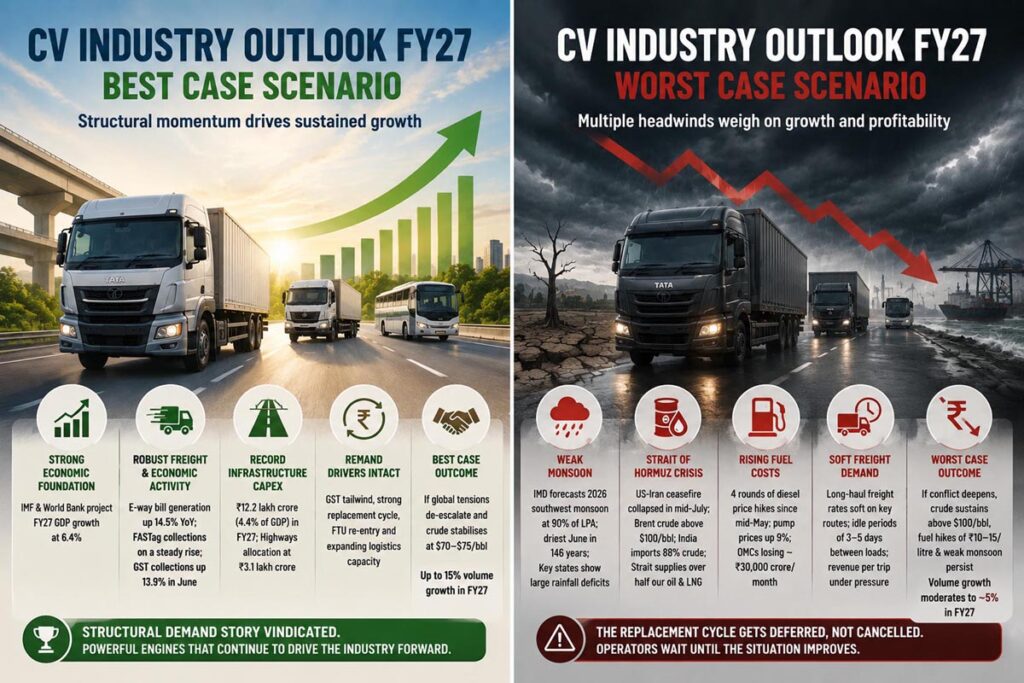
We see FY27 playing out along two distinct paths. If the Iran conflict de-escalates meaningfully by September — allowing Strait transit to normalize and crude to settle in the $70 to $75 range — the industry’s structural momentum should deliver up to 15% volume growth for the full year. The GST tailwind, the replacement cycle, the FTU re-entry, and the infrastructure capex pipeline are powerful engines that do not switch off easily.
If the conflict deepens, crude sustains above $100, and a further Rs 10 to 15 per litre diesel hike materializes — compounded by a deficient monsoon suppressing rural demand — we would expect volume growth to moderate to 5%, with a pronounced impact in H2. The replacement cycle gets deferred, not cancelled. Operators wait until the situation improves.
The Bottom Line
The structural demand story is vindicated. But the operating environment is now as complex as it has been since the post-Covid disruptions of 2021. Fuel costs, a weak monsoon, raw material inflation, and a war that refuses to end are all pulling against what has otherwise been a remarkable recovery. At Leaptrucks, we believe the industry’s fundamentals can absorb a moderate shock — but perhaps not all of them simultaneously. Crude prices, monsoon progression through July, and the next round of OMC pricing decisions are the three variables that will define whether FY27 becomes a record year — or merely a good one.