By. Ravichandran Srinivasan
Behind every sleek car rolling off an assembly line lies one of the world’s most sophisticated logistical operations. A modern passenger vehicle comprises approximately 30,000 individual components, ranging from tiny fasteners to complex engine blocks, translating into 1,800 to 3,000 distinct functional sub-assemblies.
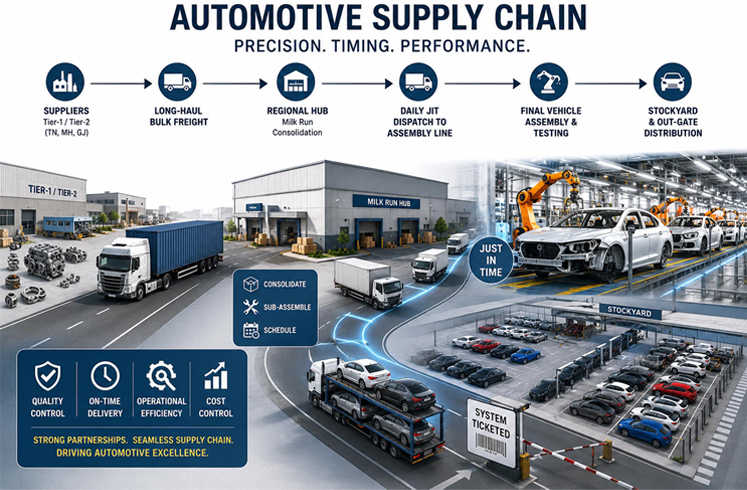
For major original equipment manufacturers (OEMs) such as Maruti Suzuki, the high degree of local indigenisation makes managing this vast network of joint ventures and independent vendors a high-stakes balancing act.
The Just-In-Time (JIT) & Milk Run Network
To minimise factory inventory and holding costs, automotive OEMs rely heavily on Just-In-Time (JIT) manufacturing. A critical enabler of this strategy is the ‘Milk Run’ system:
- Bulk Long-Haul Freight: Suppliers ship components in bulk via heavy trucks from distant manufacturing hubs such as Tamil Nadu, Maharashtra and Gujarat.
- Local Hub Consolidation: Goods arrive at regional vendor warehouses or sub-assembly facilities strategically located near the OEM’s main plant, such as Gurugram.
- Frequent Short-Haul Delivery: Components are sub-assembled locally and dispatched to the main assembly line in smaller trucks on daily, tightly scheduled routes.
While bulk items such as paints and tyres are held in-house, high-value global imports demand strict advance planning, often two to three months ahead, to account for ocean freight, port customs clearance and inland transportation.
Division of Responsibility & Quality Control
Within the OEM, the Supply Chain Division is split into specialised units focused on specific component categories:
- Powertrain & Mechanical: Engines, transmissions, axles, suspensions and shock absorbers.
- Hardware & Fasteners: Bearings, bushes, nuts and bolts.
- Trim & Finishing: Plastics, seating, paints, tyres and batteries.
- These specialised teams enforce stringent quality control through routine audits both on the main assembly line and at vendor plants.
Outbound Logistics & The Path to Success
Once a vehicle clears assembly and final road testing, outbound logistics takes over. Drivers receive system-generated tickets to transport completed cars to dedicated stockyards, where vehicles are parked systematically by bay and row to ensure efficient and error-free final delivery.
Ultimately, an OEM’s market competitiveness hinges on vendor performance. Suppliers are evaluated annually on quality, operational efficiency, JIT delivery and cost control, with top performers recognised at annual vendor meets.
In an industry defined by tight margins and high complexity, precision supply chain management is not merely a support function – it is a core driver of commercial success.