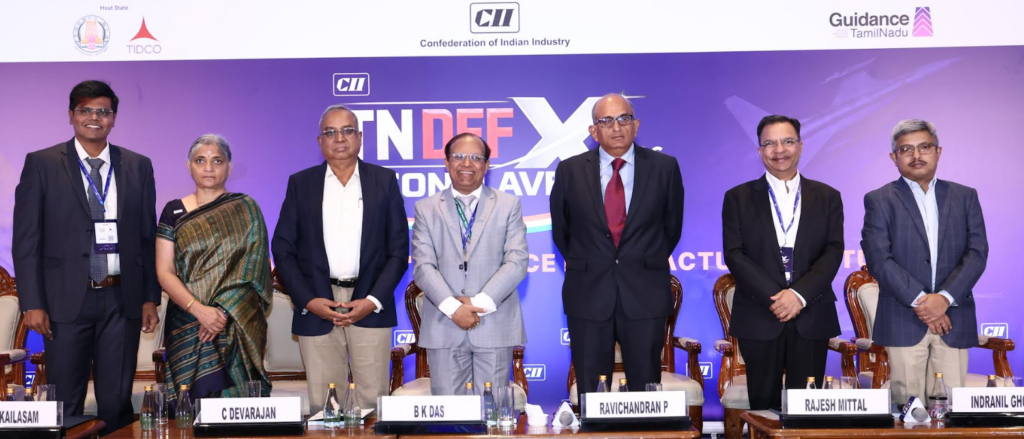
“Technology security is national security, and India’s future defence preparedness will be defined by design sovereignty, technology sovereignty, supply chain sovereignty, knowledge sovereignty and digital sovereignty. Manufacturing alone cannot make India a global power. Strengthening these strategic capabilities will be critical to building a resilient and globally competitive defence ecosystem for the country,” said Dr B K Das, Distinguished Scientist & Director General (ECS), DRDO, Government of India, at the CII TN Defence X Conclave 2026 held in Chennai under the theme ‘Powering Tamil Nadu’s Defence Manufacturing Future’.
Technology Sovereignty to Shape Future Warfare
Highlighting the rapidly evolving nature of warfare, Dr Das said future defence systems would increasingly be shaped by artificial intelligence, advanced electronics, cyber capabilities and digital technologies. He cautioned that even a single disruption in the supply chain could impact an entire defence system, underlining the need to build resilient indigenous capabilities.
Calling upon industry, MSMEs, startups and academia to work together, he urged stakeholders to develop advanced technologies, strengthen innovation and build globally competitive defence capabilities that will shape India’s future security landscape.
Tamil Nadu Well Positioned to Lead Defence Manufacturing
Delivering the theme address, Mr Rajesh Mittal, Chairman – CII Tamil Nadu Defence Manufacturing Taskforce and President & Managing Director, ISUZU Motors India Private Limited, said India’s defence production has crossed ₹1.5 lakh crore, while defence exports have reached nearly ₹38,000 crore. He noted that Tamil Nadu is uniquely positioned to emerge as a major player in aerospace, defence and marine manufacturing by leveraging its engineering strengths, industrial base, Defence Industrial Corridor and supportive policy ecosystem. He urged industry stakeholders to capitalise on opportunities across defence manufacturing, technology transfer, testing, maintenance and repair, and work collectively towards making Tamil Nadu a leading defence manufacturing hub by 2029.
Mr Ravichandran Purushothaman, Chairman, CII Southern Region, and President, Danfoss India, Danfoss Industries Private Limited, said Tamil Nadu’s mature automotive, electronics and engineering ecosystem provides a strong foundation for MSMEs to diversify into defence manufacturing. He stressed the need to leverage digital transformation, deep technologies, artificial intelligence, machine learning and sustainability to help MSMEs move up the defence value chain, while encouraging greater collaboration with large anchor companies through the Society of Indian Defence Manufacturers (SIDM).
Mr C Devarajan, Chairman, CII Tamil Nadu, and Managing Director, URC Constructions Private Limited, said Tamil Nadu stands at a defining moment in India’s defence manufacturing journey as the nation accelerates its vision of Atmanirbhar Bharat. He highlighted that the Tamil Nadu Aerospace and Defence Industry Policy 2022 and the Tamil Nadu Space Industry Policy 2025 together target investments exceeding ₹85,000 crore across the aerospace, defence and space sectors. He added that the Tamil Nadu Defence Industrial Corridor, which has already attracted investments of over ₹23,000 crore, will play a pivotal role in strengthening indigenous manufacturing capabilities and positioning the State among India’s foremost defence manufacturing destinations.
Welcoming the delegates, Ms Gowri Kailasam, Vice Chairperson, CII Chennai Zone, and Executive Director – Engine Components Division & Aftermarket Division, Rane Madras Limited, said, “India’s defence manufacturing landscape is undergoing a transformational shift with increasing emphasis on self-reliance, indigenous capability development and global competitiveness. Chennai’s manufacturing excellence, engineering talent, research institutions, defence establishments and technology-driven startup ecosystem, together with the Tamil Nadu Defence Industrial Corridor, provide the State with a strong foundation to become one of the nation’s leading centres for defence manufacturing and innovation.”
Collaboration and Localisation Take Centre Stage
During a special plenary session, Dr D Karthikeyan, IAS, Chairman & Managing Director, Tamil Nadu Industrial Development Corporation (TIDCO), Government of Tamil Nadu, reiterated the State Government’s commitment to strengthening Tamil Nadu’s defence, aerospace and space manufacturing ecosystem through continued investments, infrastructure development and strategic partnerships.
Dr Karthikeyan said the Government of Tamil Nadu remains committed to supporting startups and industrial ventures, adding that funding would not be a constraint for promising initiatives. He also highlighted TIDCO’s partnerships with Siemens, GE and Bosch in establishing advanced facilities that support MSMEs, students and academic institutions through testing, skilling and innovation.
Speaking at the conclave, Dr N Muthukumar, Managing Director, Kaynes Technology India Limited, pointed out that India currently imports around 80% of its electronic components and virtually 100% of PCB parts. Addressing this gap, he said Kaynes is setting up a manufacturing facility for PCB production in India.
During a panel discussion, Mr R Muralidharan, CTO, Tata Advanced Systems Limited, noted that India imported semiconductor chips worth nearly US$65 billion in 2025, with imports expected to rise to US$150 billion by 2030. Drawing parallels with Russia’s self-reliance in defence equipment, he stressed that India should accelerate localisation of semiconductor manufacturing and other critical electronic components by leveraging the capabilities of SMEs and the opportunities available within the domestic ecosystem.
The conclave brought together senior representatives from DRDO, the armed forces, defence PSUs, industry, MSMEs, startups and academia to deliberate on opportunities in defence manufacturing, indigenisation, technology transfer, digital transformation, emerging technologies and policy initiatives. The event also served as a platform to strengthen collaboration aimed at positioning Tamil Nadu as a key contributor to India’s defence manufacturing growth.