By. Ravichandran Srinivasan
By keeping a tight grip on vehicle ageing and elevating the role of workshop parts management, dealers can plug a massive drain on working capital.

For any automobile dealership, inventory is a double-edged sword. On the one hand, maintaining a healthy stock of vehicles and spare parts is non-negotiable for meeting customer demand on the spot. On the other hand, every unit sitting on the lot or collecting dust on a warehouse shelf represents frozen capital.
Ideally, an agile dealership aims for a lean, 30-day average inventory turnover. When stock moves at this pace, working capital circulates efficiently and the bank’s interest costs remain manageable. However, the line between an optimal stock level and a financial drain is incredibly thin. When inventory stagnates, it transforms into “dead stock” – a silent profit-killer that erodes the bottom line through compounding interest costs and depreciation.
To survive in today’s fiercely competitive market, dealers must treat inventory tracking not just as an administrative chore, but as a core strategic discipline.
The Vehicle Dilemma: Overcoming the 90-Day Wall
Vehicle wholesale planning is a delicate game of forecasting. Dealers must align their factory orders with micro-trends in consumer behaviour, accurately predicting the exact mix of models, variants and colours that will find demand in their local market.
Despite meticulous planning, the market is fickle. A sudden shift in fuel prices, a competitor’s aggressive promotion or changing consumer tastes can cause specific trims to stall. When a vehicle crosses the critical 90-day ageing threshold, it triggers a costly chain reaction.
Holding costs skyrocket, and the dealer is forced to deploy aggressive retail tactics. To move these stubborn units, dealerships often have to slash their own margins by offering steep customer incentives or dip into profits to provide sales staff bonuses simply to get the vehicle off the books. Stocks over 90 days eat into dealer profitability through higher interest payments to the bank.
This challenge intensifies during new model launches. OEMs (Original Equipment Manufacturers) naturally push hard for high initial wholesales. Dealers, eager to capitalise on the hype, often make wrong judgements regarding the variant mix – such as overestimating demand for manual transmissions over automatics or choosing the wrong colours. When the initial launch buzz fades, dealerships are frequently left with highly specific, slow-moving configurations that quickly transition into dead stock.
The Parts Maze: A High-Stakes Complexity
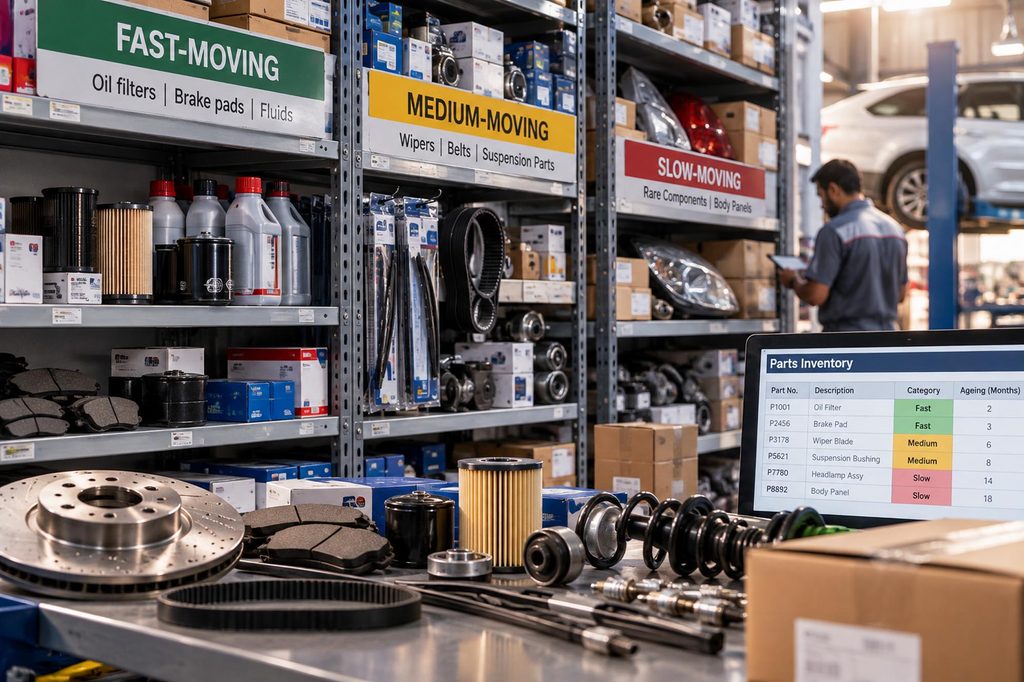
If managing a handful of vehicle variants is difficult, managing spare parts inventory is a logistical mountain. A typical dealership handles thousands of unique part numbers (SKUs), each falling into distinct velocity categories:
- Fast-Moving: Routine service items such as oil filters, brake pads and fluids.
- Medium-Moving: Component assemblies such as wipers, belts and common suspension bushings.
- Slow-Moving: Rare mechanical components or specific body panels.
The complexity multiplies with every new vehicle launch. To ensure that the workshop can repair a new car from day one, OEMs push predetermined “initial kit parts” to the dealership. While essential for customer confidence, many of these specialised parts remain completely untouched for months – sometimes years – if the new model proves highly reliable or does not experience early accidents.
While a healthy dealership should maintain its parts ageing below six months, reality often tells a different story. It is alarmingly common for parts ageing to cross the 12-month mark. The industry gold standard is clear: the total value of dead stock older than 12 months must be rigorously capped at less than 5% of total stock value. Crossing this threshold severely restricts a dealer’s liquidity.
The Vital Organ: Why Workshop Success Hinges on Parts Management
While vehicle sales get the showroom glamour, the true engine room of dealership profitability is the workshop. Here, the importance of parts management cannot be overstated. A workshop’s efficiency, technician productivity and Customer Satisfaction Index (CSI) are directly tied to the parts department’s accuracy.
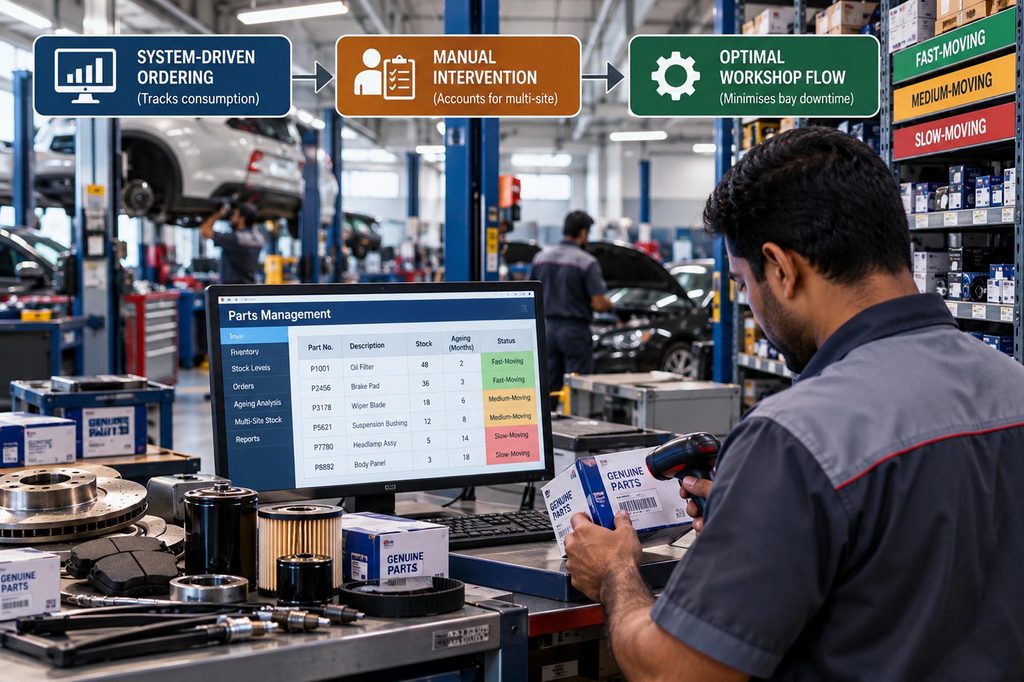
System-Driven Ordering → Manual Intervention → Optimal Workshop Flow
(Tracks consumption) → (Accounts for multi-site operations) → (Minimises bay downtime)
The Parts Manager holds one of the most critical roles in the entire ecosystem. They must balance two opposing forces: avoiding “stock-outs”, which leave customer cars stranded on lifts, while simultaneously preventing capital from being locked up in slow-moving items.
Modern parts ordering is largely system-driven, relying on historical consumption algorithms. However, a purely automated system falls short in complex, multi-workshop operations. When a dealer operates a hub-and-spoke model, with a central warehouse feeding multiple satellite workshops, manual checking becomes vital. The Parts Manager must actively analyse body and paint repair trends versus routine mechanical servicing to ensure the right parts are in the right bay at the right time.
If parts management fails, the workshop grinds to a halt. Stranded vehicles clog up service bays, “Right First Time” fix rates plummet and frustrated customers take their business to independent garages.
Tactical Liquidation: Breaking the Deadlock
When parts do cross into the dangerous 12-month dead zone, aggressive, proactive liquidation strategies are required. This cannot be achieved by the parts team alone; it demands absolute synchronisation with the workshop team and Service Advisors.
Dealers should roll out regular, targeted incentive schemes for the service team. Service Advisors, who interact directly with customers, can be incentivised to suggest preventive maintenance packages that utilise ageing, medium-moving parts. Technicians can similarly be rewarded for identifying and replacing worn components that match stagnant inventory during multi-point vehicle inspections.
- Dealership Liquidation Tactics
- Service Advisor Incentive Schemes
- Preventive Maintenance Bundling
- Multi-Workshop Stock Rebalancing
- OEM Scrapping/Buyback Programmes
Occasionally, relief comes from the manufacturer. At the end of financial years, some OEMs introduce schemes to help dealers scrap dead stock, crediting the dealership up to 50% of the parts’ value. However, relying on this is a dangerous gamble. These buyback programmes are rare – often occurring only once every two to three years – and are usually rolled out only after intense, collective feedback and pressure from the dealer council.
The Blueprint for a Lean Operation
Dead stock is not just an inevitability of the auto retail business; it is a controllable risk. Allowing vehicles to sit past 90 days or letting slow-moving parts quietly breach 5% of total inventory is an expensive choice that directly compromises a dealership’s financial health.
The path forward requires an uncompromised, disciplined approach to stock planning. Dealership principals must implement rigorous weekly vehicle ageing reviews and monthly parts velocity audits.
By combining automated dealer management systems (DMS) with sharp manual oversight across multi-site workshops, and fostering tight synergy between the parts counter and the service bay, dealerships can significantly lower their interest costs, safeguard their cash flow and ensure that every rupee deployed on the shelves actively drives profit.