Sitting lower on the automotive value chain, component makers are enabling innovation and growth
By Poonam Upadhyay, Director, Crisil Ratings Limited

A quiet revolution is underway in India’s thriving automotive sector as vehicles become increasingly sophisticated and supply chains more globalised. At its heart are the country’s auto component makers, who have emerged as a vital cog in India’s manufacturing competitiveness and export ambitions.
They generated nearly Rs 9 lakh crore in revenue last fiscal and are poised for an increase of 9-11% on-year this fiscal. That said, the true narrative extends far beyond mere numbers, reflecting trends such as premiumisation, higher-value components, enhanced export capabilities and electric mobility.
The premiumisation prop
Consumers are increasingly prioritising better-equipped and higher-value vehicles. Every move up the value chain increases component content and boosts revenue per vehicle.
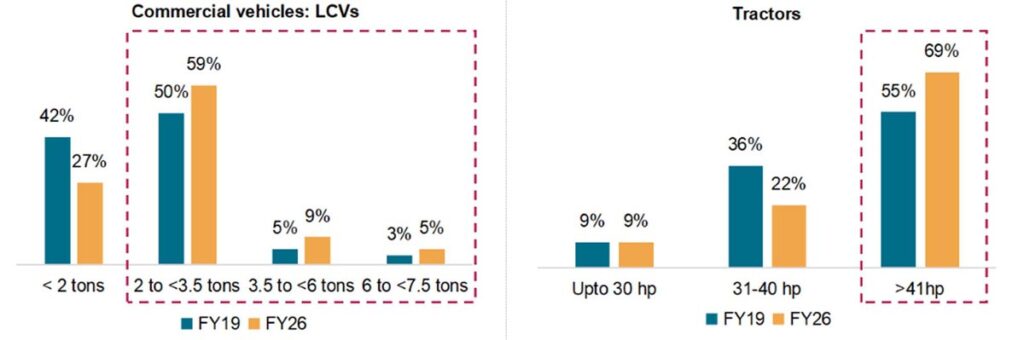
The shift is hard to miss. Premium two-wheelers now account for 23% of sales, up from 13% in fiscal 2019, while utility vehicles have expanded their share of passenger vehicle sales to 67% from 28%. The same preference for higher-value products is visible in higher-horsepower tractors and larger light commercial vehicles (LCVs), making premiumisation a defining theme across the mobility landscape.
This trend is expected to continue this fiscal. Backed by premiumisation and affordability gains from the rationalisation of the goods and services tax, demand across key vehicle segments should remain healthy, with two-wheelers and passenger vehicles driving the bulk of domestic vehicle sales.
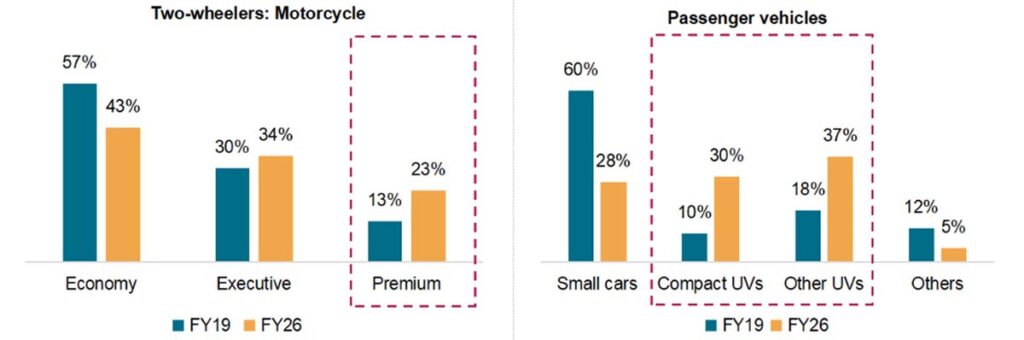
For component makers, this translates into a powerful combination of volume and value growth. Unlike earlier cycles, where volumes did most of the heavy lifting, the current upcycle is also being driven by richer component content and higher value per vehicle.
Exports ride up the value chain
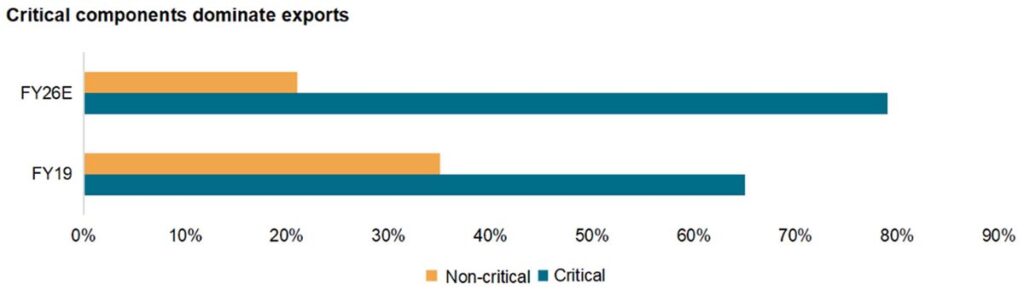
The Indian auto component industry’s export profile, which contributes about 15% of revenue, looks markedly different from a decade ago.
Critical, engineering-intensive products such as engines, gearboxes, drive axles and steering systems accounted for 79% of the export basket last fiscal, up from 65% in fiscal 2019. Gears and engines have been among the standout performers, with both growing more than 55% annually since fiscal 2020.
India’s growing role in global auto supply chains is reflected in its exports, which are expected to grow 8-9% on-year this fiscal despite an uncertain trade environment.
For India, the United States remains the largest market, accounting for roughly a quarter of shipments. While trade policy developments may create short-term volatility, they are unlikely to alter the broader trend of India’s growing integration into global auto supply chains.
For EVs, localization is a key imperative
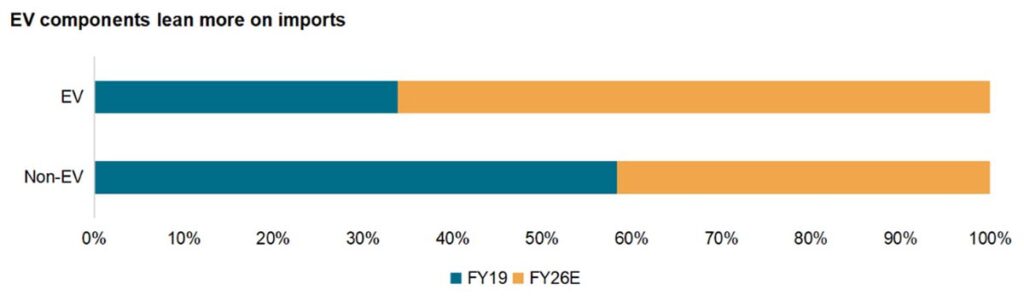
As the electric vehicle (EV) ecosystem expands in India, the country’s reliance on imported components, primarily from China, has grown faster than domestic capabilities.
In the first 10 months of last fiscal, imports accounted for 45% of India’s EV component requirements, up from 23% in fiscal 2019.
Domestic manufacturing of EV components is still in its early stages, with such components — excluding lithium-ion batteries—making up only a small proportion of local original equipment manufacturer (OEM) supplies.
To bridge this gap, localisation, investment and technology are crucial.
Rising costs near term challenge, credit outlook seen to be stable
Auto component makers face an immediate challenge: rising costs. The conflict in West Asia has driven up commodity prices and freight rates, thereby increasing input costs across the supply chain.
With raw materials accounting for ~75% of total costs—steel and aluminium alone representing 50-60% — operating margins are likely to moderate this fiscal as cost pass-throughs typically lag by a quarter or two.
Even so, manufacturers have entered this phase from a position of strength. Their revenue is expected to grow 9-11% this fiscal, which will help offset near-term margin pressure.
More importantly, confidence in the long-term outlook is reflected in investment plans. Auto component makers rated by us are set to invest about Rs 27,000 crore this fiscal, focusing on capacity expansion and EV-related opportunities.
Supported by healthy cash flows and prudent borrowing, they appear well positioned to fund growth while maintaining controlled balance sheets.
The road to fiscal 2030
The near-term performance of auto component makers will be influenced by commodity prices, freight costs, regulatory requirements (including Corporate Average Fuel Efficiency norms and Bharat Stage 7 requirements), geopolitical uncertainties and the pace of cost pass-throughs.
Their long-term growth hinges on structural imperatives: can India build a competitive EV component ecosystem, transition to higher-value products and strengthen its position in global supply chains as manufacturers diversify their sourcing destinations?
For Indian manufacturers, the road to fiscal 2030 will be defined not only by growth in production volume but also by the creation of superior value through enhanced localisation, technology and engineering capabilities.