
India’s automotive retail market recorded its best-ever June performance in history, with total registrations reaching 25,57,234 units — a 21.83% year-on-year increase and a 1.03% rise over May 2026. According to the data released by FADA – The Federation of Automobile Dealers Associations, the month marked record June figures across two-wheelers, three-wheelers, commercial vehicles, passenger vehicles, and total registrations, painting a picture of broad-based momentum across the industry.
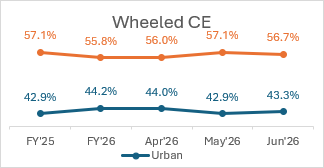
Two-wheeler registrations led in volume, reaching 18,28,458 units, up 21.22% year-on-year. Passenger vehicles posted an even sharper jump of 28.63% to 4,10,853 units, while commercial vehicles grew 16.88% to 90,972 units. Three-wheelers rose 16.20% to 1,20,889 units, and tractors delivered the second-best June ever with 1,00,818 units, up 25.31%. Wheeled construction equipment was the lone weak spot, declining 40.94% to 5,244 units.
The month’s defining story, however, was the rapid shift in fuel mix. The share of alternative-fuel passenger vehicles — combining CNG, hybrid, and electric — crossed 40% for the first time, reaching 40.35%. CNG accounted for 24.33% of PV sales, hybrids for 8.27%, and EVs for 7.75%. In the two-wheeler segment, EV share entered double digits for the first time at 10.60%, with CV, PV, and overall EV retails all hitting all-time highs in June.
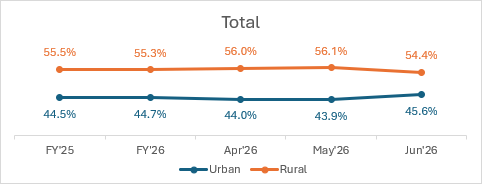
Rural India continued to outpace urban markets on a year-on-year basis, with rural PV growth at 35.09% compared to 24.67% in urban areas. However, some softness was visible month-on-month, with rural two-wheeler sales dipping 4.55% and rural PV sales slipping 0.11%, attributed to the late onset and uneven progress of the monsoon. A West Asia ceasefire easing crude oil prices and stable OEM supplies provided a supportive backdrop, and price hikes of around 2–3% implemented by OEMs on 1 June were absorbed by the market with limited impact on bookings.

On inventory, passenger vehicle stock rose by one day over May-end to 32–34 days, still well above FADA’s recommended 21-day benchmark. The industry body has urged continued dispatch discipline from OEMs through the monsoon-softness window.
The Road Ahead
Looking ahead, dealer sentiment for July 2026 is cautiously optimistic, with 51.24% of dealers expecting growth, 41.79% anticipating flat sales, and only 6.97% expecting a decline. Monsoon catch-up, Kharif sowing activity, and normalised supplies are seen as the key growth drivers, while potential July price hikes, deficient-rainfall pockets, and financing conditions remain the key risks to watch.
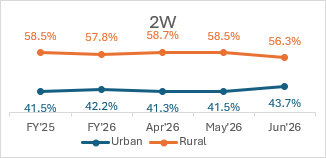
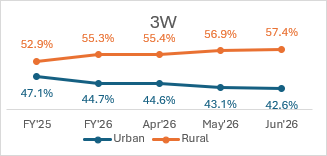
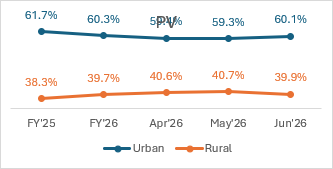
For the July-to-September quarter, confidence runs higher, with 66.17% of dealers expecting growth — the firmest reading in recent surveys — buoyed by the festive build-up ahead of Ganesh Chaturthi and Onam. 38.31% of dealers have revised their FY27 outlook upward, with 45.27% keeping their outlook unchanged. The single biggest risk flagged by dealers for the period ahead remains a potential monsoon shortfall or El Niño impact on rural demand.
Mr. C S Vigneshwar, President, FADA, described June 2026 as a landmark month for Indian auto retail, noting that records being set in a seasonally transitional month underscores the structural depth of India’s growth story and the widening aspirations of Bharat.
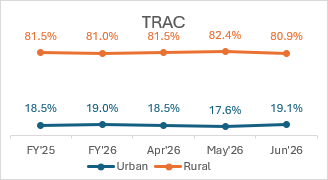
On two-wheelers, he pointed out that the sequential month-on-month dip was entirely rural in character, with urban two-wheeler sales actually growing 4.25% month-on-month while rural sales dipped 4.55%, reflecting the late onset and uneven progress of the south-west monsoon. Despite this, dealers reported strong entry-level demand and improved OEM supplies following the West Asia ceasefire.
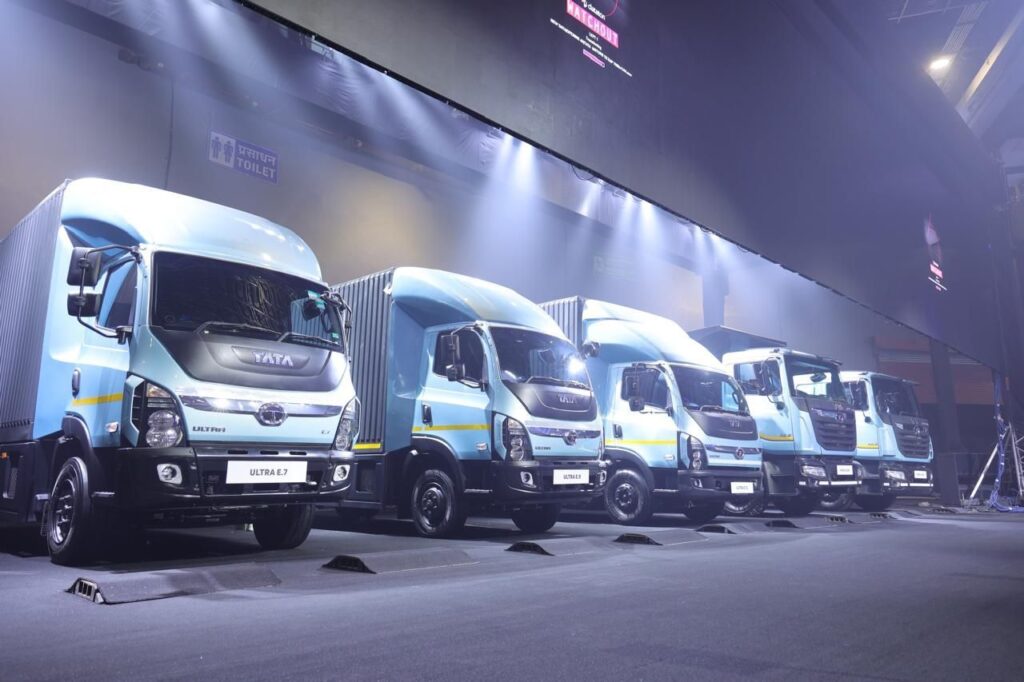
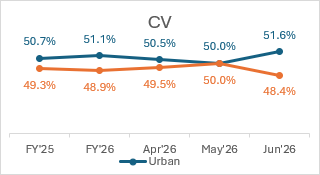
In commercial vehicles, he highlighted that rural CV growth at 21.63% year-on-year outpaced urban growth at 12.75%, suggesting that goods-movement demand is broadening well beyond the metros. CV EV share rose to an all-time high of 3.53% from just 1.57% a year ago.
On passenger vehicles, Mr. Vigneshwar flagged the inventory situation as a concern, with PV stock rising to 32–34 days — well above FADA’s recommended 21-day benchmark. He urged PV OEMs to calibrate dispatches to actual retail through the monsoon-soft July window to prevent dealer capital from being locked in aged stock.
He also noted that total EV retails across all categories touched 3,06,220 units in June — the highest ever for any single month — taking overall EV penetration to approximately 12.5%.