The Indian automotive aftermarket is entering the most transformative decade in its history. For the companies and garages willing to change with it, the prize is not just India — it is the global south.
A single number frames the decade ahead. Over the next fifteen years, already one of the world’s largest, the Indian automotive aftermarket is set to sell roughly three times what it sold in the previous fifteen — not thirty per cent more, but three hundred. A market worth about ₹98,000 crore, tripling. It is the largest opportunity the industry has seen in a generation. And yet many of today’s established players will fail to capture it — not for want of good products, but because the market is changing faster than they are. The change is not only one of size; it is a change in technology and in the shape of the product portfolio, and it will decide who leads the next decade.
Three generations on the same road
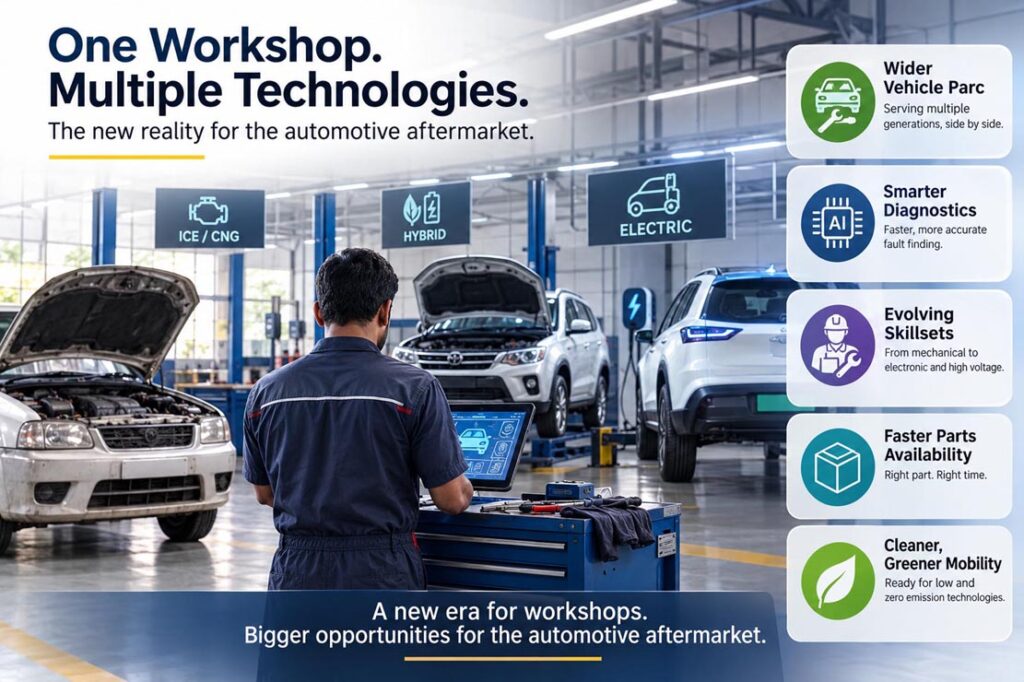
Consider the vehicle park built up over the last fifteen years. The oldest cohort — BS2, BS3 and BS4 vehicles from the first five years — still accounts for around 40 per cent of what is on the road. Vehicles from the pandemic years add another 20–25 per cent. The most recent three to four years, roughly the remaining 35 per cent, are already BS6. The consequence is striking: at any moment, the aftermarket must serve three generations of vehicles simultaneously, running on at least three kinds of energy — conventional petrol and diesel, hybrid, and electric — side by side. Every trend that follows flows from this one fact.
The customer has changed
Who is buying all these vehicles? India’s bottom quartile — some 250 million people — has climbed out of poverty in the past decade and now aspires, at the very least, to a two-wheeler. But the more consequential group sits just above: around 350 million people whose purchasing power parity, at roughly $12,000–13,000, is comparable to that of many European nations. They want a small car, a good motorcycle, well-made things — and they wear a smartwatch. Naturally, they expect smartwatch-grade experience from a small car. Call it German quality expectations: German quality, Chinese prices, delivered to the doorstep. Rising expectation is the defining pressure on the industry — and its source is the rapidly widening vehicle park.
A market that has spread out
The dispersion is easy to underestimate. The top quartile of two-wheelers sits in just 44 districts — the comfortable 80/20 that planners love. But two-wheelers as a whole are spread across roughly 450 districts. For cars the contrast is sharper still: the top quartile occupies 19 districts, yet the total car park reaches more than 500. Cars in India are, remarkably, more widely dispersed than two-wheelers. The car is no longer a metro phenomenon; it is in Mathura and Vrindavan, in Kanpur and Pandharpur. That geographic spread rewrites the rules of the business — beginning with distribution.
Distribution is being redrawn
Proximity is now measured in logistics, not sentiment. Mumbai is closer to Dubai than to Guwahati; Chennai is closer to Colombo or Singapore than to Chandigarh. As free trade agreements open borders, the question of where parts are sourced and how fast they move will be answered by the map of trade, not the map of the nation. Meanwhile, the traditional distributor model is fading. The number of retail outlets stocking Bosch spark plugs is around 100,000; the number stocking Maggi noodles, 100,000–120,000. Auto components — filters, wipers, lubricants, spark plugs, bulbs — are now distributed as widely as everyday groceries.
The deeper disruption is expectation. A consumer who receives almost anything through quick-commerce apps in ten to twenty minutes will not accept being told that a “sophisticated technical part” requires a week’s wait. That mismatch is precisely what is breaking the old distribution model — and it will break completely.
The salesman’s role — and the arrival of AI
As telemarketing gives way to digital, and as every retailer and garage can reach a manufacturer directly on a screen, the classic field-sales model must be reinvented rather than merely defended. The larger disruption, though, is artificial intelligence. For an earlier generation, “AI” meant Air India; today it means Grok, Meta and ChatGPT. Brought into the workshop, these tools are transformative. A mechanic in a small town can describe a fault in his own words and receive the most probable causes and remedies. The right part can be identified first time, across a catalogue that now spans three vehicle generations and several fuel types — a complexity no individual can hold in memory. Demand can be predicted district by district; estimates and customer communication drafted in seconds. AI does not replace the skilled technician; it multiplies him, and it hands a tier-three garage the knowledge that once lived only in the metros. The workshops that adopt it first will pull decisively ahead.
Ethanol: turning anxiety into service
No subject generates more anxiety at present than fuel — and anxiety, handled well, is an opportunity. India reached 20 per cent ethanol blending (E20) in 2025, five years ahead of the original target; from April 2026, E20 is the standard petrol at pumps nationwide, and standards for higher blends such as E27 and E30 are already being notified.
Owners of older vehicles worry about mileage and engine wear. The measured picture is reassuring: E20 carries a far higher octane rating than plain petrol, delivering better acceleration and lower emissions, and the government reports no pattern of engine failures since it became the base fuel. But older vehicles — the BS3 and BS4 cars never tuned for ethanol — do benefit from care: ethanol-compatible seals, hoses and fuel-system components, and regular fuel-system maintenance. Every anxious owner of a pre-2023 vehicle is therefore not a problem but a prospective customer — one who needs advice, a compatibility check, a few upgraded parts and an ongoing servicing relationship. The garage that answers panic with knowledge, rather than amplifying it, earns that customer for years. The right posture is not to fear the ethanol transition, but to sell into it.
Many fuels, one opportunity
Ethanol is only the opening chapter of the fuel story. Electric vehicles have crossed 12 per cent of new-vehicle sales in recent months — up from a rounding error a few years ago — with public charging points passing 27,000. Hybrids are growing; hydrogen is on the horizon. The instinctive question is which technology will win. For the next ten to fifteen years, however, the honest answer is that none needs to: all of them will share the road.
That is where the opportunity lies. An electric vehicle has fewer moving parts — no oil changes, less engine work — which by itself compresses traditional garage revenue. But it introduces new work: battery health, thermal management, high-voltage safety, and tyres and suspension that wear faster under instant torque and added weight. Hybrids are richer still, carrying both an engine and an electric drivetrain, and therefore twice the service surface; hydrogen will add a further layer in time. The workshop that prospers through the transition will not be the one that guesses the winning fuel, but the one that builds the capability to service the entire range — petrol, diesel, ethanol blends, CNG, hybrid, electric and, in time, hydrogen. In a market of three vehicle generations and every kind of fuel, being the single workshop that can handle all of it is the most valuable position available.
The choice — and the prize
Put together, the forces are formidable: a market of exceptional size, unusually dispersed; three generations of technology and every kind of fuel on the road at once; a customer who, able to summon medicine in twenty minutes, now asks with some justice why a car part should take longer; and trade agreements steadily opening the market. The industry faces a straightforward choice — to become future-ready, as many have already begun to, or to be left re-reading Who Moved My Cheese?
The real prize is larger than India. The companies, distributors and garages that master this market will be positioned, almost overnight, to serve the wider global south. A player that can conquer Kashmere Gate in Delhi can conquer Kenya, South Africa, Mauritius or the Fiji Islands. Therein lies the opportunity — and, in all likelihood, the next generation will carry it further than the present one imagines.