As engineers iterate software and AI systems more rapidly, MathWorks believes continuous simulation and validation are becoming critical to ensure reliability, safety and performance.

Generative AI is rapidly changing the way engineers work. What started as a tool that could write code and assist with tasks has now evolved into intelligent AI agents capable of handling complete workflows across multiple software tools. For many in the engineering world, this shift is unlocking a level of speed, automation and productivity that was almost unimaginable just a few years ago.
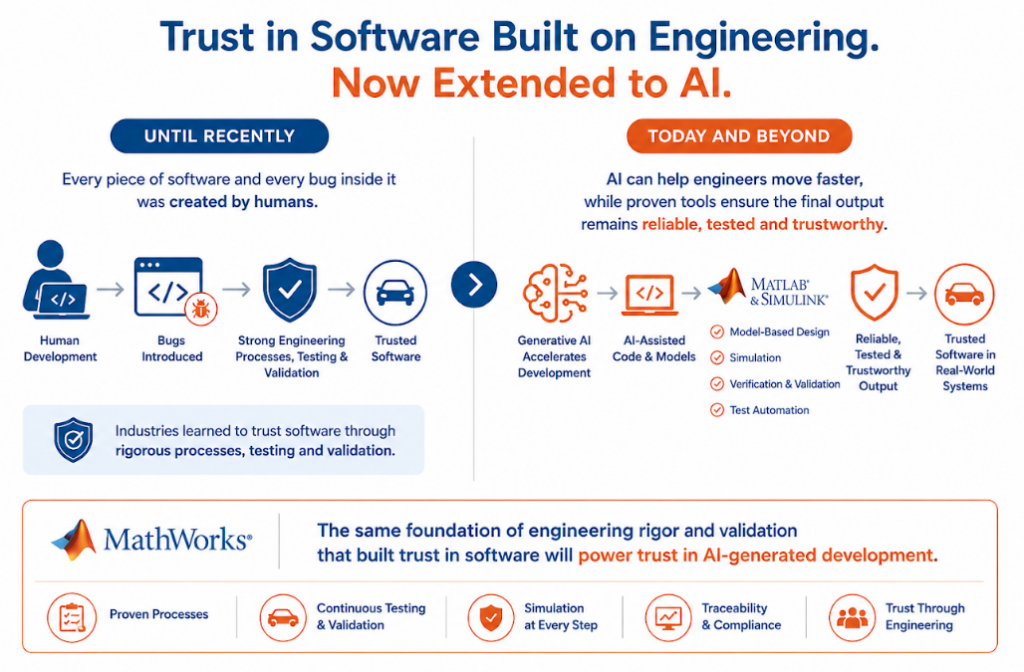
Until recently, every piece of software and every bug inside it was created by humans. Yet industries still learned to trust software because strong engineering processes, testing and validation systems were built around it. MathWorks believes the same approach will now apply to AI-generated development as well — where generative AI can help engineers move faster, while tools like Matlab and Simulink ensure the final output remains reliable, tested and trustworthy, Mr. Avinash Nehemiah, Head – Product Mgmt & Mktg – Design Automation, MathWorks, has said.
Speaking to this publication on the sidelines of MATLAB EXPO 2026, held in Bengaluru, Mr. Nehemiah said, even as AI copilots make engineering faster and more productive, MathWorks believes strong verification and validation processes are becoming more important than ever before. AI may help generate code and solve smaller problems quickly, but safety-critical embedded systems still require rigorous testing when all components are brought together into one complete system.
Integration testing is now becoming a critical checkpoint because AI-generated components that work well individually may still create unexpected issues when combined inside complex automotive or embedded systems.
Accelerating Existing Workflows
According to Mr. Nehemiah, one of the biggest advantages of modern AI tools is that engineers do not need to completely change the way they work. Instead of replacing existing engineering systems, AI copilots and agentic workflows are being integrated into current tools and processes to make them faster and more efficient.
He said engineers can continue using familiar platforms like Matlab and Simulink while connecting them with AI assistants to speed up coding, modelling and development activities. This allows organisations to evolve gradually without starting from scratch.
Human Judgment Matters
Even as AI takes over repetitive and time-consuming tasks, he believed that human decision-making is becoming even more important. Engineers who deeply understand core engineering principles, system architecture and validation processes are the ones seeing the greatest success with AI-assisted development, he observed. AI can accelerate execution, but engineers still need to know how to frame problems correctly, validate results and decide where deterministic engineering methods are necessary and where AI can be safely used.
Balancing Speed
Mr. Nehemiah remained optimistic that AI can significantly reduce development time without compromising reliability and safety. Model-based design processes continue to act as important guardrails, allowing AI to improve efficiency within a structured and verified engineering framework. Interestingly, AI is also helping automate many tedious tasks related to testing and verification. “This is enabling engineers to perform more rigorous validation faster than before, helping companies improve time-to-market while still maintaining engineering discipline and compliance standards,” he highlighted.
MathWorks also sees AI helping engineers dramatically reduce simulation time for electric and autonomous vehicle development. Instead of relying only on heavy physics-based simulations that take longer to run, engineers are increasingly using AI-driven models that can deliver faster approximations during the early stages of design. At the same time, he reiterated the “need for simulation itself will continue to grow in the AI era, especially for autonomous vehicles where real-world testing alone is not enough. AI is now helping engineers generate simulation data, create test cases and even introduce unexpected scenarios that improve the overall robustness and safety of vehicle systems,” he added.
Choosing The Right Tools
One of the biggest challenges with generative AI is that it can produce different answers for the same question. While this flexibility can help with creativity and exploration, engineering systems often require deterministic and mathematically correct outputs that remain consistent every single time.
This is why, Mr. Nehemiah said, “engineers must carefully decide where AI should be used and where traditional deterministic tools are still necessary.” AI may be excellent at orchestrating workflows and accelerating development, but critical calculations, physics models and safety-sensitive systems still need trusted engineering methods underneath.
Human Judgment Critical
He also mentioned that successful AI adoption depends heavily on how engineers define problems. Teams that break large challenges into smaller, clearly defined tasks are currently seeing the best productivity gains from AI-assisted development.
Instead of expecting AI to directly generate complete safety-certified systems from broad requirements, engineers still need to apply human judgment, validate outputs and carefully control the development process, he expressed.
Bridging Design Gaps
Tools such as Embedded Coder continue to play an important role in maintaining engineering rigor between simulation and final ECU software production. Once engineers are satisfied with an AI-assisted design or algorithm, Embedded Coder can generate deterministic and repeatable code that consistently matches the original simulation results. This helps create greater confidence during validation because every time the code is generated, the output remains identical and traceable back to the validated simulation model. According to the company, this combination of AI acceleration and proven code-generation workflows offers a balanced path toward faster yet reliable embedded systems development.
Managing Software Complexity
As vehicles become increasingly software-defined, managing engineering complexity is becoming one of the biggest challenges for automakers. MathWorks believes model-based design is now evolving beyond individual components and playing a much larger role at the complete system and vehicle architecture level. Software reuse is becoming extremely important in the SDV era, where the same algorithms often need to work across multiple vehicle platforms and processors. By allowing engineers to reuse and adapt software more efficiently, model-based design is helping companies speed up development cycles while reducing complexity, he said.
Interestingly, the company believes faster development actually increases the need for simulation rather than reducing it. As automakers iterate software and AI systems more rapidly, continuous simulation and validation are becoming critical to ensure reliability and performance across complex vehicle architectures.
Supporting Faster Innovation
Mr. Nehemiah said Indian OEMs, startups and Tier-1 suppliers are increasingly using Matlab and Simulink to accelerate product development while remaining globally competitive and cost efficient. Many startups today are benefiting from the same advanced engineering tools and processes that large global OEMs have used for years. According to him, the automotive industry is currently going through a phase of major disruption and innovation, where both established companies and startups are rethinking traditional development approaches. This changing landscape is also driving greater collaboration and strategic partnerships across the mobility ecosystem, he added.