ADAS has evolved from simple driver alerts into intelligent systems that can observe, analyse and assist in real-time. According to MarketsandMarkets, the ADAS market is set to expand from 361.4 million units in 2026 to 582.6 million units by 2033, growing at a CAGR of 7.1%.
Not long ago, driving was entirely a human affair. The driver observed the road, judged distances, reacted to danger and made every decision behind the wheel. Today, that story is gradually changing. Cars are increasingly becoming intelligent companions that can watch, analyse and even react faster than humans in critical situations.
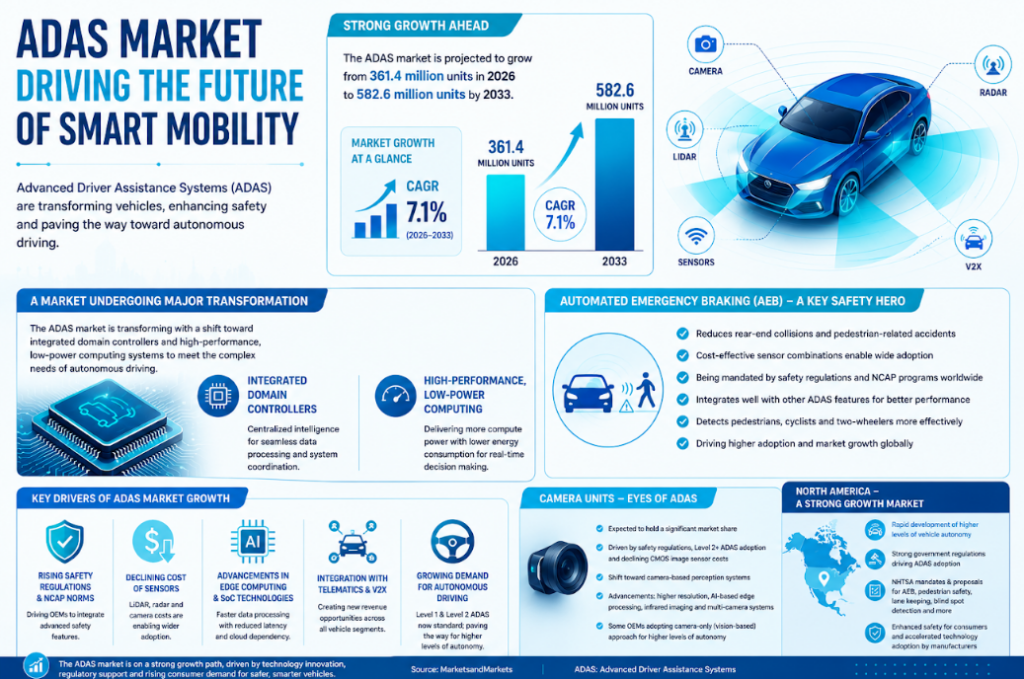
This shift is happening through Advanced Driver Assistance Systems (ADAS), a technology layer that started with basic warning systems and is now steadily moving towards autonomous driving. The growth numbers themselves tell an interesting story. According to MarketsandMarkets, the ADAS market is expected to rise from 361.4 million units in 2026 to 582.6 million units by 2033, growing at a CAGR of 7.1%. But the real story is not just about numbers. It is about how vehicles are learning to see, think and assist.
Safety First
Every major technology revolution in automobiles has usually started with one thing: safety. Initially, ADAS systems appeared as premium features reserved for high-end vehicles. Functions such as lane warning systems or adaptive cruise control were considered luxury additions rather than necessities.
Today, that perception is changing quickly. Most newly launched vehicles now come equipped with Level 1 and Level 2 driver assistance features. These systems can assist with steering, braking, acceleration and monitoring the surroundings. They have quietly become the foundation on which future autonomous vehicles are being built.
A major reason for this shift is changing safety regulations across the world. Programmes such as Bharat NCAP, JNCAP and China NCAP are encouraging vehicle manufacturers to integrate advanced safety technologies by rewarding them with higher safety ratings. A five-star safety badge is no longer only about stronger structures and airbags. Increasingly, it is also becoming about how intelligent a vehicle is.
Braking Before Humans
Among all ADAS technologies, one feature is emerging as a silent hero — Automated Emergency Braking (AEB). Imagine a driver momentarily losing focus in heavy traffic. In the fraction of a second before a collision occurs, the car itself detects danger and applies brakes automatically. That single action can prevent accidents, reduce injuries and potentially save lives. This explains why AEB is expected to account for a major share of the passenger vehicle ADAS market. What makes AEB particularly attractive is its practicality. It usually relies on relatively affordable combinations of cameras and radar sensors, making it suitable even for entry-level and mid-range vehicles.
Vehicle manufacturers are therefore increasingly treating AEB not as an optional feature, but as a standard safety layer. The technology itself is also becoming smarter. Earlier systems mainly focused on vehicles ahead. Modern systems are capable of identifying pedestrians, cyclists and two-wheelers more effectively, while also improving performance during low-light conditions and complex urban traffic situations.
Global regulations are further accelerating adoption. Japan already made AEB mandatory for new passenger vehicles, while the European Union introduced phased requirements under its safety regulations. Other countries, including South Korea, are moving in a similar direction. The result is that the cars are beginning to react before drivers do.
Camera Revolution
If ADAS were compared to human senses, cameras would probably represent its eyes. The camera unit is expected to remain one of the largest components within the ADAS ecosystem during the coming years. Several reasons are driving this trend. The cost of CMOS image sensors has fallen steadily, making cameras more affordable for mass-market vehicles. At the same time, safety requirements for functions such as lane departure warnings and emergency braking are increasing the need for visual perception systems. Vehicle manufacturers and suppliers are also moving beyond single-camera systems, the report observed.
Companies are now developing integrated sensor packages where cameras work together with radar and LiDAR to create a complete understanding of the vehicle environment. For example, next-generation systems are introducing multiple high-definition cameras capable of generating a 360-degree view around the vehicle. Improvements in night vision and low-light performance are helping vehicles “see” more clearly in challenging situations. Meanwhile, artificial intelligence is beginning to transform camera performance.
Instead of simply capturing images, cameras are increasingly analysing and understanding what they see. Higher-resolution sensors and AI-based processing can identify objects more accurately and process information locally within the vehicle, reducing delays. Some manufacturers are even moving toward camera-only approaches for future autonomous systems. The car, in many ways, is developing vision similar to a human brain.
Smarter Machines
ADAS development today is no longer only about adding more sensors. The industry is now shifting towards integrated domain controllers and high-performance computing systems capable of handling enormous amounts of information while consuming less power. A modern vehicle generates large volumes of data every second through cameras, radar, LiDAR and connected systems. Processing all this information quickly is critical. Advancements in edge computing and specialised chips are enabling vehicles to process information inside the vehicle itself rather than relying heavily on cloud connectivity. This reduces delays and improves decision-making speed — a crucial requirement when milliseconds can determine whether an accident is avoided.
Commercial Vehicles
The technology is also expanding beyond passenger vehicles. Commercial vehicles are increasingly integrating ADAS with telematics systems, fleet management platforms and vehicle-to-everything (V2X) communication technologies, opening new business opportunities.
North America Push
North America is expected to become the second-largest ADAS market globally over the forecast period. The region’s growing investment in autonomous driving development is acting as a key driver. Automakers and technology companies are actively testing advanced self-driving systems, moving steadily toward higher levels of automation.
Government regulations are also adding momentum. The National Highway Traffic Safety Administration has introduced and proposed several measures requiring technologies such as AEB, pedestrian protection systems and advanced lane assistance features. These regulations are designed not only to improve road safety but also to encourage manufacturers to accelerate technology adoption.
Human To Machine
The larger transformation happening inside the automotive world is perhaps less about replacing drivers and more about redefining the relationship between humans and machines. Cars are no longer simply mechanical machines moving from one place to another. They are becoming intelligent systems capable of understanding surroundings, predicting danger and assisting people in ways that were once imagined only in science fiction. The road to fully autonomous vehicles may still have several milestones ahead, but the journey has already started. And every time a car warns a distracted driver, stays within a lane or applies brakes automatically, it is quietly reminding us that the future of driving is arriving one feature at a time.