
By Abhilash Maurya, CoFounder and CEO, Naxatra Labs
India’s electric vehicle (EV) industry is at a pivotal moment. Over the past few years, the country has made significant progress in EV adoption, supported by policy initiatives, growing consumer awareness, and increasing investments across the mobility value chain. However, while the conversation around electric mobility often focuses on vehicle sales, charging infrastructure, and battery technology, a critical element of long-term success remains underappreciated: deep-tech manufacturing.
For India to emerge as a global EV powerhouse, it must move beyond assembly-led growth and invest aggressively in developing indigenous capabilities across motors, power electronics, control systems, advanced materials, embedded software, and intelligent manufacturing technologies. The future of electric mobility will be determined not only by how many vehicles are produced but also by who owns the underlying technology that powers them.
Moving Beyond Assembly-Led Growth
India has established itself as a major automotive manufacturing hub, but the EV transition presents an opportunity to rethink the country’s role in the global mobility ecosystem. Historically, many industries have relied heavily on imported components and technologies, limiting domestic value creation and technological ownership.
As the EV market matures, merely assembling imported components will not be enough to create sustainable competitive advantages. The real value lies in intellectual property, engineering innovation, and advanced manufacturing capabilities that can be exported globally.
Deep-tech manufacturing enables countries to move higher up the value chain by developing products and technologies that are designed, engineered, and optimized locally. For India, this represents an opportunity to create a more resilient and self-reliant EV ecosystem.
The Strategic Importance of Core Technologies
Electric vehicles are fundamentally technology-driven products. While batteries often receive the most attention, several other components play a crucial role in determining efficiency, performance, reliability, and cost.
Advanced electric motors, power electronics, thermal management systems, motor controllers, sensors, and intelligent software platforms are becoming increasingly important as manufacturers seek to improve vehicle range and optimize energy consumption.
Developing domestic expertise in these areas is not simply a manufacturing challenge—it is a strategic necessity. Nations that control critical technologies are better positioned to influence supply chains, drive innovation, and capture a larger share of economic value.
For India, investing in deep-tech capabilities today can help reduce dependence on imported technologies while strengthening the country’s position in global EV markets.
Building Technologies for Indian Conditions
One of the strongest arguments for deep-tech manufacturing is the need to design solutions that address India’s unique operating environment.
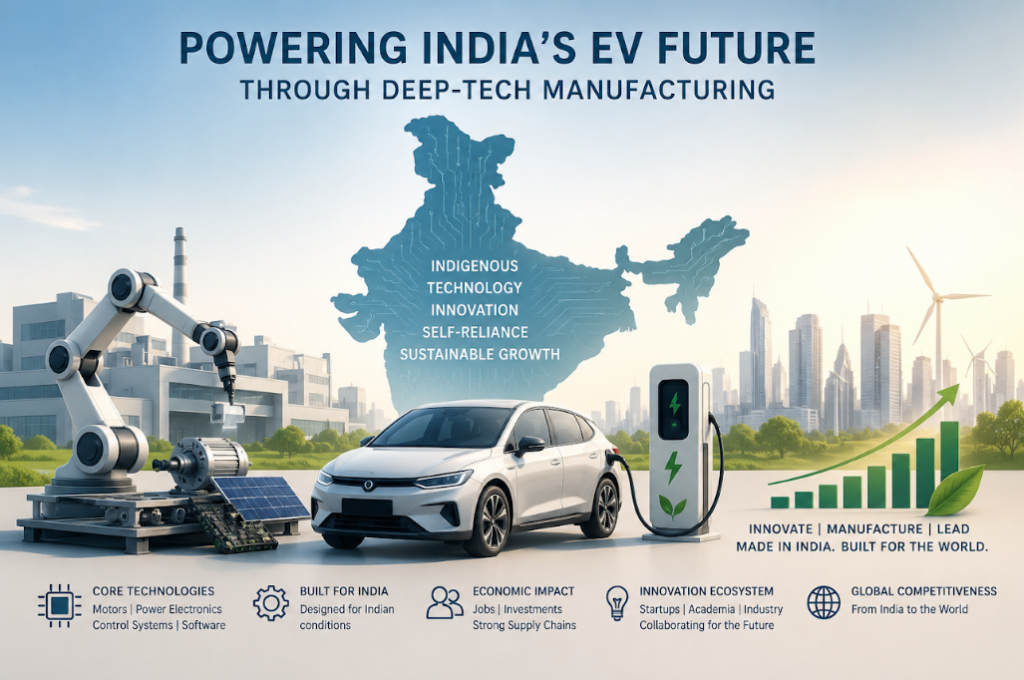
Indian vehicles operate under conditions that are significantly different from those in many developed markets. Extreme temperatures, high dust exposure, varied road quality, frequent stop-and-go traffic, and diverse usage patterns create engineering challenges that require localized innovation.
Technologies developed specifically for Indian conditions are often more effective than solutions adapted from international markets. Local engineering teams have a better understanding of operational realities and can optimize products for performance, durability, and cost efficiency.
This localization advantage can become a major differentiator as India continues to expand its EV ecosystem.
Deep-Tech as an Economic Multiplier
The impact of deep-tech manufacturing extends far beyond the automotive sector. Investments in advanced engineering, industrial automation, semiconductor technologies, AI-driven systems, robotics, and digital manufacturing create benefits across multiple industries.
A strong deep-tech ecosystem generates high-value jobs, encourages research and development, attracts global investments, and supports the growth of specialized supply chains.
It also fosters collaboration between startups, academic institutions, manufacturers, and technology providers, creating an innovation ecosystem capable of competing on a global scale.
Countries that lead in deep-tech manufacturing often enjoy long-term economic advantages because innovation becomes embedded across their industrial base rather than being confined to individual sectors.
The Growing Role of Software and Intelligence
The future of electric mobility will increasingly be defined by the convergence of hardware and software.
Modern electric powertrains are becoming more intelligent, connected, and software-driven. Artificial intelligence, predictive analytics, digital twins, and real-time optimization technologies are transforming how vehicles are designed, manufactured, and operated.
Software-defined mobility systems can continuously improve performance, enhance efficiency, enable predictive maintenance, and deliver better user experiences throughout the vehicle lifecycle.
This shift creates a significant opportunity for Indian deep-tech companies to develop advanced software platforms that complement domestically manufactured hardware. The combination of engineering excellence and digital innovation can become a powerful competitive advantage.
Scaling Innovation from Lab to Factory
One of the biggest challenges facing India’s deep-tech sector is the transition from innovation to large-scale commercialization.
Developing breakthrough technologies is only the first step. Scaling those technologies into reliable, cost-effective products requires robust manufacturing infrastructure, supply chain capabilities, testing frameworks, and industry collaboration.
To accelerate this transition, stronger partnerships between startups, established manufacturers, research institutions, and policymakers will be essential. Creating environments where innovation can move efficiently from prototype to production will determine how quickly India can build globally competitive capabilities.
The Road Ahead
India’s EV ambitions cannot be achieved through adoption alone. Long-term leadership will require ownership of the technologies that define the future of mobility.
Deep-tech manufacturing offers a pathway to greater self-reliance, stronger supply chains, higher-value exports, and sustained industrial growth. It allows India to move beyond being a large consumer market and position itself as a global center for innovation and advanced manufacturing.
As the world accelerates towards electric mobility, the countries that invest in core technologies today will shape the industry tomorrow. For India, the opportunity is clear: build not just electric vehicles, but the deep-tech ecosystem that powers them.
The next chapter of India’s EV journey will not be written solely on factory floors or in assembly plants. It will be driven by innovation, engineering, and the ability to create world-class technologies that can compete on the global stage.