By Ravichandran Srinivasan
Developing a modern vehicle transit stockyard is a complex infrastructure project that goes far beyond simply creating a parking area. Transforming an open, uneven tract of land covered with vegetation and soft soil into a state-of-the-art stockyard capable of accommodating 10,000 vehicles requires meticulous planning, robust civil engineering and the seamless integration of digital technologies.
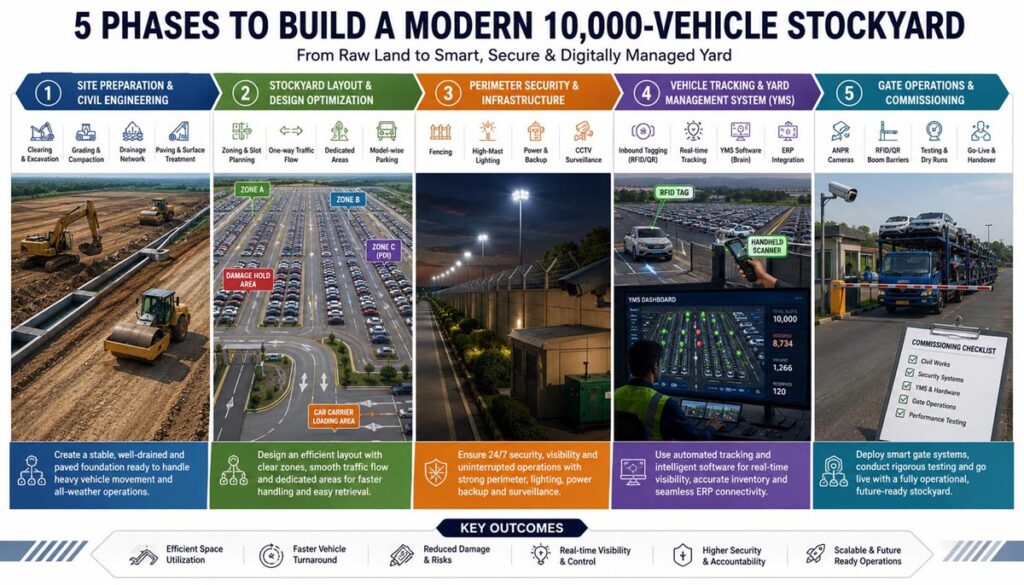
A stockyard of this capacity typically requires around 50–60 acres of usable land, assuming an average allocation of 22–25 sq. m per vehicle, including circulation roads. Successful execution demands a structured, phased approach encompassing site preparation, infrastructure development, technology deployment and operational optimisation.
Phase 1 – Site Preparation and Civil Engineering
The first stage focuses on preparing the land to create a stable foundation capable of supporting continuous vehicle movement and long-term operations.
The process begins with clearing the site by removing vegetation, bushes and small trees using heavy equipment such as excavators and bulldozers. The organic topsoil, typically 150–300 mm thick, is stripped away as it cannot support heavy vehicle loads. Any marshy or unstable soil pockets are excavated and replaced with suitable material to expose firm ground.
The land is then levelled through cut-and-fill operations to create a gentle gradient of around 1–2%, allowing efficient rainwater drainage. Where soil conditions demand it, stabilisation using lime or cement is carried out before the entire area is compacted using vibratory rollers to achieve the specified Proctor density.
An efficient drainage network is equally critical. Concrete stormwater drains are constructed around the perimeter and between parking bays to prevent waterlogging, while oil-water separators are installed at discharge points to capture any vehicle fluid leakage before runoff leaves the premises.
The final stage of civil development involves constructing the pavement structure. After laying Granular Sub-Base (GSB) and Wet Mix Macadam (WMM) layers, the final surface may comprise one of the following:
- Interlocking concrete paver blocks for superior durability and easy maintenance.
- Bituminous (asphalt) pavement for faster construction and a smoother finish.
- Dense gravel or WMM with dust suppressants as a lower-cost solution requiring higher maintenance.
Phase 2 – Stockyard Layout and Design Optimisation
An efficient layout is essential for managing a large vehicle inventory while ensuring smooth traffic flow and quick vehicle retrieval.
The yard should be divided into clearly defined alphanumeric zones, rows and parking slots (for example, Zone A – Row 05 – Slot 12), enabling precise vehicle identification and tracking.
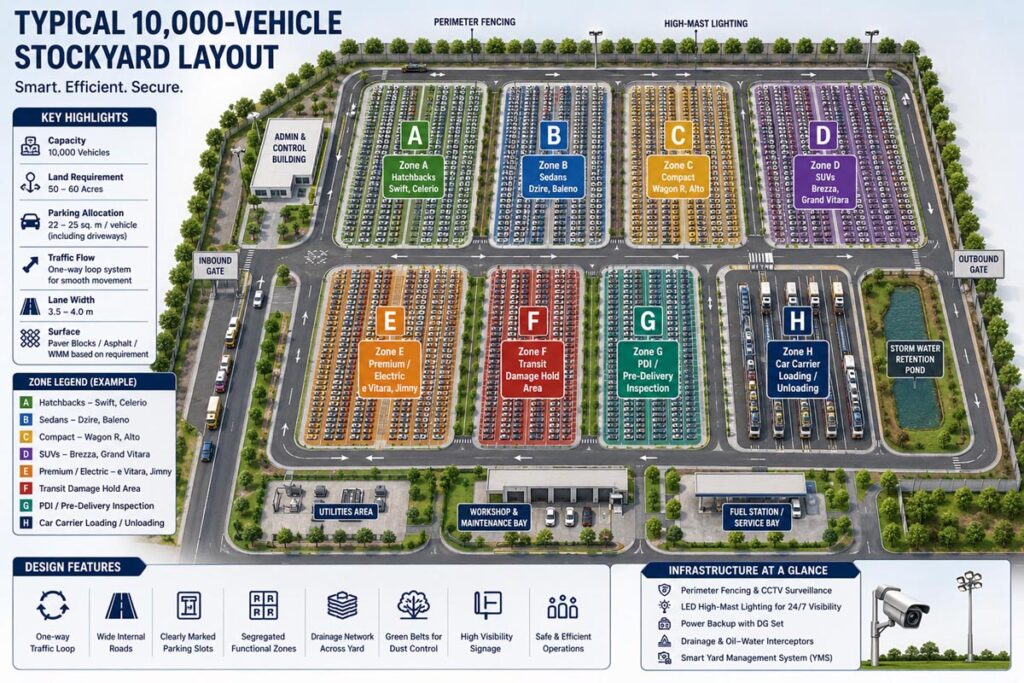
Internal roads should follow a one-way circulation pattern with standard lane widths of 3.5–4 metres to eliminate congestion. Dedicated loading bays should be provided for car carriers so that heavy transporters do not enter the vehicle parking areas unnecessarily.
Separate zones should be earmarked for high-volume models, fast-moving variants, pre-delivery inspection (PDI) areas, transit damage inspection, quarantine parking and loading/unloading operations.
Model-wise parking is particularly beneficial in large OEM stockyards. Taking the example of a Maruti Suzuki stockyard, individual zones may be allocated for models such as Swift, Celerio, Dzire, Wagon R and Baleno, while separate sections can accommodate SUVs including Brezza, Grand Vitara, e Vitara, Jimny and Fronx. Clear directional signage at the entrance and throughout the facility significantly improves vehicle identification and reduces retrieval time.
Phase 3 – Perimeter Security and Infrastructure
Security infrastructure plays a vital role in protecting both the vehicles and operational assets.
The facility should be enclosed with a robust boundary wall or heavy-duty chain-link fencing topped with razor wire wherever necessary. High-mast LED lighting towers should provide uniform illumination throughout the yard, eliminating blind spots and ensuring round-the-clock surveillance.
A dedicated electrical substation or transformer, supported by diesel generator backup, should ensure uninterrupted operation of lighting, security systems, gates and digital tracking infrastructure. Adequate CCTV coverage must also be provided across the stockyard to minimise theft, pilferage and accidental damage.
Phase 4 – Vehicle Tracking and Yard Management System (YMS)
Managing an inventory of 10,000 vehicles manually is impractical. A digital Yard Management System (YMS) is therefore essential for real-time visibility and operational efficiency.
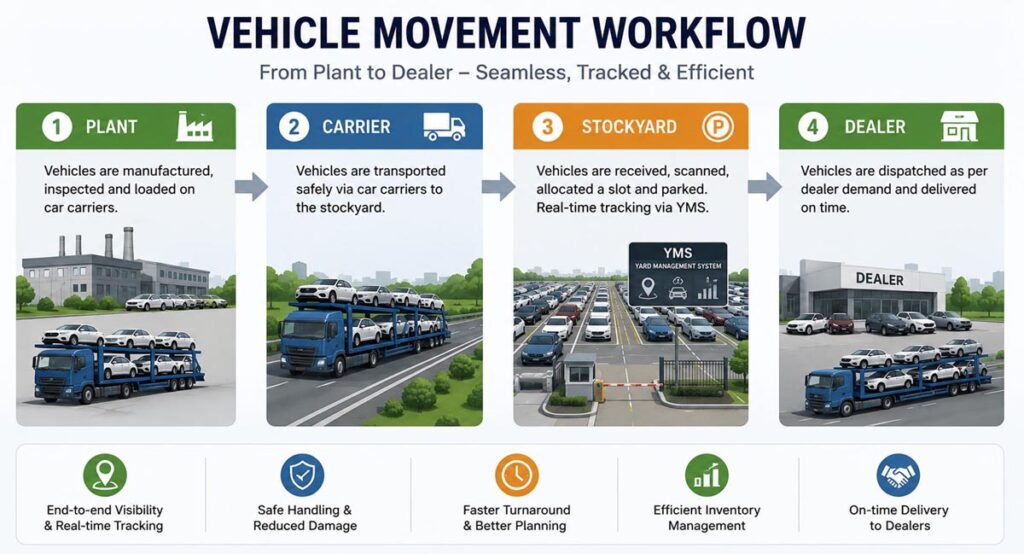
The typical workflow follows a simple sequence:
Inbound Gate > Vehicle Identification (Barcode/RFID) > YMS Slot Allocation > Vehicle Parking > Real-time Tracking > Outbound Dispatch
In one large stockyard implementation, each parking bay was embedded with a barcode (one barcode serving two parking positions). Upon arrival from the manufacturing plant or port, the driver parks the vehicle in the designated bay and scans both the vehicle barcode and the bay barcode using a handheld scanner. The information is transmitted through the yard’s wireless communication network to the YMS, allowing the exact vehicle location to be displayed instantly.
Several technology options are available for vehicle tracking:
- RFID-based tracking using passive windshield tags and handheld or fixed RFID readers.
- Real-Time Location Systems (RTLS) using Bluetooth Low Energy (BLE) beacons for continuous location tracking.
- QR code-based tracking through ruggedised mobile applications with GPS-enabled geofencing.
The YMS functions as the digital brain of the facility by maintaining a live map of every parking location, indicating whether each slot is vacant, occupied or reserved. Integration with the OEM’s ERP platform, such as SAP, enables manufacturing, logistics and dispatch teams to access real-time stockyard information.
Phase 5 – Gate Operations and Commissioning
Modern gate infrastructure improves security while accelerating vehicle movement.
Automatic Number Plate Recognition (ANPR) cameras record the arrival and departure of car carrier trucks, while RFID or QR-enabled boom barriers ensure that vehicles cannot leave the premises without authorised dispatch documentation.
Before commercial operations commence, comprehensive dry runs should be conducted with approximately 100–200 vehicles to validate traffic flow, gate performance, communication coverage and software integration. Following successful testing, the project can be formally commissioned after verifying civil works, security systems and digital infrastructure.
Continuous Improvement Through Kaizen
Once the stockyard becomes operational, continuous improvement initiatives can significantly enhance productivity, safety and vehicle protection. Recommended Kaizen practices include:
- Installing protective overhead netting, particularly over premium vehicle parking areas, to minimise bird droppings and environmental contamination.
- Providing rubberised protective covers on steel columns and structural members to prevent accidental vehicle damage during manoeuvring.
- Using anti-scratch door edge guards to minimise paint damage when vehicle doors are opened in confined spaces.
- Deploying highly visible mobile service trolleys equipped with industrial jump starters, tyre inflators and digital multimeters to quickly attend to vehicles with discharged batteries.
- Introducing a mandatory ‘Zero-Contact Driver Kit’ containing reusable steering wheel covers and washable shoe covers to prevent stains, scratches and interior contamination during vehicle movement.
- Improving speed management by painting large countdown markings (20…15…10…STOP) directly on internal roads leading to intersections, encouraging drivers to reduce speed progressively.
- Enhancing pedestrian safety by marking walkways with high-visibility 3D optical patterns that naturally attract driver attention.
- Implementing a visual Shadow Board system in the key room, directly mapped to the stockyard layout, to eliminate delays caused by misplaced key fobs.
- Dividing the entire stockyard into manageable micro-zones, each assigned to a dedicated team leader responsible for housekeeping, debris removal and rodent control, thereby reducing the risk of wiring harness damage and improving overall operational discipline.
A well-designed vehicle stockyard is far more than a parking facility. It represents an integrated logistics ecosystem that combines sound civil engineering, intelligent layout planning, advanced digital tracking, robust security infrastructure and continuous operational improvement. When executed effectively, such a facility enables OEMs and logistics providers to maximise throughput, minimise vehicle handling time, reduce damage risks and maintain complete visibility across the vehicle distribution chain.

About the Author
With over four decades of experience across India and overseas markets, including a significant stint in Oman, Mr. Ravichandran Srinivasan brings deep expertise in process excellence, leadership, and team development. He has held senior roles at Maruti Suzuki Limited, culminating as General Manager, and has led large automotive dealership operations as COO/CEO, overseeing Sales, Service, Parts, and Used Car businesses. He also worked as Head of Logistics & Distribution Division in Saud Bahwan Group, Oman and Maruti Udyog Ltd, Gurgaon (presently MSIL). His international exposure and hands-on leadership across OEMs, distributors, and dealerships provide a comprehensive, results-driven perspective on the automotive ecosystem.