By Ravichandran Srinivasan, Industry Domain Expert
Running an automobile dealership is a paradox of scale. It is a high-volume, capital-intensive business that operates on razor-thin net margins, typically between 1% and 2%. In this hyper-competitive environment, even minor operational inefficiencies or unmonitored financial leakages can quickly transform a high-revenue enterprise into a loss-making one. Achieving sustainable profitability requires dealer principals to look beyond vehicle sales volumes and adopt a data-driven approach to optimising the Profit & Loss (P&L) statement.
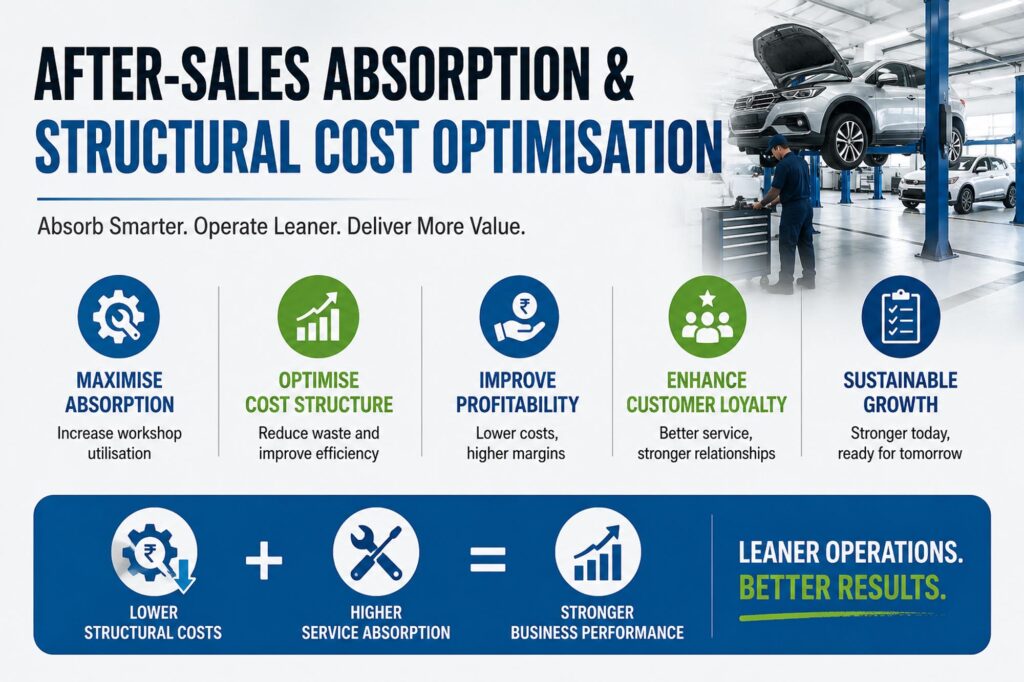
While new vehicle sales generate showroom traffic, the real engine of dealership profitability lies in the after-sales business. By building a highly efficient workshop and spare parts operation, dealerships can move beyond thin retail margins and achieve an industry-leading Profit After Tax (PAT) of 4% to 5%.
1) After-Sales Absorption & Structural Cost Optimisation
The ultimate benchmark of a dealership’s financial health is its Service Absorption Rate. This measures the percentage of the dealership’s fixed operating expenses—including showroom rent, administrative salaries and utilities—that are covered by the gross profit generated solely from the workshop and spare parts departments.
When service absorption exceeds 85% and moves closer to 100%, the dealership becomes significantly less dependent on fluctuations in new vehicle sales. Achieving this requires structural cost optimisation and better utilisation of infrastructure and assets.
Footprint Rationalisation
Showroom space commands a premium. Relocating non-customer-facing functions, such as vehicle stockyards and long-term spare parts storage, to lower-cost peripheral locations can substantially reduce rental and infrastructure costs.
Workshop Equipment Optimisation
Capital investments in diagnostic equipment, wheel alignment and balancing systems, and vehicle lifts must deliver high utilisation. Equipment layout should minimise vehicle movement within the workshop, while preventive maintenance schedules should eliminate avoidable downtime.
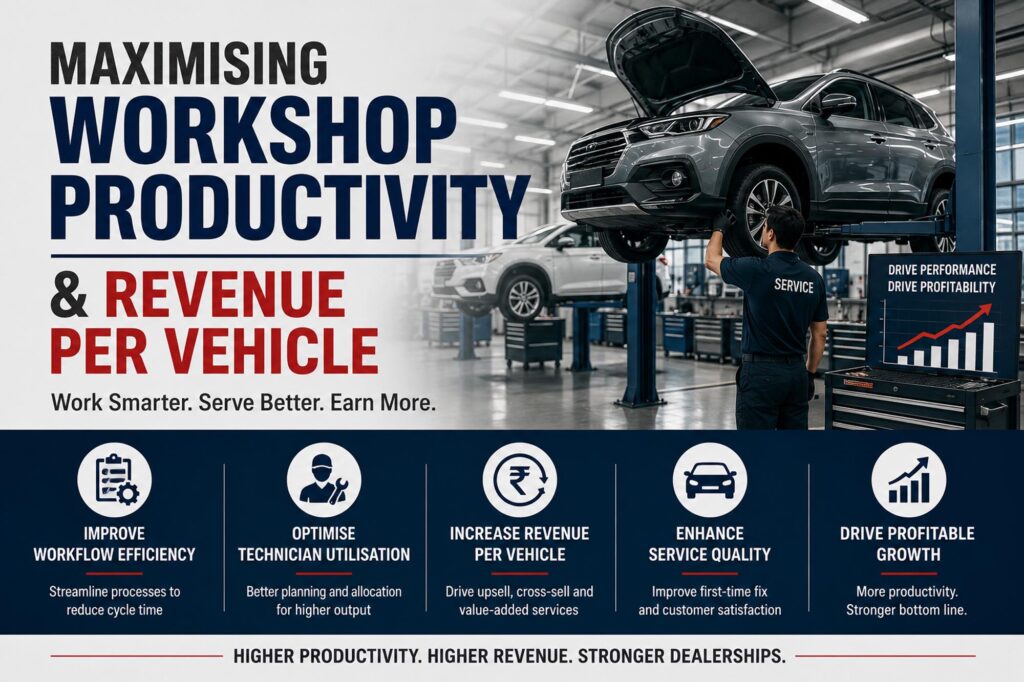
2) Maximising Workshop Productivity & Revenue Per Vehicle
To achieve a sustainable 4–5% PAT, the workshop must evolve from a reactive repair facility into a highly productive service operation. Management should focus on maximising technician productivity, workshop utilisation and revenue generated per vehicle.
Revenue Per Bay
Revenue per bay is influenced by two key factors:
- Total workshop revenue generated
- Labour and parts revenue per vehicle serviced
- Increasing either of these metrics improves overall workshop profitability.
- High-Velocity Bay & Manpower Productivity
- Dealer principals should closely monitor the technician-to-bay ratio to maximise workshop capacity. An optimal benchmark is 1.5 to 2.0 technicians per active bay, supported by dedicated quick-service teams.
- Synchronising service advisors, technicians and parts personnel through a digital workshop management system helps reduce idle bay time and increase daily vehicle throughput.
- Driving Higher Labour & Parts Revenue Per Vehicle
- Maximising bay utilisation alone is not enough if invoice values remain stagnant. Service advisors should move beyond order-taking and adopt a consultative selling approach.
A structured 25-point vehicle health check for every vehicle entering the workshop enables advisors to identify genuine wear-and-tear items—such as brake pads, suspension bushes, belts and wiper blades—thereby increasing both labour and parts revenue per repair order.
Value-Added Services (VAS)
Value-added services deliver some of the highest margins within the after-sales business. Dedicated workshop profit centres can be established for services such as:
Anti-rust underbody and silencer coatings
Ceramic coatings, Paint Protection Film (PPF) and interior detailing
Engine decarbonisation and air-conditioning disinfection
Incentivising service advisors to promote these services and technicians to execute them efficiently can enable VAS to contribute as much as 15% of total workshop profitability.
3) First-Time-Right (FTR) & Customer Retention
Building a First-Time-Right Workforce
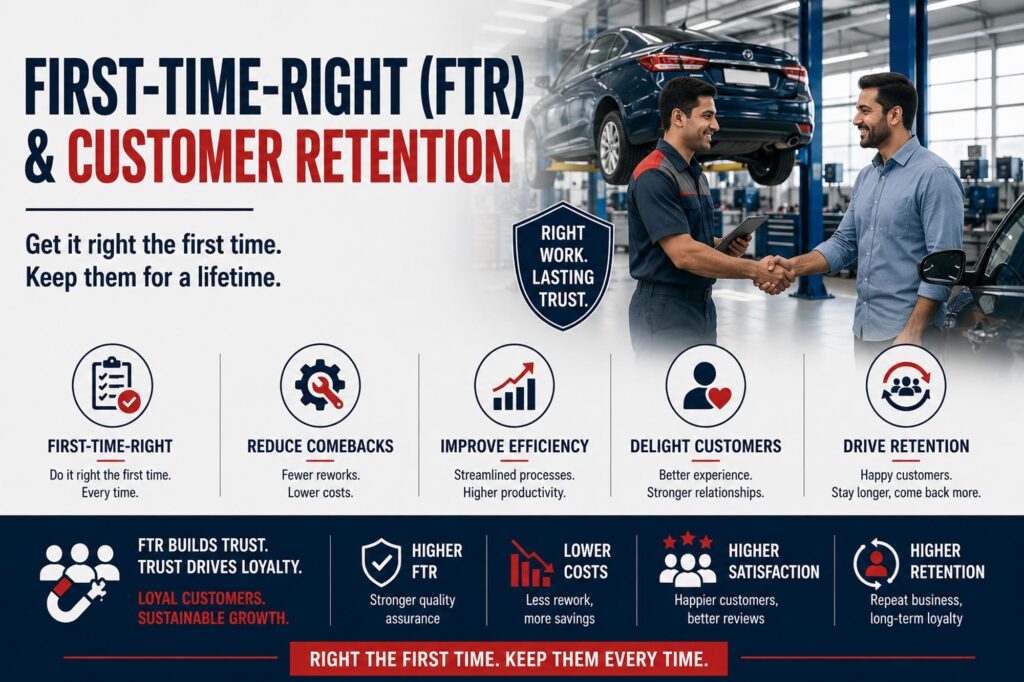
Modern automotive retail demands technicians with advanced technical and diagnostic capabilities. Repeat repairs consume valuable workshop capacity, reduce technician productivity and increase costs without generating additional revenue.
Continuous technical training improves the Fixed Right First Time (FRFT) score. A workshop consistently achieving an FTR rate above 95% eliminates costly rework, frees up workshop capacity and strengthens customer confidence.
The Customer Retention Multiplier
Retaining an existing customer is significantly more cost-effective than acquiring a new one. Customers who continue servicing their vehicles through the third, fourth and fifth years of ownership generate recurring high-margin labour and genuine spare parts revenue.
Automated service reminders, customised loyalty programmes for ageing vehicles and periodic service clinics help retain customers within the dealership network instead of losing them to independent workshops.
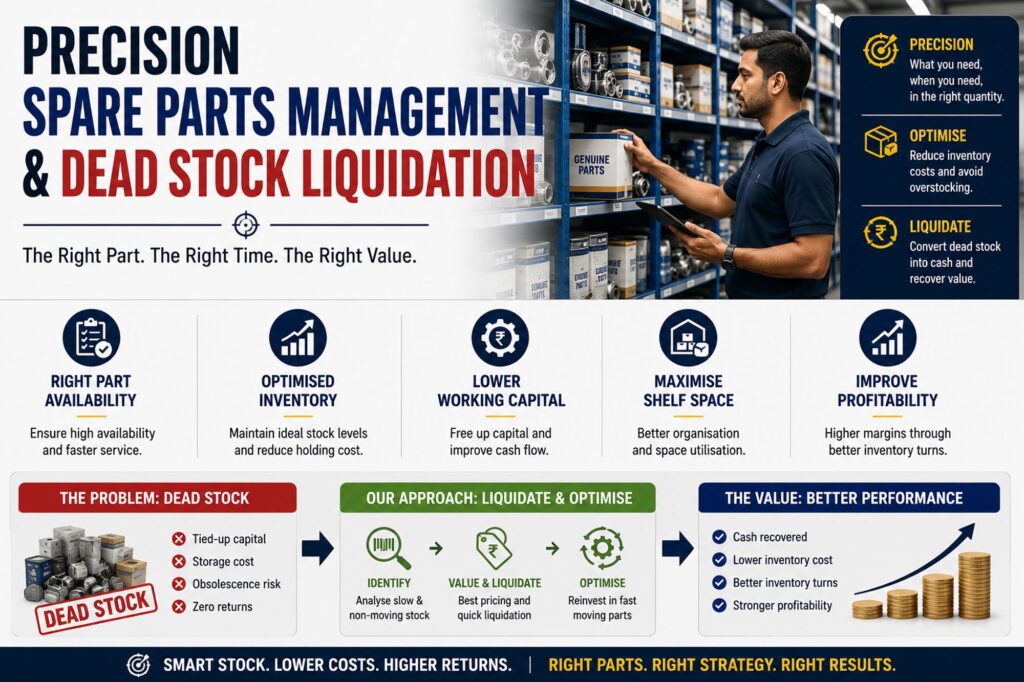
4) Precision Spare Parts Management & Dead Stock Liquidation
Obsolete inventory silently erodes dealership profitability by locking up valuable working capital. Effective inventory management requires disciplined stock monitoring and data-driven replenishment practices.
ABC Inventory Classification
A structured ABC inventory system should categorise parts as:
- Category A – Fast-moving: Approximately 75% of demand; managed through automated replenishment.
- Category B – Slow-moving: Approximately 20% of demand; monitored through periodic inventory reviews.
- Category C – Non-moving: Approximately 5% of demand; identified for immediate liquidation.
- Fast-moving parts should operate under just-in-time replenishment systems, while slow-moving items should be maintained at carefully calculated safety stock levels.
- Aggressive Dead Stock Liquidation
- Any spare part or accessory showing no movement for 90–120 days should be classified as dead stock. Dealerships can recover working capital through measures such as:
- Negotiating structured return-to-vendor programmes with OEMs.
- Participating in inter-dealer spare parts exchange networks.
- Bundling slow-moving accessories with new vehicle deliveries or seasonal service campaigns.
5) Quality Control, Employee Engagement & Performance Alignment
A Robust Quality Control System
An independent Quality Control (QC) team should inspect every vehicle before delivery. Each vehicle must undergo a standardised road test and final inspection by a certified master technician before being handed over to the customer.
This final quality gate minimises repeat repairs, protects the dealership’s reputation and helps sustain high FTR performance.
Employee Suggestion Schemes
Technicians and workshop supervisors are often best placed to identify inefficiencies and improvement opportunities. A structured Employee Suggestion Scheme (ESS) that rewards practical ideas—from improved tool layouts to workshop process enhancements—can reduce operating costs while fostering employee ownership and engagement.
Performance-Linked Incentives
Traditional seniority-based compensation should be replaced with performance-driven incentive systems.
Sales, service, spare parts and QC teams should be rewarded based on measurable parameters such as gross profit contribution, productivity, customer satisfaction and quality performance rather than simply vehicle volumes.
Targets should be aligned with local market potential, historical performance and seasonal demand. When technicians clearly see the link between higher efficiency, zero QC rejections and improved earnings, the entire organisation naturally shifts towards productivity and profitability.
Conclusion: Achieving the 4–5% PAT Benchmark
A successful automotive dealership cannot depend solely on the cyclical nature of vehicle sales. Long-term financial strength—and a sustainable Profit After Tax of 4% to 5%—is built through an efficient after-sales business.
By maximising service absorption, improving workshop productivity, strengthening First-Time-Right performance, optimising inventory management and aligning employee incentives with profitability, dealerships can build agile, resilient and highly profitable businesses capable of thriving in any market environment.