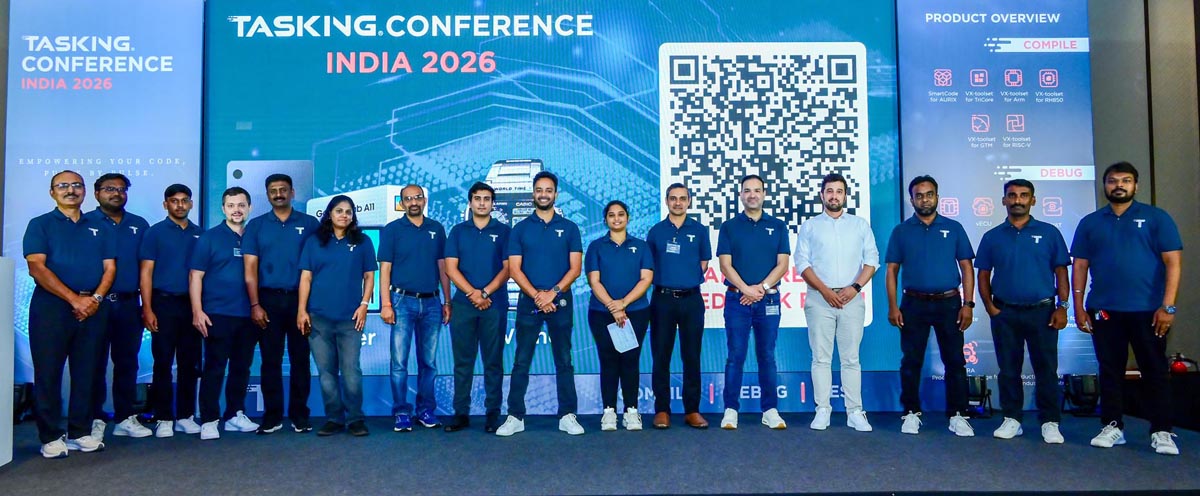
The TASKING Conference 2026, held at Taj Wellington, Chennai, convened automotive software leaders, ecosystem partners and engineering practitioners for a focused exchange on safe, secure and scalable mobility. With Software Defined Vehicles (SDVs) and increasingly complex ECU architectures reshaping the industry, the event delivered a compelling mix of technical depth, strategic direction and real-world application insights.
Setting the tone, Christoph Herzog, Co-CEO of TASKING, outlined the company’s roadmap and its evolution from a compiler specialist to a full-stack provider of debug, trace and test solutions. He underscored the growing need for flexible, scalable and future-ready development environments as OEMs and Tier 1 suppliers grapple with rising software complexity.
TASKING’s expanding toolchain ecosystem – supporting platforms from Infineon, Renesas and others – was positioned as a critical enabler in balancing performance, safety and development efficiency across diverse architectures. Complementing this, Houssem Ben Abderrahman, Chief Revenue Officer, highlighted the company’s global footprint, with over 320 employees serving more than 1,000 customers, including leading automotive players such as Bosch, Denso, Cummins and Forvia.
Driving the SDV Transition
A central theme throughout the conference was the industry’s transition towards software-defined mobility and the ecosystem collaboration required to support it. David Kraft of Renesas Electronics Europe GmbH emphasised the strategic alignment between silicon providers and toolchain partners, particularly in enabling seamless support for next-generation R-Car MCUs and the RH850 family.
The message was clear – innovation in SDVs is no longer driven by isolated advancements but by tightly integrated ecosystems that enable scalability, interoperability and faster time-to-market. TASKING’s positioning within this ecosystem reflects a deliberate strategy to embed itself deeper into the automotive software value chain.
Enhancing Productivity, Safety and Compliance
Safety-critical development remained another strong focus area. Through its collaboration with Infineon and LDRA, TASKING showcased solutions that enhance code quality, verification and standards compliance. Industry expert Satrabrata Mohanty shared practical insights into deploying these tools across automotive and IoT applications, highlighting their role in enabling reliable, standards-compliant embedded systems.
A dedicated session on AURIX™ TC4x/TC3x/TC2x platforms further illustrated how trace-driven analysis and early validation techniques can improve software quality in multi-core and multi-SoC environments. Adding a broader industry perspective, Girish Padmanabha Kamala, Senior Director and Country Head of Sales – Automotive, Infineon noted that automotive continues to contribute over 60% of the company’s business, underlining the sector’s centrality to semiconductor innovation. His session also explored evolving ECU architectures, RTOS choices such as Zephyr and FreeRTOS, and best practices in lifecycle management as the industry moves decisively towards SDVs.
Building Capability, Strengthening Engagement
With around 100 participants, the conference maintained a high level of engagement through interactive sessions, technical discussions and curated networking opportunities. Well-structured sessions, coupled with thoughtful hospitality and interactive elements such as quizzes and giveaways, contributed to a cohesive and impactful experience.
In essence, TASKING Conference 2026 reinforced a clear strategic narrative – as vehicles become increasingly software-defined, the role of integrated, scalable and safety-driven development ecosystems will be pivotal in shaping the next phase of automotive innovation.