Saudi Arabia runs four of the five localization instruments at scale. Four segments of its machinery economy still lie outside all of them — and the reason is not policy design.
By Abid Hussain

I spent part of my career localizing a tractor platform in Mexico. We took local content to 65 per cent, and what I remember is not the number. It is how much of the work had nothing to do with manufacturing: finding out which parts were actually the same part, arguing with people certain their variant was special, and rebuilding a homologation process that was adding months to every launch.
That is the part of localization nobody photographs, and it decides whether a national programme produces an industry or a compliance exercise.
Five instruments, and how each one fails
| Instrument | Where it breaks |
| Percentage mandate | When the percentage becomes the product. Certification is reached through packaging and manual assembly rather than component manufacture. |
| Outcome-linked incentive | Assembly deepens faster than the component base beneath it. |
| Anchor-buyer procurement | It localizes the buyer’s supply chain. You get service yards and fabrication; on its own it seldom produces OEM manufacture. |
| Sovereign capitalisation | It needs concentrated volume. Where demand is fragmented across many brands, the instrument stalls. |
| Supplier capability building | When it runs as training rather than as a pipeline into real contracts. |
India’s production-linked scheme is the best-documented of them: 836 approved applications, more than $23bn of investment, handset imports down roughly 77 per cent. But over 99 per cent of demand is now met by phones assembled in India, which is a statement about final assembly rather than value added — and why a separate components scheme had to follow, reaching 75 approved projects by March 2026.
One company, two countries, two outcomes
The clearest natural experiment is not a country but a single manufacturer in two markets.
In China, Tesla built as a wholly owned subsidiary — the first foreign carmaker allowed to — with about $521m of loans at favourable rates and a 15 per cent tax rate against the usual 25. Shanghai now reports component localization above 95 per cent across more than 400 suppliers, over 60 of which have entered Tesla’s global supply chain.
India offered more on paper: duty cut to 15 per cent from 70 to 110, against roughly $500m of investment and local sourcing of 25 per cent by year three. Tesla declined, and in May 2026 India’s heavy industries minister confirmed the plant was formally off the table. It imports from Shanghai at full duty: 1,017 cars sold by early October 2026, with its own plants near 60 per cent capacity.
The deciding variable was not policy. India’s incentive was larger and produced nothing; China’s terms sat on demand and a supplier base that already existed. The trap in the Indian case is familiar: duty keeps the price high, price suppresses demand, absent demand kills the case for building locally, and the duty stays. Asking a manufacturer to carry volume risk before the volume exists is a trade very few accept.
Scale is not an output of a localization programme. It is the entry condition.
Where Saudi Arabia stands
All five instruments are available inside the Kingdom’s institutional system and four are run at scale: Aramco’s procurement programme, which reached 70 per cent local content in February 2026 after $280bn added to GDP; the mining local-content programme; a defence target of more than half of military spending by 2030; a machinery cluster working to roughly 50 per cent localization by 2030; sovereign capitalisation through the automotive supplier hub, which signed five tier-1 agreements in February 2026; and a six-month programme connecting Saudi manufacturers to portfolio-company procurement.
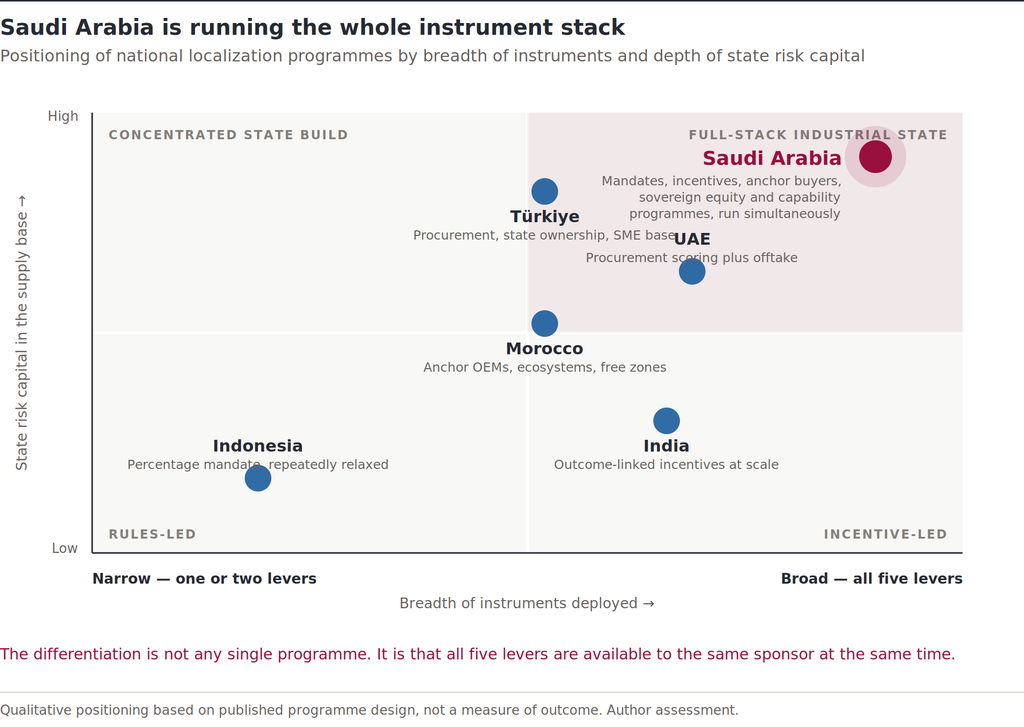
Four numbers frame what is open. Machinery, electrical equipment and parts were the largest import category in the fourth quarter of 2025, about 31 per cent of a SAR 247.7bn quarterly bill. Import dependence in machinery runs near 78 per cent. The market is roughly $25.6bn. The installed base moves from 1.11m equipment-equivalent units toward 1.67m by 2031.
Presence is not production
A service centre is not a factory. Neither is a distributor, a warehouse or a Saudi-specific product variant. Keeping that distinction straight is what makes the opportunity visible.
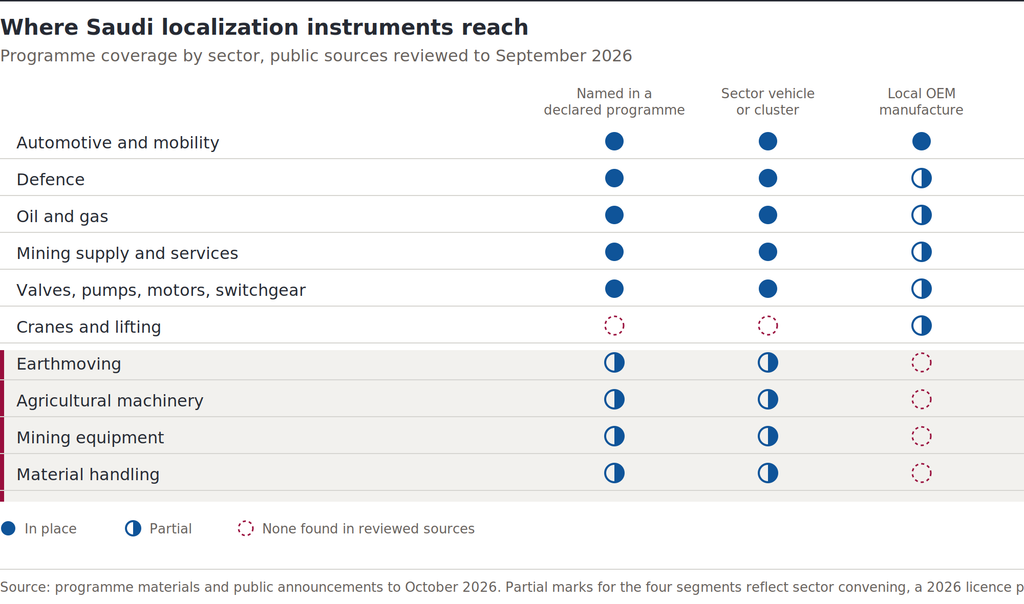
The mining programme deepens what a miner buys, not the manufacture of mining machines. Agriculture is still distributor-served. Material handling, the segment most exposed to the logistics build-out, is distributor-led end to end. Earthmoving is sold by every global brand and built locally by none.
Two developments matter. In February 2026 the national industrial development centre convened the first Heavy Equipment Connect forum and expo in Dammam, alongside a package of machinery and equipment industrial licences. And the Kingdom’s advanced-manufacturing vehicle carries building and heavy equipment as one of its four sectors, though its deals so far sit elsewhere. The sector has been convened and licensed; what is missing is narrower. Pooled demand across the four segments, and a shared supplier model sized against it.
The claim, stated narrowly. The public sources I reviewed do not identify a dedicated, cross-OEM mobile-heavy-equipment localization platform with declared products, production volumes and a shared supplier model. That is not a claim that nothing is happening — private investment, distribution, service, repair and exploratory memoranda all exist.