By Nachiket Devasthaley, Senior Consultant, Mobility Growth Advisory, Frost & Sullivan

For over a century, success in the commercial vehicle industry has been measured by familiar metrics: payload, fuel efficiency, reliability, and ultimately, the number of vehicles sold. That equation is beginning to change.
By 2030, industry leaders may not necessarily be those build the best trucks or buses, but rather those who will create intelligent mobility ecosystems-integrating vehicles, energy infrastructure, software platforms, fleet services, financing, and lifecycle support into a single value proposition.
This shift is being driven by a fundamental change in customer priorities. Fleet operators today are under pressure from rising operating costs, driver shortages, tighter safety regulations, decarbonization commitments, and increasing expectations for uptime and delivery efficiency.
Purchasing decisions are therefore becoming less about the vehicle itself and more about the business outcomes it enables.
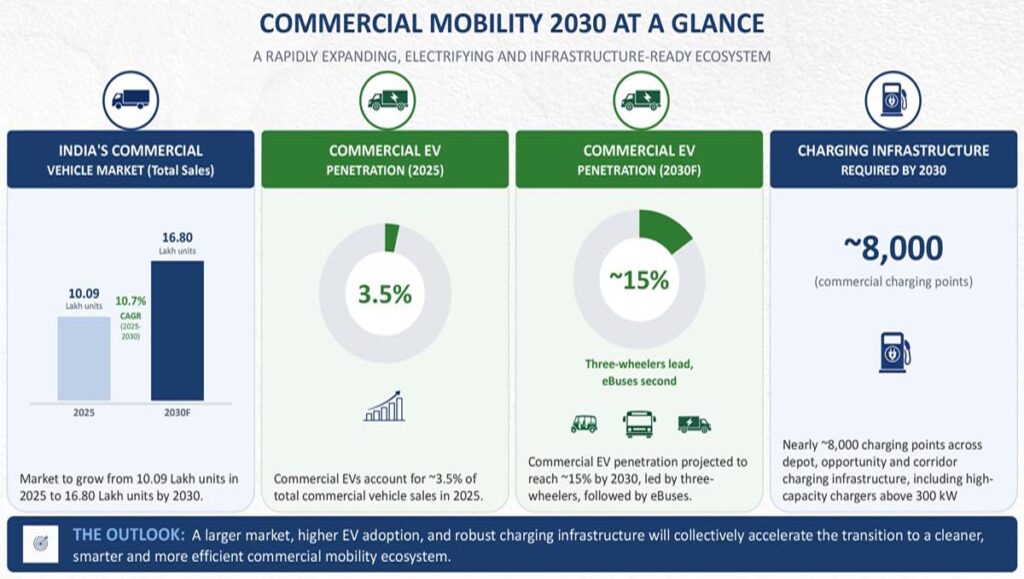
Frost & Sullivan analysis indicates that India’s commercial vehicle market, which stood at 1.09 million units in 2025, is entering an accelerated technology adoption cycle. Commercial electric vehicles, which currently account for ~ 3.5% of new vehicle sales, are projected to achieve ~15% market penetration by 2030, led by three-wheelers and electric buses as improving Total Cost of Ownership (TCO), supportive policies, and expanding charging infrastructure strengthen the business case for electrification. Supporting this transition will require the deployment of nearly 8,000 high-capacity charging stations (300 kW and above) across key freight corridors and fleet hubs, underscoring that the future of commercial mobility will be shaped as much by ecosystem readiness as by vehicle technology itself.
Economics Will Trump Powertrain
Electrification is often portrayed as the defining trend in commercial mobility. However, electrification is an outcome, not the transformation itself. The real shift is economic.
Fleet operators have moved beyond acquisition cost as the primary decision criterion. Today, vehicles are evaluated through the lens of Total Cost of Ownership (TCO), balancing purchase price against energy costs, maintenance, financing, uptime, utilization, and residual value.
This explains why electrification is accelerating first in applications such as city buses, municipal fleets, and last-mile logistics, where predictable duty cycles maximize economic returns. Under the right operating conditions, the business case- and not the technology-drives adoption.
The Future Is Multi-Powertrain, Not All-Electric
Unlike passenger vehicles, commercial mobility will not converge around a single propulsion technology. Different operating environments require different solutions.Battery-electric vehicles are best suited for applications with predictable operating cycles. LNG and CNG continue to offer advantages in selected regional freight applications, while hydrogen is expected to play an increasingly important role in long-haul and heavy-duty transport as infrastructure matures. Diesel will remain indispensable in remote applications, where payload, range, and operational flexibility remain paramount.
The winners will therefore not be those promoting a single technology, but those matching the right powertrain to the right application.
Energy Infrastructure Will Define the Pace of Adoption
Commercial vehicle electrification will be constrained not by vehicle availability, but by energy availability.
Unlike passenger cars, commercial fleets require purpose-built charging strategies that minimize downtime and maximize asset utilization. Depot charging will underpin urban operations, while opportunity charging, high-capacity highway corridors, and future megawatt charging systems will enable regional and long-haul applications.
India’s commercial vehicle (CV) charging landscape is expanding rapidly alongside a surging fleet electrification drive. As per the Ministry of Heavy Industries data, India’s public charging network exceeded 29,151 chargers, but continues to face a significant vehicle-to-charger gap of 235:1 versus the global benchmark of 20:1. To narrow this infrastructure bottleneck, the federal government allocated ₹2,000 crore specifically for public charging networks under the flagship PM E-DRIVE Scheme. The policy has already approved over ₹503.86 crore in fresh funding to seed 4,874 public stations nationwide, providing essential heavy-duty fast chargers required for logistics fleets.
Intelligence Will Become the New Competitive Advantage
The next generation of commercial vehicles will derive as much value from software as from hardware.
Connected vehicles are rapidly evolving into intelligent assets capable of optimizing routes, predicting maintenance requirements, monitoring battery health, improving driver performance, and maximizing fleet utilization through AI-driven analytics.
Frost & Sullivan analysis shows, by 2030 AI-enabled connected vehicles will evolve from regulatory compliance (AIS-140 mandated GPS tracking and basic connectivity suite) to intelligent fleet ecosystems, improving productivity by 20–25% through predictive maintenance, route optimization, battery health monitoring, and advanced driver assistance.
Safety Takes Center Stage
Safety is no longer a compliance exercise, as it is becoming measurable contributor to profitability.
By 2030, Frost & Sullivan expects commercial vehicle ADAS adoption to follow two complementary routes.
- Route 1 will be regulation-led, driving widespread adoption of camera-based safety features such as DMS, FCW, LDW, and AEB across volume segments.
- Route 2 will be OEM-led, leveraging multi-sensor architectures, AI, and radar to enable advanced safety, highway assist, and intelligent driving for premium trucks and buses.
ADAS penetration to increase from current <1% to a staggering 48% by 2030, as segments N2, N3,M2 and M3 lead roll-out of regulation mandated ADAS features.
India Can Shape the Next Commercial Mobility Playbook
India enters this transformation with unique structural advantages: a rapidly expanding manufacturing base, world-class engineering talent, improving transport infrastructure, and supportive industrial policies. The country’s diverse operating conditions also make it an ideal test bed for next-generation commercial mobility solutions. Rather than replicating global models, India has the opportunity to define a mobility ecosystem tailored to high-utilization fleets, diverse duty cycles, and relentless cost optimization.
By 2030, leadership will no longer be determined solely by production volumes or market share. It will be defined by the ability to maximize fleet productivity through integrated solutions that combine vehicles, energy, software, data, and lifecycle services.
Commercial mobility has always been about moving people and goods. By the end of this decade, it will be equally about moving energy, intelligence, and value across an increasingly connected ecosystem.