By Rajkiran Kanagala, CBO & President, TCI Group

For decades, road freight has dominated India’s logistics, helped by highway expansion, trucking liberalization and the rise of 3PLs. Yet this dominance masks inefficiency: road is capital-intensive for operators, emissions-intensive for society and increasingly congested. The future lies not in faster highways but in combining highways with railways, ports and inland waterways. This is the multimodal revolution.
Why Has Road Freight Dominated India’s Logistics?
Road’s dominance is economically rational. Trucks reach 99% of districts and deliver door to door without transshipment, which suits small, point-to-point and time-sensitive loads. But the efficiency is incomplete. Road concentrates externalities: pollution, congested corridors and driver shortages. Thin operator margins can compromise safety, maintenance and driver welfare, and saturated highways create bottlenecks and cost spikes. Multimodal logistics is the next rational step. In addition, to manage movements of large volumes above 2000 Tons typically rail and ships become much more efficient in every sense.
Infrastructure Enabling Multimodal Growth
PM Gati Shakti has mapped logistics corridors integrating roads, rail, ports and waterways, while the National Logistics Policy removes barriers to intermodal movement. Railways have upgraded freight corridors, ports have expanded container capacity, inland waterways are being developed and multimodal transportation zones are emerging. But infrastructure alone does not drive modal shift. Shippers must trust that multimodal delivers road-like reliability, which requires visibility, coordination and data integration that have long been missing.
When Should Shippers Choose Multimodal Solutions?
Multimodal logistics delivers the greatest value on long-haul, high-volume routes, such as auto parts moving from Pune to Chennai, grain shipments from Punjab to Kolkata, and containers destined for ports. Rail costs 40-50% less than road on long hauls, and coastal shipping is cheaper still for heavy cargo. A tonne moved 500 km by rail produces about 70% less emissions than by road, which helps manufacturers meeting BRSR or customer ESG commitments. Multimodal networks also add resilience when highways are congested or monsoons close routes. For time-sensitive point-to-point cargo, road remains best. The choice should rest on total cost, reliability and customer requirements.
TCI and Logistics Providers Enabling Multimodal Solutions
TCI sees multimodal as a matter of orchestration, visibility and trust. It is building partnerships with Indian Railways for high-volume corridors, with ports for container and break-bulk movement, and with coastal and inland waterway operators for bulk cargo. Real-time tracking sends customers automated updates on timing, cost and emissions when cargo moves from road to rail. Technology coordinates transshipment to cut idle time, and analytics shows when multimodal beats road. This positions TCI as a supply chain integrator choosing the best mode for each movement, not a road operator competing with rail.
Barriers to Overcome
Barriers remain. Scheduling road, rail and port movements across operators with different systems and incentives is complex. Infrastructure silos, inconsistent handling, tracking and liability standards, and fragmented data limit visibility. Savings may accrue to different parties than the costs, which discourages adoption. Shippers still perceive road as more reliable, though rail has improved, and smaller shippers need aggregation to reach viable volumes. These barriers are being addressed through policy, investment and innovation, but progress is gradual.
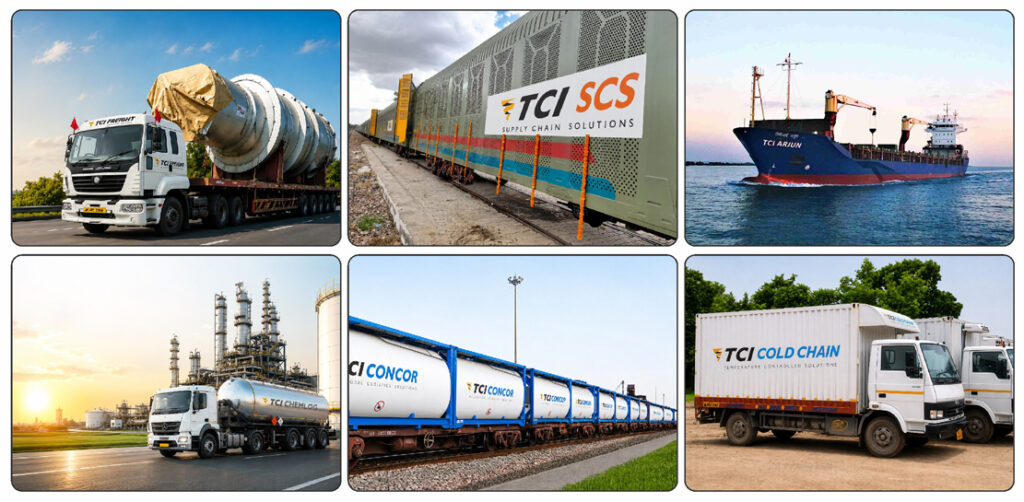
What Does Multimodal Logistics Enable?
Beyond cost and emissions, multimodal enables resilience, because shipments can be redirected when one mode is disrupted. It adds capacity by shifting volume off congested highways without new road investment, and it improves competitiveness by giving tier-2 and tier-3 manufacturers and farmers cheaper access to distant markets. It supports India’s Paris commitments, with tools such as TCI’s Transportation Emission Measurement Tool (TEMT) helping shippers track and report progress. And it forces integration across fragmented railways, ports and trucking operators.
The Road Ahead
Over the next 3-5 years, PM Gati Shakti will ease intermodal coordination, digital platforms will give real-time visibility across modes, and standards for handling, tracking and liability will emerge. Rail will grow more reliable, especially for automotive, chemicals and consumer goods, while coastal and inland waterways carry more bulk cargo. Road will shift toward shorter distances, premium time-sensitive cargo and last-mile delivery. Pure road operators will face margin pressure while integrated logistics companies thrive, and sustainability, measured through BRSR and customer ESG demands, will become a competitive advantage
Conclusion
The future is not beyond highways, which remain essential, but beyond road-only logistics. The next decade belongs to organisations that combine modes intelligently, optimize for total cost and orchestrate seamless movement across India’s expanding infrastructure. Multimodal logistics is not a niche opportunity; it is the defining transformation of India’s supply chains.
PM Gati Shakti National Master Plan for Multi-Modal Connectivity, Ministry of Commerce, Government of India (2023); National Logistics Policy, Department of Commerce, Government of India (2022); Ministry of Railways Freight Policy Documentation (2023-2024); Ministry of Shipping Port Development Plans (2023-2024); Inland Waterways Authority of India (IWAI) Expansion Plans (2023-2024); World Economic Forum Multimodal Logistics Studies (2023-2024); CII Logistics and Supply Chain Reports (2023-2024); TCI Multimodal Supply Chain Strategy and Partnerships Documentation (2024); TCI Transportation Emission Measurement Tool (TEMT) and Sustainability Reporting (2024).