By Siddhartha Gupta, Director, Mobility Growth Advisory, Frost & Sullivan

India’s intercity bus segment is gradually shifting from basic, price-led travel toward more organized and comfort focused services. AC sleeper and seater-sleeper buses are particularly important on longer routes, while luxury and electric coaches are likely to grow first on routes where higher fares, strong utilization and supporting infrastructure make them commercially viable.
India’s bus segment is growing, with electrification gaining ground
India recorded 79,756 registrations under the Bus vehicle class in CY2025. Diesel remained dominant, accounting for nearly 86% of Bus registrations, while electric buses represented about 6%. The shift is becoming more visible in 2026: during January to September, India recorded 58,505 Bus registrations, of which 4,916 were electric, already marginally above the full-year 2025 electric-bus volume.
This is not a one-year spike. Registrations under the BUS vehicle class for Electric (BOV) and Pure EV increased from 3,961 units in CY2024 to 4,892 units in CY2025, a 23.5% rise. Intercity electric coaches, however, are likely to scale more selectively than urban e-buses because longer routes, charging requirements, turnaround times and high vehicle utilization create a more demanding operating environment.
Electric-bus registrations continue to rise in 2026
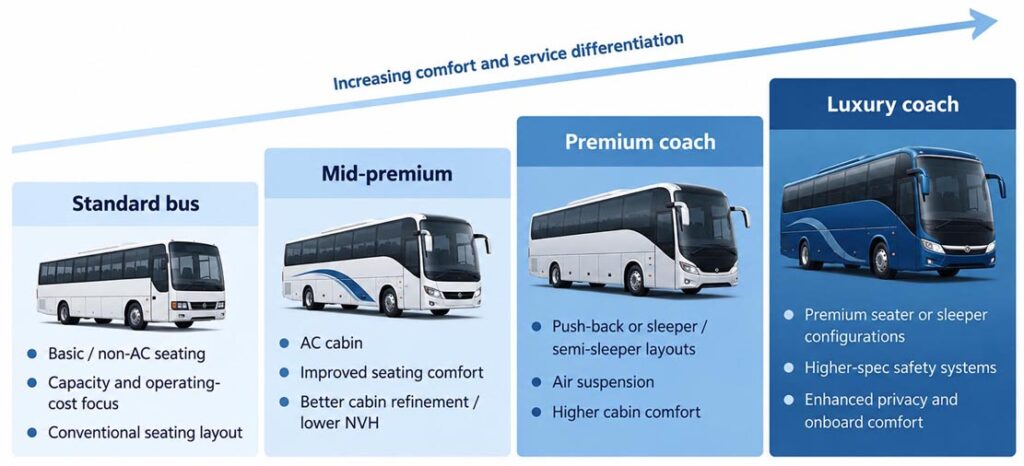
The distinction between standard, mid-premium, premium and luxury coaches is increasingly shaped by seating configuration, cabin comfort, ride quality, onboard features and service positioning. For the mid-premium segment, the opportunity lies in combining AC, improved seating and better ride quality without moving fully into luxury-coach economics. Premium and luxury coaches add more differentiated sleeper or seater layouts, air suspension, higher-spec safety systems and stronger onboard experience.
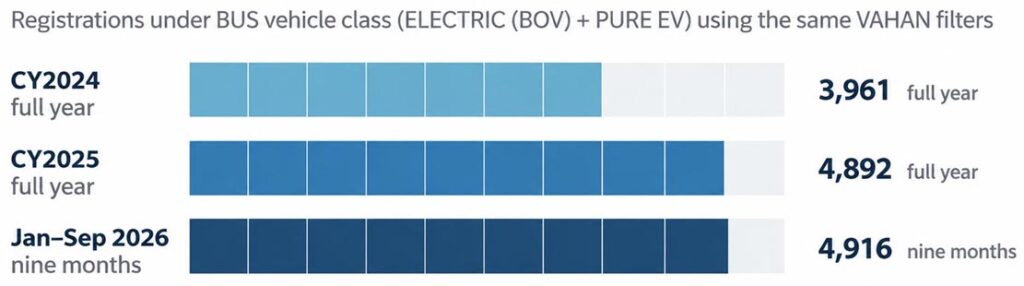
Note: Vehicle class = BUS, fuels = ELECTRIC (BOV) and PURE EV. CY2024 and CY2025 are full-year registrations, 2026 covers January to September
Comfort is becoming a mainstream part of intercity travel
India’s medium- and heavy-duty passenger-carrier market continued to grow in CY2025, with domestic sales increasing by about 7.5% year-on-year. Segment F, covering buses above 14.5 tonnes and up to 18.5 tonnes, accounts for a sizeable part of the full-size bus market.
Alongside this growth, intercity travel is becoming more differentiated by comfort and service quality. Recent private-market data points to a high share of journeys on AC buses, with sleeper and seater-sleeper formats particularly relevant on longer routes. The trend is also visible among state operators through services such as MSRTC’s Shivneri and e-Shivneri and KSRTC’s Airavat and Flybus.
Infrastructure expands the corridor opportunity
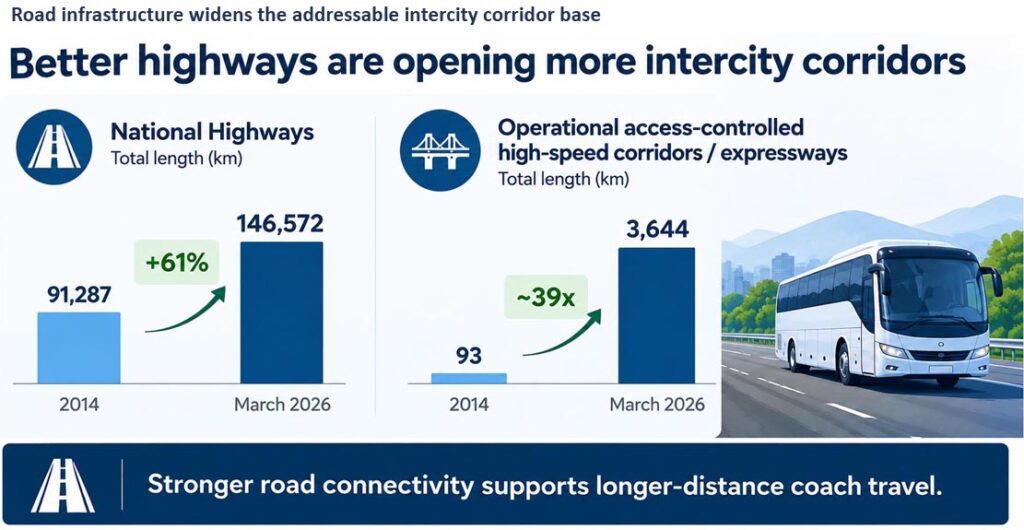
MoRTH reports that National Highways increased from 91,287 km in 2014 to 146,572 km by March 2026, while operational access-controlled high-speed corridors and expressways grew from 93 km to 3,644 km. Better roads can shorten journey times, improve ride quality and make overnight and Tier II/III routes more practical for coach operators. For mid-premium and luxury coaches, this creates more routes where better seating, suspension and sleeper formats can make a noticeable difference to the passenger experience. Route economics, however, will still depend on tolls, permits, competition from rail and air, passenger density and return journey utilization.
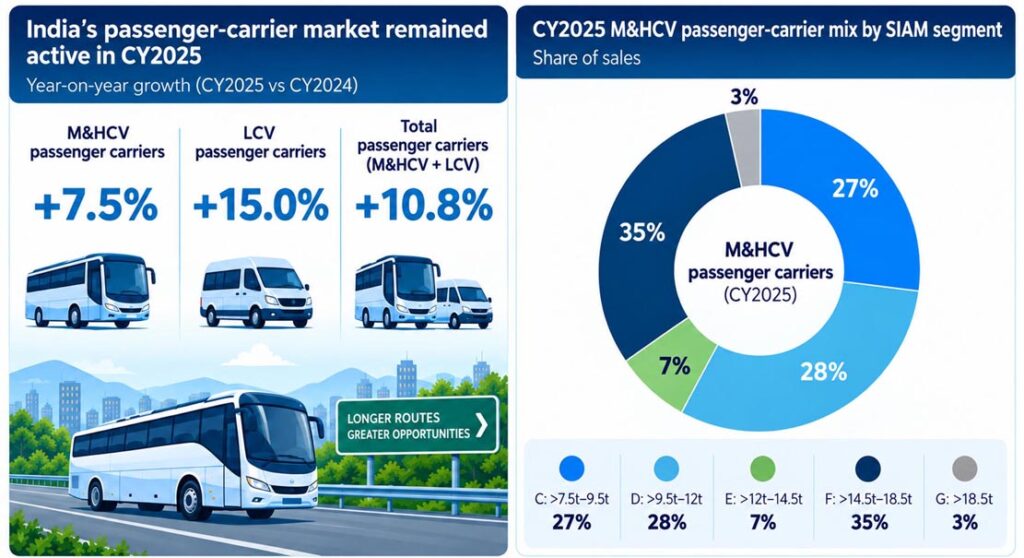
Note: CY 2025 refers to Jan-Dec 2025 domestic sales, SIAM segments are based on gross vehicle weight (GVW)
Global lessons need selective translation
Global markets offer different lessons for India. China shows that stronger road infrastructure can support coach travel, but high-speed rail can also compete for long-distance passengers. In Europe, platforms such as Flix combine digital booking, network planning and pricing with local bus operators, helping create a more consistent customer experience. In the U.S. and Canada, motorcoaches are widely used for charter, tourism and sightseeing.
For India, the most relevant lessons are service consistency, network branding, digital customer experience and route-specific planning, rather than copying another market’s operating model.
Where the opportunity is strongest
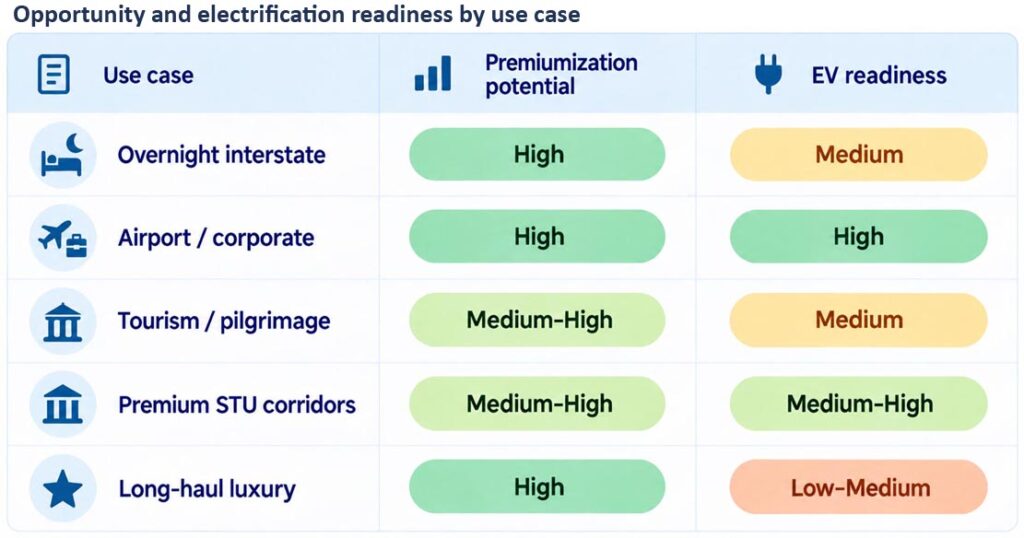
The most credible near-term opportunity lies in organized overnight travel on busy, repeatable routes. Sleeper and seater-sleeper formats are well suited to longer journeys, where passengers value privacy, comfort and the ability to travel overnight. Airport and corporate mobility also offer attractive potential, particularly where routes are predictable and service standards are tightly managed. Tourism and pilgrimage travel can support better-equipped coaches as well, although demand in these segments may be more seasonal and less consistent throughout the year.
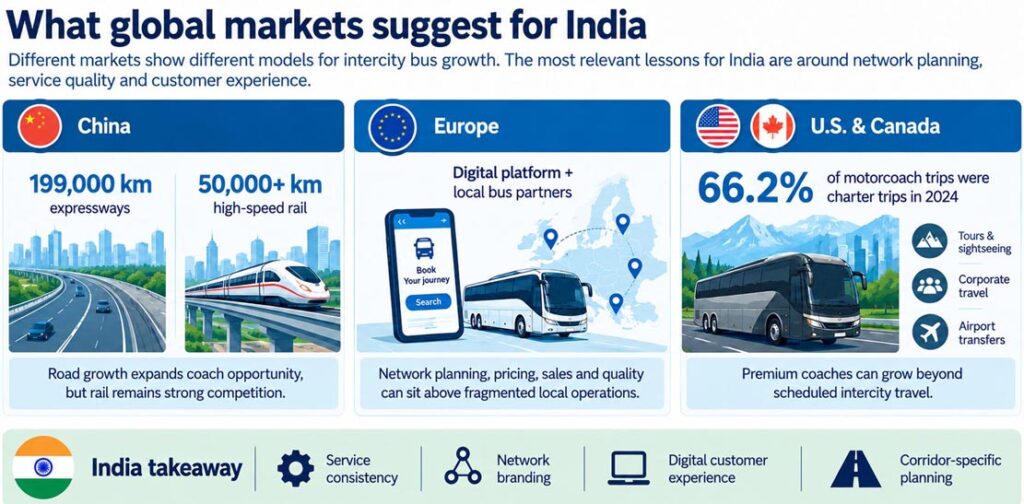
Note: The infographic highlights are selected examples to illustrate how different markets organize intercity and coach travel. Metrics are market-specific and are intended to show directional lessons for India, not direct like-for-like comparisons.
Electric intercity coaches are still at an early stage, but the operating model is beginning to take shape. NueGo, which operates around 300 intercity electric buses across more than 30 cities, now offers seater, semi-sleeper and sleeper configurations on selected routes. This shows that electric coaches are beginning to move beyond daytime seater services into longer and more comfort-oriented applications.
For now, electric coaches’ wider adoption will depend on whether operators can maintain high vehicle utilization while managing charging time and battery costs.
Conclusion
India’s intercity bus market is moving selectively towards better-managed and more comfortable travel rather than uniformly towards luxury. The strongest near-term opportunity lies in mid-premium AC sleeper and seater-sleeper coaches on busy intercity corridors, with premium state services and electric coaches expanding where demand, charging and utilization support the economics.
For operators, higher fares and occupancy must justify the added cost of the vehicle, financing, maintenance and downtime. Ultimately, the opportunity will depend on matching the right coach with the right route, operating model and passenger experience.
