Celebrating 130 years of truck invention, Daimler Truck sees its edge, in its journey towards Software Defined Vehicles (SDVs) with JV partner Volvo Group, not in the shared operating system itself, but in the functional layer built on top of it, the specific features and capabilities each manufacturer chooses to develop independently. This will become Daimler Truck’s distinct differentiator, its CEO, Ms. Karin Rådström, told this publication at IAA Transportation 2026. Coretura, its joint venture with Volvo Group, is moving from concept into reality, with the platform set to run in a truck by year-end, she indicated.
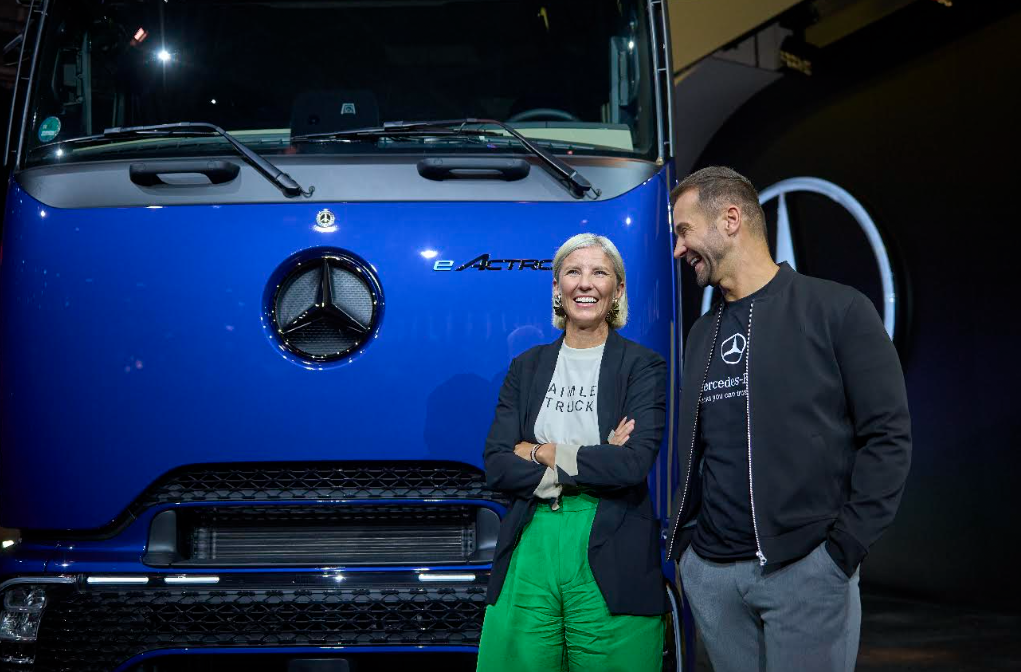
Addressing yet another evolution – Fuel Cells, she said, Cellcentric the JV with Volvo and Toyota, will reach commercial scale 2030 or beyond, not just because of its own progress, but because “building hydrogen refuelling infrastructure will ultimately determine when series production makes sense,” she said.
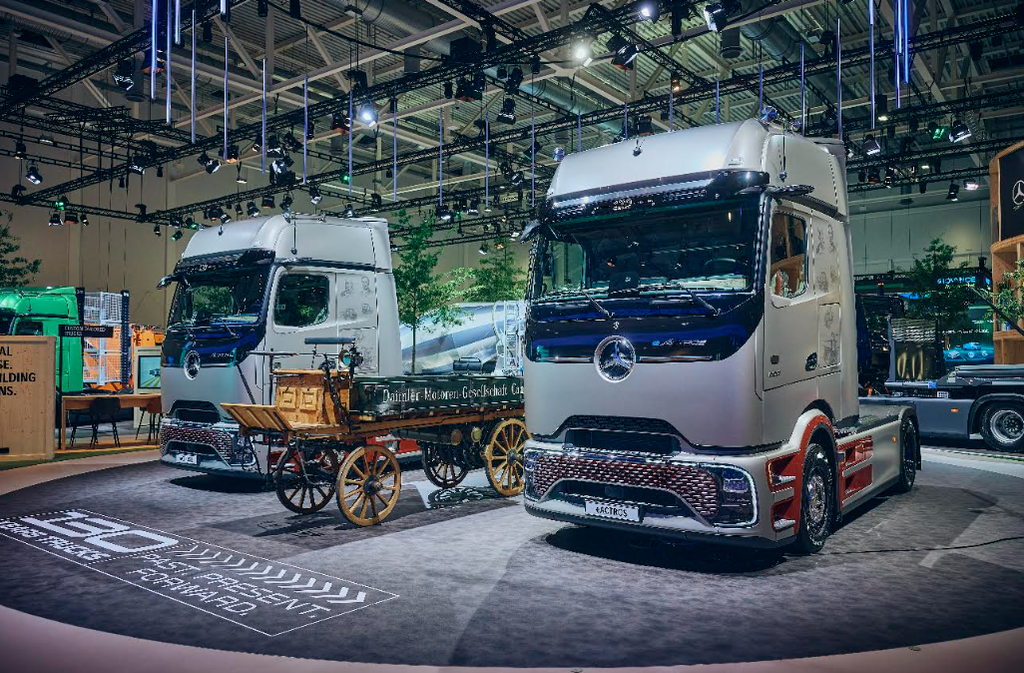
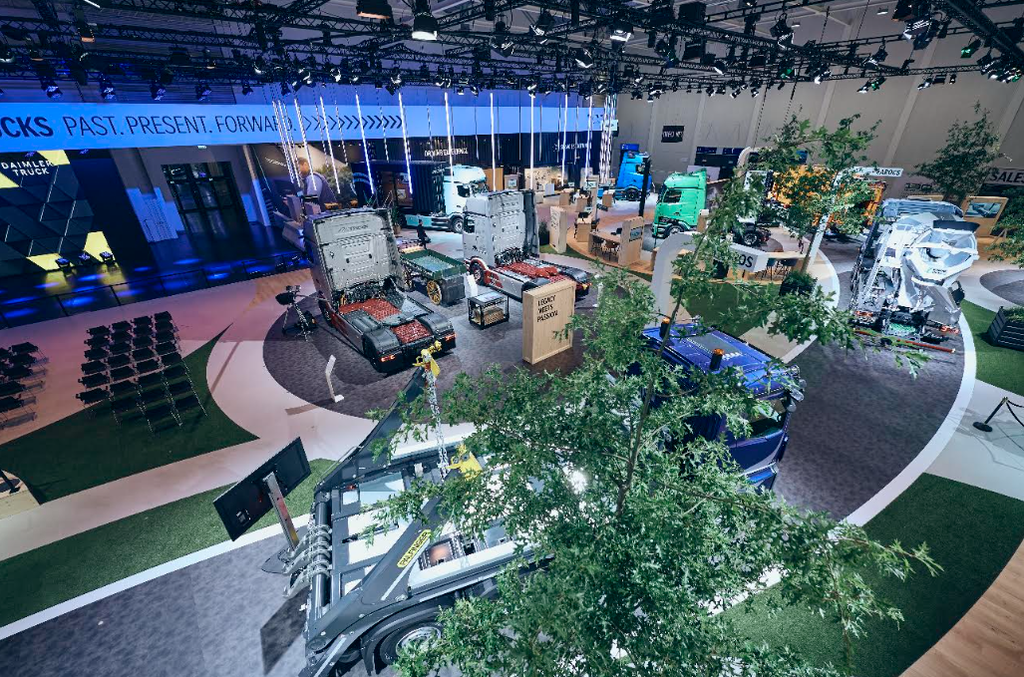
The anniversary celebrations also brought a host of announcements, including the new eActros Lowliner, new Active Cross Traffic Assist and Active Sideguard Assist 3 systems, and a streamlined Fleetboard digital platform.
The Genesis
The story traces back to 1896, when Gottlieb Daimler is credited with inventing the truck. For most of the 20th century, truck manufacturing was part of the broader Daimler-Benz (later DaimlerChrysler, then Daimler AG) automotive group, alongside Mercedes-Benz passenger cars. Daimler Truck as a standalone, independently listed company is relatively recent, it was spun off from Daimler AG (which kept the Mercedes-Benz car business) and listed separately on the stock exchange in December 2021. This made it one of the world’s largest pure-play commercial vehicle manufacturers, encompassing brands like Mercedes-Benz Trucks, Freightliner, Western Star, BharatBenz, FUSO, Rizon, Detroit Diesel Engines, Setra and Thomas Built Buses.
Speed of Right
Ms. Rådström also outlined the company’s execution priorities. Last year, the company updated its corporate strategy, ‘Stronger 2030,’ and now the focus is entirely on execution. One major move, she said, is that after more than 20 years as part of Daimler Truck, Mitsubishi Fuso has been merged with Hino Motors into a new company called ARCHION, bringing Daimler Truck a cash inflow of around €1.7 billion, with Daimler Truck and Toyota each holding a 25% stake as strategic shareholders.
Defence has also emerged as a key growth area, with the launch of a new global brand, Daimler Truck Defence. Built on the company’s scale as one of the world’s largest truck manufacturers, it gives customers access to a global portfolio, robust supply chains, and shared civilian technologies like autonomous vehicles. The Mercedes-Benz Zetros, already used by armed forces in countries including Canada, France, and Ukraine, showcases this strength, produced at a plant capable of building over 400 trucks a day, she mentioned.
In autonomous driving, subsidiary Torc is targeting a major “driver-out” milestone on US public roads before the end of 2026, paving the way for commercial freight trials in 2027 and scaling by 2028. In North America, Freightliner remains the clear market leader, holding 37% share in the heavy-duty Class 8 segment, with the new fifth-generation Cascadia delivering further fuel efficiency gains. Meanwhile, the new Detroit Gen 6 engine and the Mercedes-Benz Powerliner powertrain, both built on shared platforms, reflect its ability to scale innovation across its entire global portfolio, she added.
Global Reach, Electric Momentum
Elaborating on the successful evolution of the brand, Mr. Achim Puchert, CEO Mercedes-Benz Trucks said, at its core, this business isn’t really about trucks, it’s about the people who depend on them such as entrepreneurs, drivers, and customers who promise to deliver, every single day. That trust, is something it never takes for granted.
Once rooted mainly in Europe and Latin America, Mercedes-Benz Trucks is now a truly global business. Since last year, China and India, including the BharatBenz brand, have joined the fold. The company holds strong positions worldwide – number one in Turkey and Argentina, a strong second in Brazil, fourth in India since entering in 2012, and the clear European leader in heavy and medium-duty trucks, he elaborated.
Electric trucks are where the real momentum lies. The flagship Mercedes-Benz eActros 600 has already clocked over 160 million kilometres since production began in December 2024, he said, with customers reporting even better real-world range than the promised 500 km. Alongside it, the lighter eActros 400 offered higher payloads, which will be augmented by the newly unveiled eActros Lowliner. The purpose-built high-volume truck with an especially low chassis height, is ideal for automotive plant logistics. It offers 500 km of range, with megawatt charging arriving in late 2027 for an 80% charge in under 30 minutes. Orders open from September 15, with production starting Q2CY2027.
Recognising no single technology fits every use case, Mercedes-Benz is also pushing hydrogen power through its Gen H2 truck, already driven nearly 600,000 kilometres by customers, with a next-generation version entering customer operation with logistics firm DACHSER by late 2026.
Mr. Puchert said safety gets a boost too, with the new Active Cross Traffic Assist and Active Sideguard Assist 3 systems, designed to protect against collisions at intersections, arriving from 2027. Behind it all sits a strengthening service ecosystem: over 1,400 service locations, a fully operational global parts hub in Halberstadt, an expanding Truck Charge network targeting 3,000 charging points by 2030, and a streamlined Fleetboard digital platform, all built to keep customers’ trucks moving forward.
Voices from the Road
To understand how electric trucks perform in the real world, Mercedes-Benz Trucks turned to the people actually driving the transformation. First up was Mr. Stefan Behrendt, Managing Director of DACHSER Food Logistics, one of Europe’s leading logistics companies, who shared a numbers-driven view of decarbonisation. DACHSER aims to cut emissions from its own fleet by 42% by 2030, and already runs more than 200 battery-electric trucks, including over 160 eActros models, across 25 emission-free delivery zones in Europe. But scaling further, he said, is far harder for its transport partners, who run over 15,000 vehicles in toto. The biggest barriers, he explained, aren’t just upfront costs, but inconsistent toll policies across Europe and limited grid capacity, with many of the company’s branches capped at just 1-3 megawatts of power. “Depot charging works best today, but public and semi-public charging along Europe’s corridors, backed by stable, predictable pricing, are essential to scale further,” he said.
On hydrogen, DACHSER is the first customer for Mercedes-Benz’s next-generation GenH2 truck, which will need to deliver long range, fast refuelling, and strong reliability, running two shifts and covering 220,000 km a year at a demanding test site near Karlsruhe.
Then came a different kind of story from a professional truck driver, Mr. Tobias Wagner, known as the “Elektrotrucker,” who has already driven over 200,000 km across 22 European countries in battery-electric trucks. Inspired by Jules Verne’s “Around the World in 80 Days,” Mr. Wagner is embarking on a real-world test of his own: a year-long, 45,000 km journey across more than 30 countries in a Mercedes-Benz eActros 600, from Eastern Europe through Central Asia in freezing winter conditions, on to China, Australia, and finally down the Pan-American Highway to Patagonia. His goal is not only to set a record, but to learn how electric trucks perform far beyond Europe’s relatively advanced infrastructure, and to help shift the global conversation from “does this work?” to “how do we build the ecosystem to scale it?”