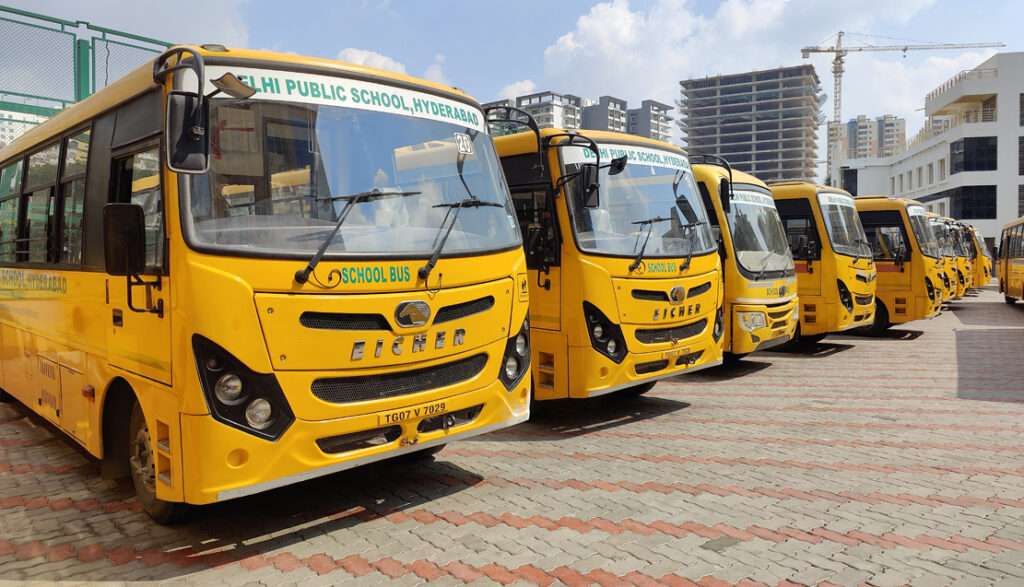
Delhi Public School, Khajaguda, runs a fleet of 80 buses, most of them Eicher, and has built a careful safety system around them.
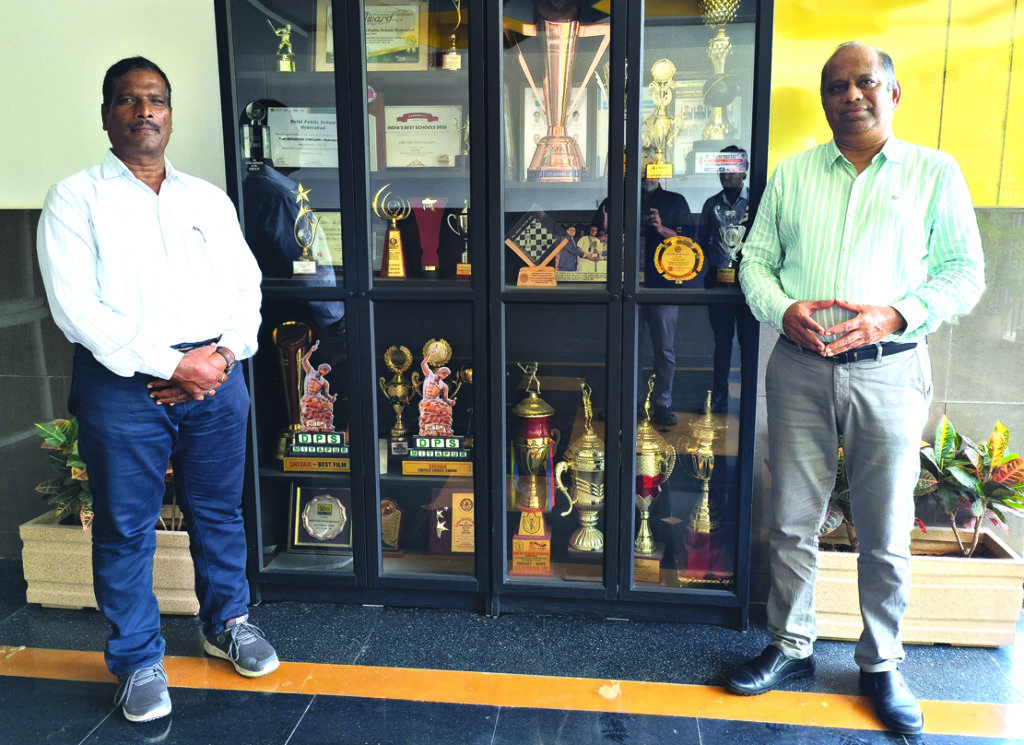
Delhi Public School, Khajaguda, in Hyderabad, is in its 25th year. Every school day, its fleet of 80 buses carries about 90% of its more than 4,000 students between home and classroom. Nearly all of these buses are Eicher, a partnership that goes back to the day the school opened in 2002.
“From day one we have been connected with Eicher,” said Mr. K. N. Rao, Manager – Transport Technical, DPS, Khajaguda. Only five to ten buses in the fleet come from other makers. The school’s second branch, with 60 to 65 buses, follows the same pattern, and about 95% of its fleet is Eicher too.
Why Eicher? For Mr. Rao, the answer is that service counters are close by, the team is easy to approach, and spare parts are easy to find in the market. Three Eicher service stations are within reach of the school. The nearest is about 12 to 15 km away, and the other two are roughly 20 and 25 km away. “They always give priority to school buses,” he said.
A School Parents Seek Out
The school started in 2002 and follows only the CBSE curriculum, from pre-nursery to Class 12. It sits on a six-acre campus with indoor and outdoor facilities, close to Hyderabad’s IT corridor and many gated communities.
Mr. Rama Rao Desai, General Manager, Administration, DPS Khajuguda, said the school’s real strength is its teachers. “Very few leave. We have seasoned teachers who have seen many batches,” he said. That stability helps the school keep up its quality and meet what parents expect.
Those expectations are changing. A new generation of parents, many of them Gen Z, want their children to learn by doing, not by memorising. Mr. Desai remembers his own school days, when weak marks in a language pulled down overall percentage of several students even though they did well in other subjects. Today, thanks to the National Education Policy and CBSE’s options, a child who struggles with mathematics can pick another subject. “The basic foundation is common. But as students move up, they can choose subjects that match their interests. The goal is to help children build on their strengths and become good citizens,” he said.
A Long Ride, Watched Closely
Some children travel a long way to reach this school. Buses once went as far as 50 to 55 km in one direction. The school has since cut the longest route to about 40 to 42 km. The shortest is about 4 km.
With so many children on the road for so long, safety is at the heart of the school’s transport plan. Picture a working couple in a Hyderabad office at 7.30 in the morning. Both are busy, and neither can see the school gate. Their phones tell them what they need to know.
Every student carries a smart identity card. When a child boards the bus, it is scanned by the bus attendant, and the parents get a message straight away. When the child gets off at school, they swipe again. The same happens on the way home. If a child does not board, the school’s IT team and teachers notice, and within 15 to 20 minutes of the bus reaching school, the parents are told their child was not on it. “So many parents are both working. They should not be confused about whether their child has boarded,” Mr. Rao said.
Every bus is tracked by GPS and has two CCTV cameras inside. About 95% of the bus attendants are women, a deliberate choice made with the girl students in mind. Every bus also carries at least one teacher. “Sometimes the students don’t listen to the attendant,” Mr. Rao said with a smile. “So the teacher makes up for it.”
Each bus has a first-aid box, two fire extinguishers (one in front and one at the back), a single-entry door and an emergency exit at the rear. All the buses at this branch are air-conditioned.
Keeping the Wheels Turning
A bus that breaks down on a 40 km route means late, worried children and anxious parents. To prevent that, the school has its own team of eight to 10 technicians. Every day they carry out preventive maintenance on at least 10 buses, checking things like AdBlue levels and cooling. Only problems they cannot fix go to the Eicher workshop. Regular servicing is done during school holidays, Mr. Rao explained.
Drivers and attendants get training several times a year. Some sessions cover the technical side and some cover how to run the bus. Newer BS-6 buses need AdBlue alongside diesel, and drivers must know that a bus will slow down if the AdBlue runs low.
The Carrom Board Balance
Running a school fleet means balancing four things: safety, comfort, technology and cost, a bit like the four pockets of a carrom board. Mr. Rao, who has 20 to 25 years of experience in school transport, said the first three are under control. Cost is the hard one. Diesel prices rise, and so does maintenance. The transport team and the school’s general manager meet every month or two to look at costs and decide what works best.
All the buses run on diesel, and there are no CNG buses. Electric buses are being discussed, but there is no firm plan yet, because the school would need charging stations first. “It is under process,” Mr. Rao said.
For now, as the school marks 25 years, its yellow buses keep rolling. Each morning thousands of phones light up across Hyderabad with the same quiet message, telling parents their child is on board