Cummins will start making batteries for commercial vehicles at its plant in Guadalajara, Spain, from 2028. The company announced the move at IAA Transportation 2026, saying it already has European bus makers lined up as customers.
Speaking to this publication, Ms. Amy Davis, VP & President, Accelera by Cummins and Components, said, “We’re making this investment because we see long-term opportunity in Europe and growing demand for commercial electric vehicle solutions.” She described the early bus orders as a sign that the decision is based on real customer demand. Once fully running, the plant will be able to meet growing demand across Europe.
The choice of Spain was a practical one. The company wanted a European base close to its customers in the region, and it already had a green energy plant in Guadalajara, built a few years ago for its hydrogen products. That gave it a ready investment to build on.
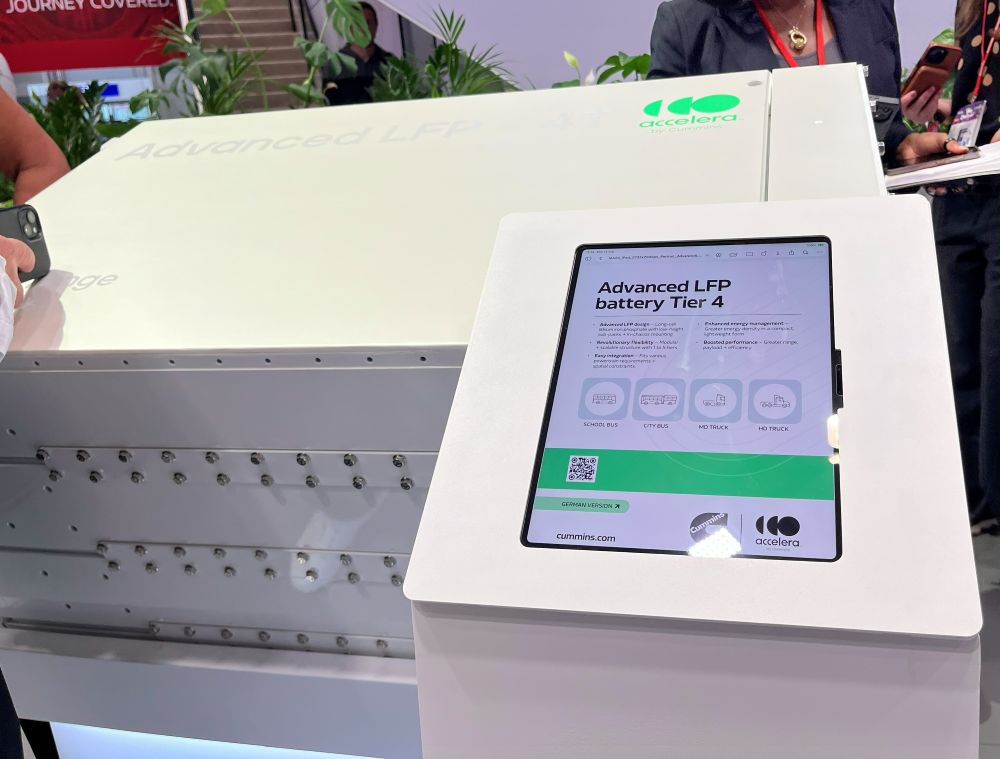
The plant will make advanced LFP (lithium iron phosphate) battery platform, designed from the start for buses and trucks. Ms. Davis explained why that matters. Commercial vehicles work much harder than passenger cars, with tough daily duty cycles, tight packaging needs and long working lives. Many electric options on the market, she said, are passenger car technology adapted for commercial use, and they don’t always last in demanding applications.
Dedicated Commercial Needs
Cummins has therefore built its battery around commercial needs. The design is modular, starting with a single-tier pack suited to low-floor city buses. Packs can be stacked into two, three or four tiers for larger buses and heavy-duty trucks, letting manufacturers choose how much energy each vehicle carries. Cummins estimates that its thermal management can extend battery life by up to 20% compared with traditional cooling. The packs are also designed to be serviced, which helps cut maintenance effort and running costs over the vehicle’s life, she explained.
Customisation is a big part of the business. Almost every sale today needs some tailoring, because each truck maker designs and electrifies its vehicles differently. “Our role as a partner is to try to use our flexibility and know-how to help make it easy for them,” Ms. Davis said. That role goes beyond batteries as the company is currently working on electric solutions with 16 OEMs across three continents, offering e-axles, motors and other driveline systems alongside its batteries, she mentioned.
Inside the Battery: Built Around the Cell
Cummins calls its chemistry “advanced LFP,” but there is a twist, Mr. Brian Wilson, Vice President & General Manager – eMobility, Accelera by Cummins, said. Explaining the unique technology, he said the cells are doped with manganese, making them LMFP (lithium manganese iron phosphate) batteries. Adding manganese raises energy density while keeping the long life that iron phosphate batteries are known for. That balance matters for trucks and buses, which need to carry a lot of energy for hard work and still last for many years. For now, he said, Cummins sees LMFP as the right chemistry for the job.
The shape of the cell is just as important. Cummins uses a long, thin prismatic cell, similar in shape to a blade cell. Once packaged, it fits neatly between the frame rails of North American trucks. Because the pack is so low, it can also sit under the floor of a city bus, which helps lower the vehicle’s centre of gravity.
Each pack in the family delivers about 102 to 104 kWh and runs at a nominal voltage of around 800 to 850 volts. Because every pack uses the same number of cells, the same chemistry and the same voltage, packs of different shapes can be mixed on the same vehicle. A truck maker could, for example, combine a long, flat pack with taller stacked ones to suit the space available, he highlighted.
The cell’s shape also explains its cooling advantage. Trucks and buses draw heavy current for long periods, so their batteries heat up more than those in passenger cars. Mr. Wilson said the benefit comes from the cell design rather than any new cooling technology. Its thin profile allows cooling plates on both the top and bottom, so heat is removed evenly through the whole cell. This keeps the cell from swelling as it heats and cools, and less swelling means a longer battery life.

The company also supplies its own battery management system, which Mr. Wilson sees as a key advantage. Because Cummins worked with its partners to develop a chemistry specifically for commercial vehicles, it has also written the software to get the most out of it. Extensive testing of its cells lets the company fine-tune how the battery tracks its health and charge level and how deeply it is discharged, all to make it last longer in tough commercial use.
Many Paths Forward
Batteries are only one part of Cummins’ plan. According to Mr. Maged Tadros, Executive Director, Global On-highway, Accelera by Cummins, the industry is being pulled in many directions at once. Regulations keep changing, new technologies keep arriving, and charging and fuelling infrastructure is growing at different speeds in different markets.
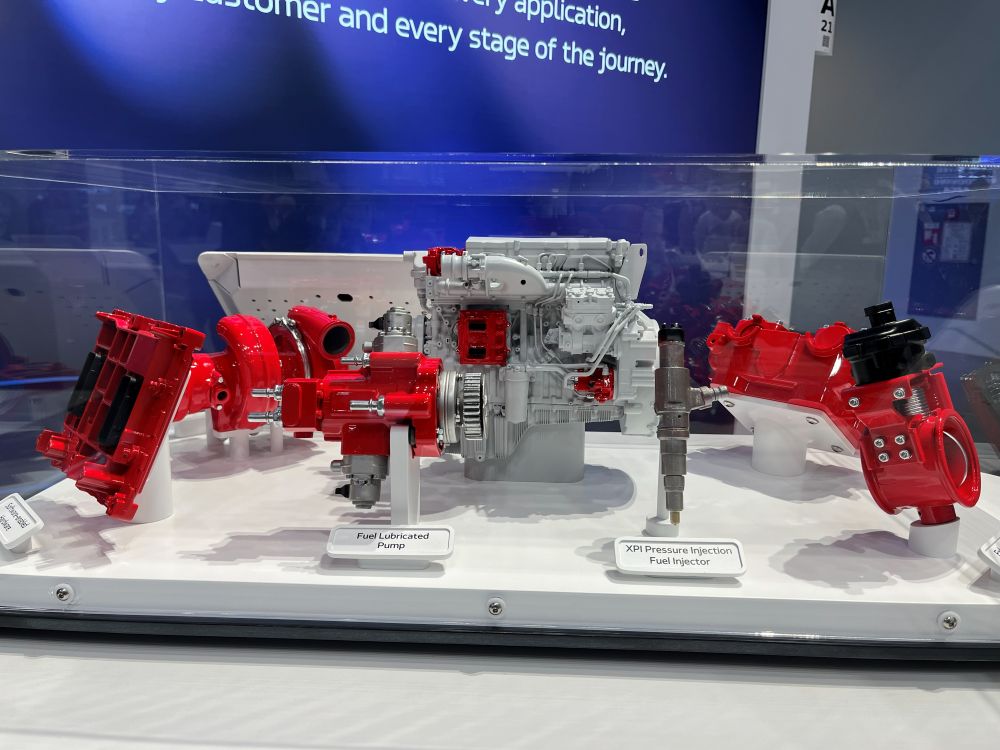
Mr. Tadros acknowledged that OEMs and fleet operators face a difficult question about which technology to back. Rather than steering them towards a single answer, Cummins offers a range of options so they can choose what fits their business. That thinking led to the HELM platforms. Short for Higher Efficiency, Lower emissions and Multiple fuels, it is a fuel-agnostic family of engines built to work with different fuels and technologies. Each fits into a package similar to what customers use today, but with more power, better efficiency and the ability to meet tough emission rules around the world. Some can also take hybrid systems or run on natural gas, so customers can move to cleaner technology at their own pace, he mentioned.
Cummins showed three examples at the show. The first is the new B7.2, an upgrade of the popular 6.7-litre B Series engine. It delivers 240 to 350 hp and up to 1,300 lb-ft of torque. Because it keeps a similar size and similar service points to the 6.7, truck makers can switch to it without major redesigns.
The second is the X10, an upgrade of Cummins’ 8.9-litre engine and its entry point into the heavy-duty market. Lighter and more compact than larger heavy-duty engines, it produces 440 hp and 2,300 Nm of torque. It meets diesel emission norms around the world, and Cummins demonstrated a hybrid version at the show for customers where that makes sense.
The third is the X15N, a natural gas engine shown in Europe for the first time. It fits in the same space as a 13-litre engine and delivers diesel-like performance, with up to 650 hp and 3,000 Nm of torque. It can run on natural gas or biomethane, depending on what is available locally. “Cummins has delivered more than 200,000 natural gas engines in North America, Latin America and Asia and we have about 13.4 million miles driven on them,” he mentioned. For fleets with access to renewable natural gas, the engine “makes a perfect business case,” cutting emissions while using fuel they already have.
Mr. Tadros said the company’s real strength lies in bringing all its technologies together. Its range spans fuel injection and after-treatment, axles and braking systems, electrification and connected technologies, backed by global manufacturing and a worldwide service network. Rather than selling a single engine, Cummins can work with customers and partners to build the right and complete powertrain for each job, he signed off.