Automotive, road transport and the operating system for Viksit Bharat
By Jinal Shah | Founder & CEO, Expandus® Consulting | Creator, OEintell™
India’s next commercial-vehicle cycle will not be a conventional volume upcycle. It will be a system reset. Real GDP is still expected to expand in the mid-6% range, road trucks carry roughly 70% of domestic freight demand, and the country’s manufacturing, construction, consumption and urbanisation engines all require more tonne-kilometres. Yet the old formula – more vehicles, more diesel and more road kilometres – cannot scale indefinitely.
By 2030, the industry will be judged less by how many vehicles it sells and more by how efficiently each vehicle converts energy, payload, driver time and capital into cash flow. That is why the operator’s buying logic matters more than any technology narrative.
“A fleet operator does not buy a powertrain. He buys uptime, payload, cost per kilometre, financeability, resale value and compliance readiness.”
MARKET STRUCTURE
Growth will be abundant; but it will not be uniform
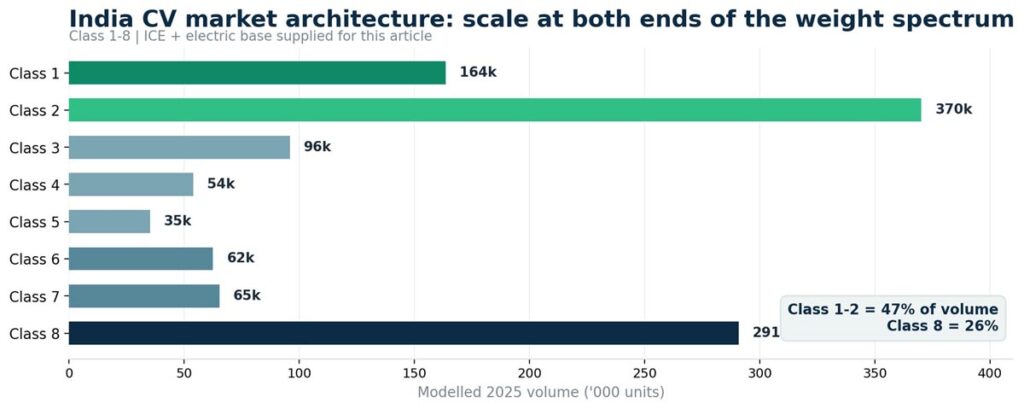
The industry is likely to produce 1.2-1.5 million vehicles for next decade. Nearly half sits in Class 1-2 small commercial vehicles and pickups, while Class 8 contributes about one-quarter. The market is therefore polarised between dense, price-sensitive urban and regional distribution at one end, and high-utilisation heavy freight at the other. The two ends will grow – and decarbonise – through very different economics.
Demand through 2030 will be supported by three overlapping engines: economic expansion, replacement and regulation-led renewal. Expandus<>OEintell estimates indicate that about 636,000 trucks and 168,000 buses already reach replacement age each year. Automated fitness testing and the voluntary vehicle-modernisation framework are turning fleet age and condition into a more visible replacement trigger; for private commercial vehicles, the regime is fitness-led rather than a blanket age-based retirement rule. As such, the volume over the next 5-7 years will be driven by replacement demand.

renewing fleets, localising technology and formalising lifecycle accountability.
POWERTRAIN TRANSITION
2030 is a portfolio market, not an EV-only market
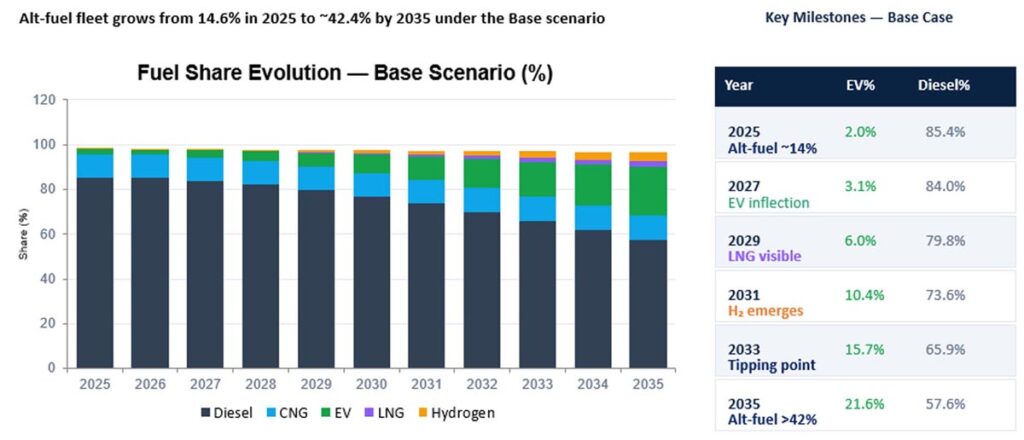
Under the Expandus base scenario, diesel’s share declines from 85.4% in 2025 to 76.9% in 2030. Electric rises from 2.0% to 22%, CNG remains around 10%, and LNG and hydrogen become visible but still targeted. This is a decisive shift and not a sudden displacement of diesel.
Electrification is a system redesign, not a powertrain swap. Content migrates towards e-axles, traction motors, inverters, BMS/VCU, high-voltage distribution, battery enclosures, thermal management and electrified auxiliaries. Route predictability, daily kilometres, payload and charging control determine where the economics work.
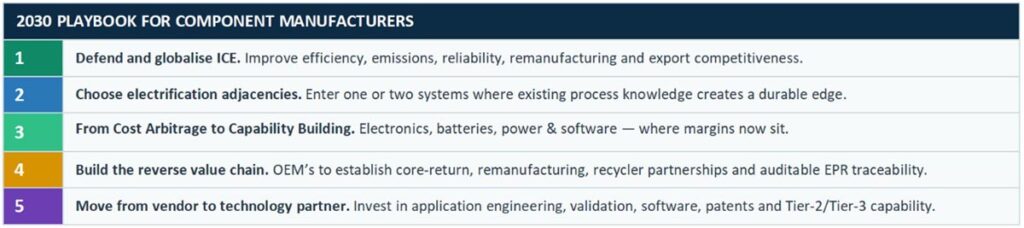
For component suppliers, ruggedisation is the product: heat, dust, vibration, water ingress, long duty cycles and roadside serviceability. The winning portfolio is ambidextrous – defend cleaner ICE and gas systems while owning one or two electric adjacencies where design, validation, software and field support create an edge.
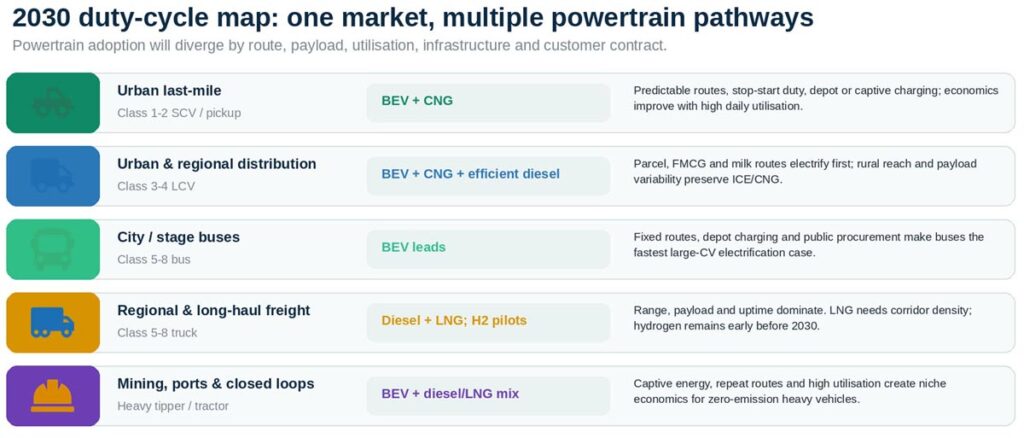
Application-wise, the inflection points are clear. E-commerce, FMCG, municipal and captive urban fleets will pull Class 1-4 electrification. City and stage buses will lead Classes 5-8. Construction, mining and ports will create closed-loop heavy-EV niches. Long-haul road freight will remain multi-fuel, with efficient diesel and LNG carrying the main commercial load while battery-electric and hydrogen prove themselves on defined routes. This divergence rewards modular platforms and application engineering: thermal systems, high-voltage safety, controls, lightweight structures and diagnostics can gain content even before EVs become a majority.

COMPONENT MANUFACTURER OPPORTUNITY
Component Value Migration: where the margin pool moves
Powertrain change is only the visible layer. The deeper shift is from hardware content to systems integration, software, lifecycle services and reverse supply chains. For component manufacturers, the opportunity is not one EV part; it is an ambidextrous portfolio spanning multiple duty cycles and four value pools.
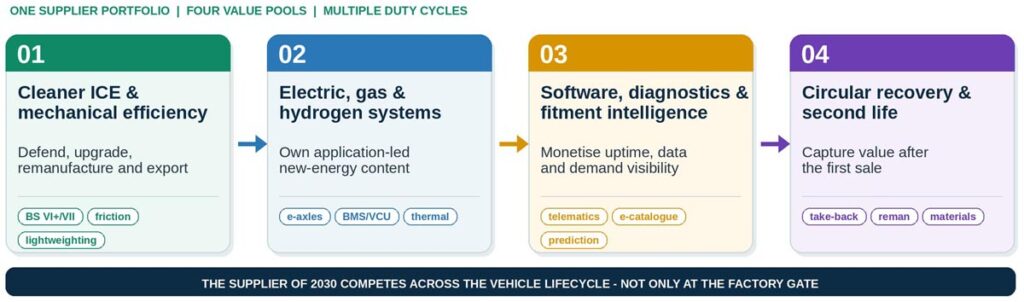
CIRCULAR ECONOMY | THE REVERSE SUPPLY CHAIN BECOMES A SECOND P&L
Battery EPR and end-of-life vehicle rules make take-back, traceability and authorised recovery strategic capabilities. Design for dismantling, core-return and remanufacturing can monetise the same engineering asset through OE supply, service replacement, remanufactured resale and recovered material. Batteries also require state-of-health diagnostics, grading and second-life pathways – not only recycling.
AFTERMARKET | FROM PARTS DISTRIBUTION TO UPTIME INTELLIGENCE
India’s mixed ICE, gas and electric parc will increase SKU and fitment complexity before it simplifies. The moat shifts from distribution reach to fitment accuracy, district/SKU demand visibility, diagnostics, technician support and first-time-right repair. The winning proposition becomes the right part, for the right vehicle, in the right district, at the right time.
ATMANIRBHAR 2.0 | FROM LOCAL CONTENT TO TECHNOLOGY SOVEREIGNTY
PLI can catalyse investment, but leadership requires ownership of design authority, validation, embedded software, tooling, materials and field data. Suppliers should choose adjacencies to existing capabilities – gears to e-axles, wiring to high-voltage harnesses, cooling to battery and fuel-cell thermal systems – and strengthen Tier-2/Tier-3 capability. India wins when it can design, manufacture, service, upgrade and recover the technology, not merely assemble it.
FROM STRATEGY TO EXECUTION
How Expandus and OEintell can support. Expandus converts macro shifts into component-specific decisions through custom market intelligence, duty-cycle and application forecasts, competitor and technology benchmarking, localisation opportunity maps and district-level demand estimation. OEintell adds India’s largest automotive e-catalogue and fitment intelligence layer, linking OE part numbers to vehicle applications. Together, they support opportunity sizing, aftermarket demand forecasting, inventory optimisation, catalogue standardisation, digital commerce and lifecycle intelligence.
About Jinal Shah. Jinal Shah is Founder & CEO of Expandus Consulting and creator of OEintell. Since founding Expandus in 2014, he has built a practitioner-led automotive intelligence practice spanning granular vehicle, product, application, competitor and aftermarket data – translating hard-to-find market information into growth, localisation and execution decisions.