Marking its 80th year, the Indian Machine Tool Manufacturers’ Association (IMTMA) organised the 20th National Productivity Summit in Coimbatore.
If India wants to become a self-reliant and a developed country, manufacturing has to lead the way as every developed economy grew through manufacturing, from the first industrial revolution to the fourth. So, people working in Indian factories today are in the right place, Mr. Sanjay Jayavarthanavelu, Chairman & Managing Director, LMW Ltd, has said.
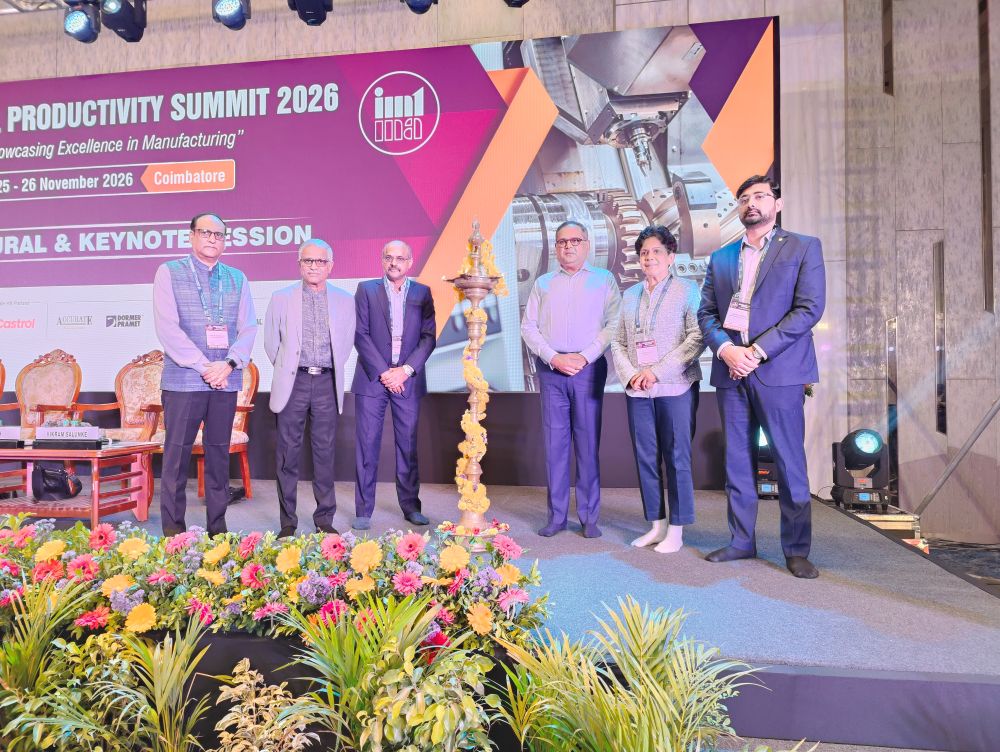
Delivering his address at the National Productivity Summit 2026 in Coimbatore, held on 25 -26 November, 2026, Mr. Jayavarthanavelu said, machine tool makers are now moving from metal into software. They offer connected machines, data and analytics. Automation companies are growing just as fast. They can help factories deal with a shortage of workers and even move towards “lights-out” factories that run without people. But he urged patience, as his friends in Japan told him their lights-out factories took about 30 years to build.
He also looked back at how Indian industry got here. After the economy opened up, Maruti helped train its suppliers and brought in strict just-in-time discipline. In the 1980s, groups like IMTMA and CII pushed quality programmes such as TPM and TQM. That gave Indian industry a strong base, and companies like Maruti, Hyundai and Toyota later chose to build large plants in India.
Peer Lessons, Productive Gains
Today, he said, almost every kind of technology exists, from spindles that spin at four lakh RPM to advanced multi-axis machines. But some of this technology is still not offered to India. He felt India is too big and important to be left out and must be given the respect it deserves.
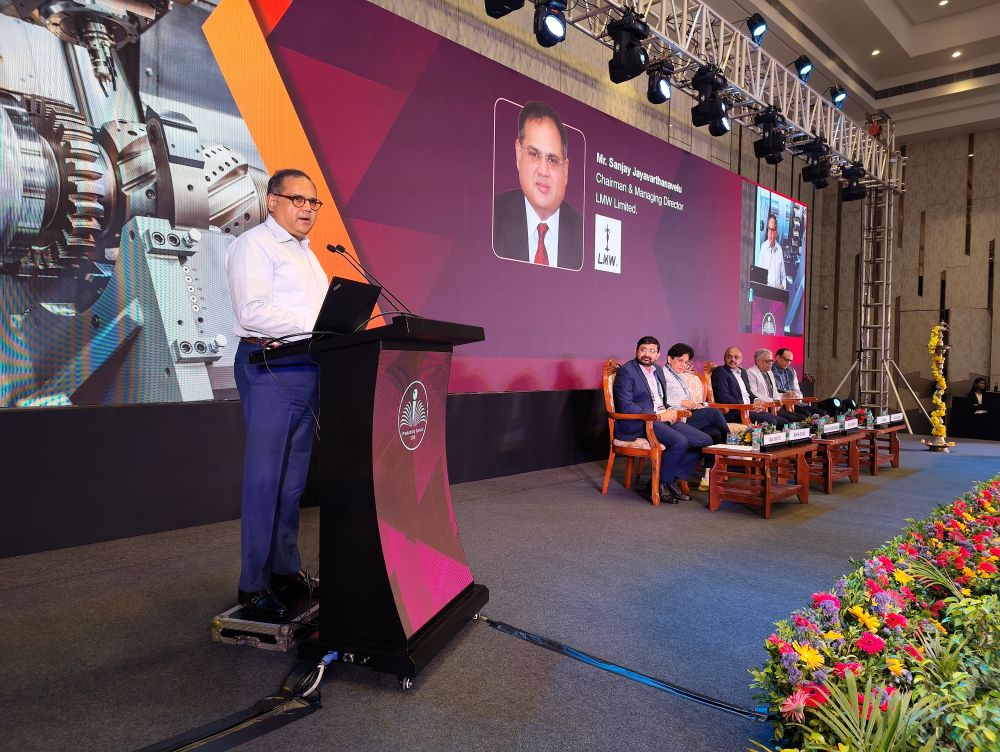
According to Mr. Jayavarthanavelu, three things matter most. First, each company should pick the technology it can actually absorb. Second, it needs a culture that welcomes new technology, “from chairman to watchman.” Third, it must be able to produce at scale. He added that innovation should not be left to machine builders. Every factory should improve its own processes and even create its own know-how.
He ended by praising Mr. Srinivasan Ravi, Chairman and Managing Director, Craftsman Automation Limited, a technocrat who builds his own automation and has grown his business steadily.
The case studies shared at events like National Productivity Summit are among the best ways for companies to learn from each other and stay motivated, he concluded.
The Old Machine That Still Shoots Straight
Mr. Ravi’s love for machines started in college. During a short training stint at LMW, he stood beside the machines for weeks and fell in love with them. In 1984 he started his own business with just two lathes. The first CNC machines he bought were also from LMW.
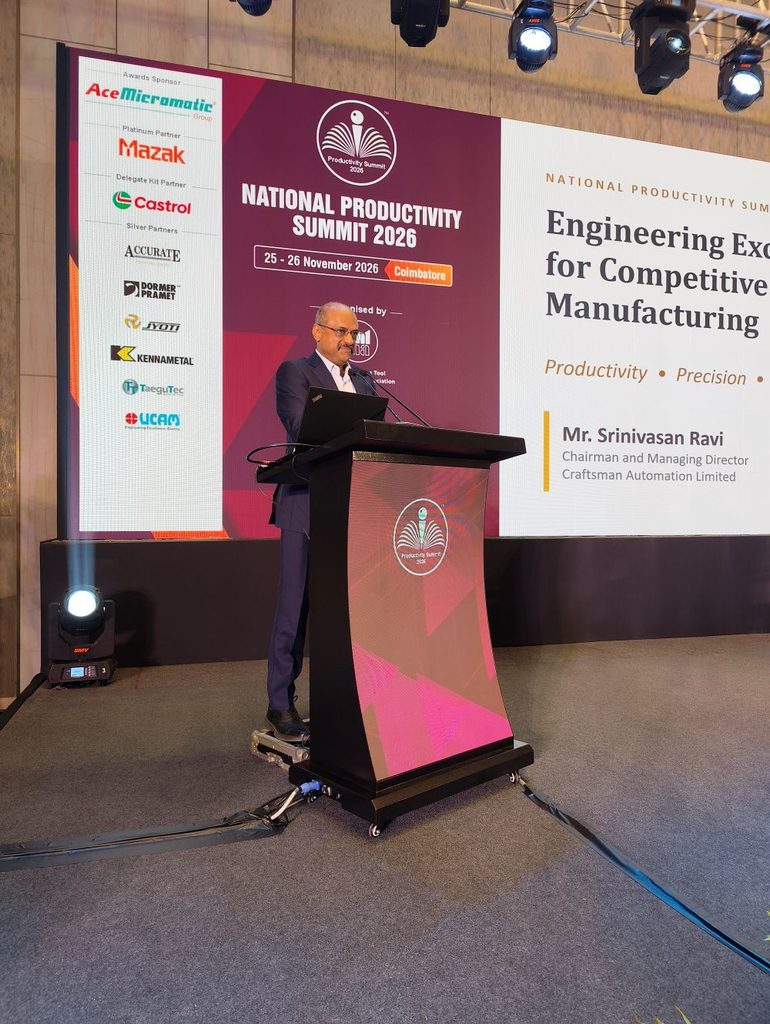
In 2019 he tried to take his company public. But investors and analysts did not understand the word “machining,” and the IPO did not happen. He is glad things have changed. Investors are now interested in manufacturing again, and he believes India cannot depend only on services.
His main message was in the importance of domain knowledge, which matters the most. He spoke of a surgeon who is now training robots to operate. The robot can learn only because the surgeon truly knows his craft. In the same way, AI cannot help a factory unless people first understand the basics, he highlighted.
Mr. Ravi explained that every machine has its place. Some jobs need an elephant’s power and others need a cheetah’s speed. He also shared small lessons from the shop floor. “If you make a drill twice as long, it bends eight times more. Even a tiny wobble in the spindle can wear out tools early. He worried that many operators now blindly trust measuring machines, when a skilled worker should be confident enough to question them. He concluded by stating that an old rifle can still shoot straight. It all depends on the person holding it.
Delivering his special address, Mr. T. K. Ramesh, Vice Chairman and Managing Director at Ace Designers Limited said, the summit was built for shop floor workers. These are the people who actually create value, and the summit gives them a place to share what they have learned, get recognised and help the whole industry grow.
He said manufacturing has finally started getting the respect it deserves over the last ten years. The best example is the auto industry. Indian two-wheelers, cars, trucks and tractors are now preferred around the world because the industry kept working on better tools and better ways of working.
Speaking at the event, Ms. Mohini Kelkar, President of IMTMA, mentioned that every car, train and aircraft begin with a machine that shapes metal. These are machine tools, and, calls them the “mother industry” of manufacturing.
India now ranks 9th in the world in making machine tools and 5th in using them. Most of the demand comes from car and auto parts makers, about half of it. Newer fields like electric vehicles, electronics, defence, aerospace and railways are growing fastest. According to her, spending more money is not enough. Real progress comes from good technology, skilled people and better ways of working. Productivity has to become a habit for everyone in a company.
Think Beyond the Machine
Delivering his keynote on the second day, Dr. M. Manickam, Chairman and Managing Director, Sakthi Auto Components Limited, said that his company runs more than 700 CNC machines in his factories. Only 10 to 20 of them are imported. The rest are made in India, which shows Indian machines are now good enough.
Quality, he said, is no longer the problem. The problems are delivery time and cost. Indian makers often take longer to deliver than foreign ones. Key parts like controls, drives, motors and guideways are still bought from abroad at a premium. Most of a machine’s value sits in these parts. He said India, which now makes iPhones and electronics, can surely make them too if companies come together. Simpler Indian controls could be about 20% cheaper.
He then pointed to a big opportunity. When he set up a factory in China around 15 years ago, workers earned about $2 an hour. Today they earn about $12, while India is at around $2.5. China makes about 50 million tonnes of castings a year, but by 2035 that could fall to 30 million. India could pick up the 20 million tonnes leaving China and double its foundry and machining industry in ten years. But only if it can deliver on quality and time, he highlighted.
Finding workers is another challenge. Young people prefer IT or delivery jobs to factory work. Tamil Nadu’s birth rate is falling and its population is ageing. So, automation is a must. He found an Indian robot for ₹10 lakh, a third of an imported one costs.
His message to machine makers is not to just sell machines. Team up with robotics and controls firms, offer complete automated solutions, and aim to export instead of worrying about foreign competition.
Mr. Jibak Dasgupta, Director General and CEO, IMTMA welcomed the gathering and Mr. Vikram Salunke, Vice President, IMTMA proposed a vote of thanks.
How the Winners are Chosen
IMTMA started the National Productivity Summit in 2006 to encourage real productivity gains on the shop floor, covering areas like supply chain, maintenance and safety. This year marks its 20th edition.
Mr. Guru Prasath, Executive Director, IMTMA, explained that the work starts six to ten months ahead. The apex body invites entries from machine tool makers and their users. These include automotive companies, non-automotive sectors such as construction, defence, aerospace and factory automation, and small and medium firms, which now have their own category.
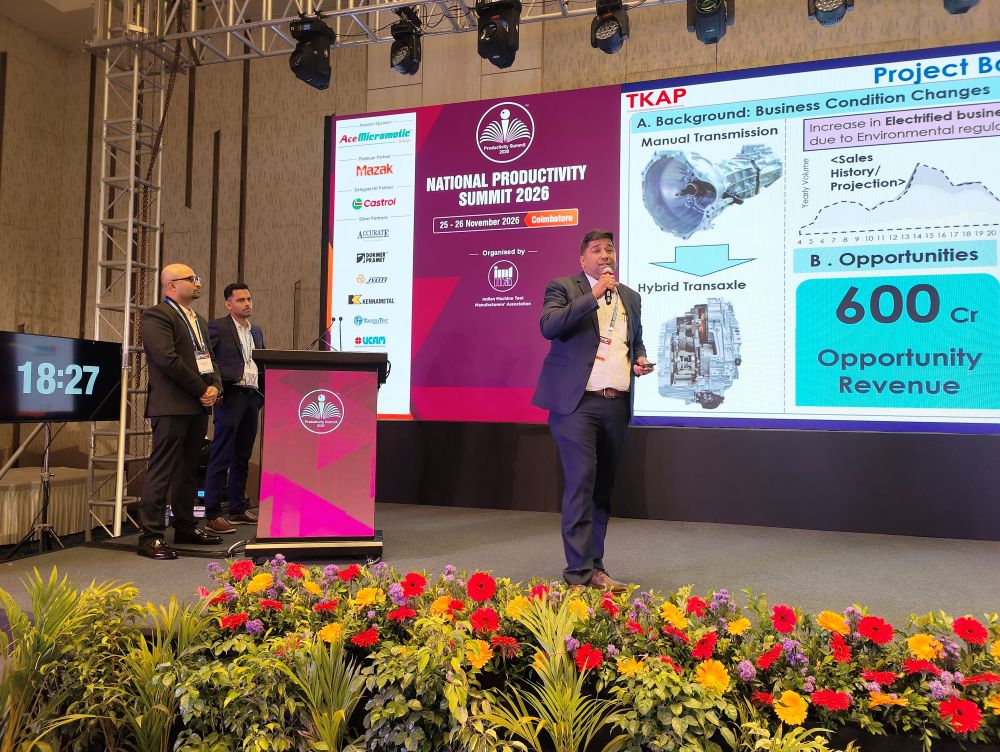
Every year, 150 to 200 case studies come in. The CII Institute of Quality narrows them to 70 and then to 36. The list is cut to 20, and the jury picks the final 12. Many companies treat anything they do as productivity, but the jury looks for measurable results like growth and return on investment.
The evening before the summit, finalists are briefed on what the jury expects. Each team gets 20 minutes to present and 10 minutes for questions. The written case study carries 40 marks and the presentation 60, with judges also looking at confidence and delivery.
Seven awards go to the top three automotive entries, the top three non-automotive entries and the best SME entry. Delegates vote for two People’s Choice awards, and the jury may add a Special Jury Award.
The prize money, from ₹50,000 to ₹1.5 lakh, goes to the people behind each project, not their companies. As he put it, each project is the team’s “brainchild.”
As part of 2026 edition of the Summit there were innovative case studies presented by 12 companies including Toyota Kirloskar Auto Parts, Titan Company, Sun Mobility, Kirloskar Oil Engines, Toyota Industries Engine India, Tata Electronics, Ather Energy and Ashok Leyland.
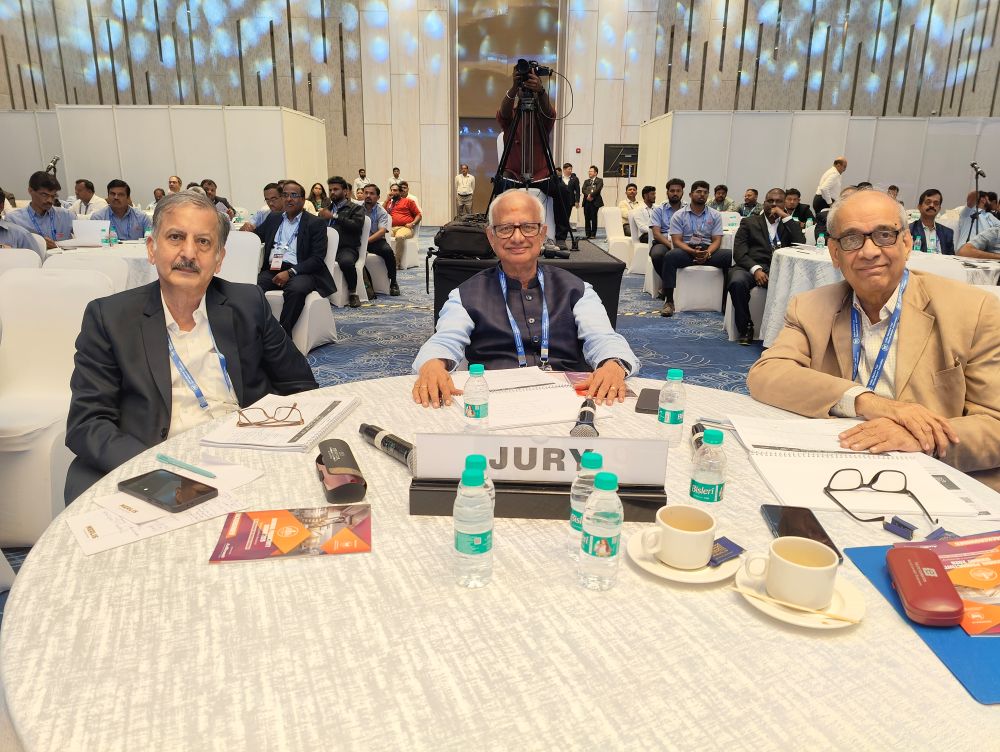
For this year, the juries were Dr. N Ravichandran, Chief Mentor – Ucal Fuel Systems, Advisor AU TVS CQM, Anna University and Premier Centre for Competency Training; Mr. Ashwin Shastri, Advisor (Chief Transformation Officer) Tata Autocomp System and Member of Tata Autocomp Hendrickson Board, and Mr. M. C. Ramakrishnan, Trained Business Excellence Assessor from CII on the EFQM model.
Awards
The highlight of the summit was the awards ceremony, which recognised companies that pushed manufacturing productivity forward over the past year. The automotive category went first. Toyota Kirloskar Auto Parts took the top prize, Ather Energy, the electric two-wheeler maker, came second, and Ashok Leyland finished third.
The non-automotive category had just as much variety. Aquasub Engineering won first place, ahead of Tata Electronics in second and Titan Company in third. These three companies make very different things, from pumps and motors to electronics to watches and jewellery. Still, the jury found that each one had made real gains in the way it runs its shop floor.
Smaller companies were also recognised. EVIG Integration Pvt. Ltd. received the SME Award, showing that mid-sized and smaller businesses can match bigger players on efficiency and innovation. The jury closed the ceremony with a special Jury Commendation Award for Advance Mechanical Services, praising its work in the field.
While the winners went home with trophies, the rest of the room left with a clearer idea of what excellent manufacturing looks like and plenty of reasons to aim higher in the future.