By Kollu Nandakumar, Director, Head of Hardware & Software Integration, Elektrobit
Middleware development for commercial vehicles presents a set of engineering challenges that are structurally different from those encountered in passenger vehicle programmes. The differences are not matters of degree, but of kind. Two forces define this distinction: the significantly longer operational lifecycles of commercial vehicle platforms, and the accelerating shift toward software-defined architectures driven by rapid electrification across vehicle categories. Together, these forces place demands on middleware platforms that require a fundamentally different design philosophy.

Lifecycle longevity changes every design assumption
In passenger vehicle development, middleware is designed within a known horizon. Platforms are refreshed on relatively predictable cycles, and the software stack evolves alongside hardware generations. Commercial vehicle platforms do not follow this pattern. A heavy-duty truck, a long-haul freight vehicle, or a transit bus may remain in active service for 15 years or more, and the underlying platform architecture may span an even longer production window. Fleet operators replace assets based on economics, not model cycles, and the same platform may serve multiple hardware generations across its production and operational life.

For middleware architects, this fundamentally changes how core design decisions are made. The basic software deployed on a commercial vehicle ECU must remain maintainable, certifiable, and supportable for many years. Communication architectures must be flexible enough to accommodate future hardware variants and evolving system requirements that may not be known at the time of the original design. Similarly, bootloaders, diagnostic services, and memory protection mechanisms must be engineered not only for current hardware, but also for the hardware generations that will emerge throughout the platform’s long operational life.
In commercial vehicle middleware, backward compatibility is not optional it is a basic requirement. Design choices, custom optimizations, or supplier-specific solutions made today can create long-term challenges because the software must be supported for many years. Since commercial vehicle platforms are not frequently replaced, any technical debt introduced now cannot be easily removed in the next generation. Therefore, middleware architecture must prioritize long-term maintainability, flexibility, and clean design from the start.
Fleet heterogeneity compounds the middleware challenge
Commercial vehicle middleware must function coherently across a wide and heterogeneous installed base. A single fleet operator may run vehicles built across multiple model years, with ECUs sourced from different Tier 1 suppliers, telematics hardware from different vendors, and region-specific variants carrying different communication and safety configurations. The middleware layer must present a consistent interface across this entire population.
This demands a discipline of hardware abstraction that goes beyond what passenger vehicle programmes typically require. The MCAL (Microcontroller Abstraction Layer) must be maintained across multiple silicon families and chip generations simultaneously. Diagnostic interfaces must remain consistent across variants so that workshop tooling and fleet management systems can operate without per-variant customisation. Any update to the middleware stack, whether a security patch, a diagnostic enhancement, or a protocol stack upgrade, must be validated across the full matrix of active hardware configurations in the fleet, not just the current production build.
The result is a significantly larger and more complex software variant management problem than passenger vehicle teams typically encounter. Middleware for commercial vehicles must be designed from the outset with configurability and modularity as first-class requirements, enabling selective deployment of functional components without fragmenting the core architecture.
Electrification accelerates the Software-Defined transition
The rapid electrification of commercial vehicles, encompassing electric buses, medium and heavy-duty trucks, and last-mile delivery fleets, is the most significant driver currently reshaping middleware requirements. Electric powertrains introduce new software domains: battery management system integration, energy optimisation algorithms, charging protocol interfaces, and real-time thermal management. These domains require deterministic, low-latency communication with existing vehicle systems, and the integration complexity scales with the number of domains that must coordinate in real time.
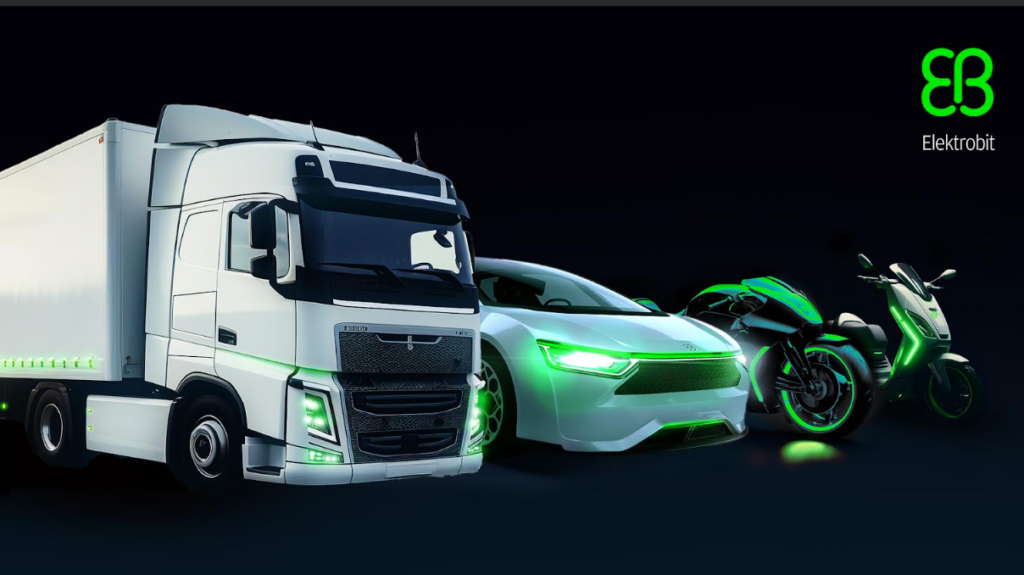
More broadly, electrification is a primary catalyst accelerating the commercial vehicle segments transition toward software-defined architectures. As propulsion systems become increasingly software-controlled and energy management evolves into an algorithm-driven function, centralized computing and domain-oriented E/E architectures become both economically and technically compelling. Modern middleware platforms, built on service-oriented communication principles, provide the foundation for these architectures by enabling dynamic software deployment, runtime service interaction, and Over-The-Air update capabilities required for software-defined vehicles.
However, this architectural transition does not eliminate the long lifecycle constraints typical of commercial vehicles; instead, it reshapes them. Service interface versioning, backward-compatible software management, and remote update frameworks must be designed from the outset for platforms expected to evolve over operational lifetimes exceeding fifteen years. The middleware platform must also scale across the full commercial vehicle spectrum from cost-optimized controllers in light-duty applications to high-performance compute platforms in premium freight systems, without requiring fundamental re-architecture at each level.
The demand for future-ready middleware platforms
What the commercial vehicle segment requires, and what the confluence of long lifecycles and software-defined electrification is making urgent, is a class of middleware platforms that are simultaneously durable and adaptable. Durable in the sense that they can be maintained, certified, and supported across operational timelines that passenger vehicle middleware is never asked to meet. Adaptable in the sense that they can absorb new hardware generations, new communication paradigms, and new functional domains without structural redesign.
Standardisation frameworks provide the interoperability foundation. Still, differentiation lies in the depth of application-specific optimisation, in middleware that is not merely compliant with the standard but engineered for the specific demands of commercial vehicle deployment at scale. As electrification continues to drive adoption of software-defined architecture across all vehicle categories, this combination of durability and scalability will determine which middleware platforms are genuinely fit for the commercial vehicle segment’s future.