Basic HTML Version


96
MOTORINDIA
l
March 2012
cash conversion cycle along with
poor credit availability can severely
impair their ability to carry on with
capex plans, which is imperative to
help suppliers weather the impact
of slowing auto sales through en-
hanced product offerings.
Key issues
The current macro-economic sce-
nario points toward slowing domes-
tic vehicle sales over the near term,
which could hamper the revenues
for auto suppliers. The 2008-09 eco-
nomic slowdown prompted these
companies to diversify their rev-
enue streams and segment exposure.
Though many auto suppliers started
targeting niche segments such as
off-road vehicles, farm equipments
and heavy machinery manufactures,
their contribution to the auto suppli-
ers’ revenue remains very low cur-
rently. As a result, auto suppliers
continue to rely on OEMs through
the supply of more components.
The developments over the last
year have also prompted a large
number of OEMs in India to step up
localisation of components which
are currently being imported. The
force majeure events in one area,
like the tsunami in Japan in early
2011 and the recent floods in Thai-
land have the potential for the dis-
ruption of the automotive supply
chain in some other area by affecting
the supply of critical components.
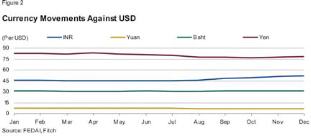
Besides, adverse currency move-
ments can affect the cash flows of
OEMs. A sudden and sharp depreci-
ation of the rupee has made imports
costlier and hurt OEM profitability,
more so in cases where such imports
are meant for domestic demand.
Fitch expects that increasing share
of local components in a vehicle
would keep the growth momentum
for domestic suppliers despite sub-
dued vehicle volumes.
Growing competition
International trade dynamics are
undergoing changes due to various
bilateral or regional trade agree-
ments, which call for closer co-oper-
ation between the
signatories. Such
agreements could
potentially affect
Indian auto sup-
pliers by increas-
ing competition
in international
geographies due to the higher duty
structure for them in comparison to
the preferred trade partners of im-
porting nations. As a result, Indian
auto suppliers could be compelled
to invest in increasing efficiencies
to counter the rising competition in
global markets.
The domestic auto component in-
dustry is likely to witness high com-
petition in the wake of such trade
agreements entered into by India
with its trading partners, particularly
in Asia. The domestic suppliers, so
far, are largely protected from im-
ports in the low value and low tech-
nology products due to higher duties
and other trade barriers, which these
pacts aim to eliminate over the me-
dium to long term.
The auto suppliers have to regu-
larly invest in improving operational
efficiencies, which are necessary to
remain competitive and to protect
operating margins. These are con-
stantly under pressure due to rising
input costs – all of
which cannot be
passed on to the
OEMs.
The
capacity
additions and ef-
ficiency improve-
ment initiatives
themselves require large invest-
ments for the auto suppliers, and
thus may limit their ability to pursue
opportunities for product expansion
which increasing localisation may
create. Many Indian auto suppliers
market outlook
Large-scale investments
by OEMs towards capacity
expansion and new model
launches entail invest-
ments for their auto sup-
pliers as well.