Basic HTML Version


MOTORINDIA
l
March 2012
69
normal steel by body builders, many
of whom are in the SME sector. Not
much attention is being paid by this
sector to standardize the body of ve-
hicles. In developed countries, use
of high strength steel (HSS) for CV
body building has been in vogue for
the last two decades, as it confers
huge advantages through incremen-
tal payload carrying ability, longer
body life and the consequent eco-
nomic advantages.
The history of HSS dates back to
the early 1960s. Such steel was pri-
marily meant for military applica-
tions. In order to obtain the required
mechanical properties for strength,
the steel was al-
loyed and hence
weldability took
a hit. The present-
day HSS still has
alloying elements,
but at much lower
levels, and uses
thermo-mechan-
ical process for
rolling. The temperature during the
rolling process is controlled to vest
the steel with its properties through
hardening and tempering. Hence
they are readily weldable.
In India, of late, the norms for
loading of CV up to their GVW
are being strictly adhered to. Hence
standardizing the CV body and use
of HSS for building them would
confer huge benefits to the truck
owners.
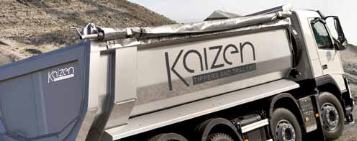
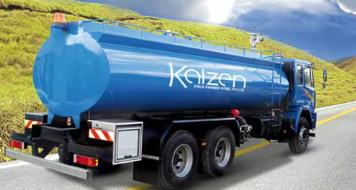
Kaizen CFS has started Kai-
zen Tippers and
Trailers in col-
laboration with
RACE, to work
on standardizing
the design of CV
bodies for various
applications us-
ing HSS. To start
with, they have
designed standard bodies for tip-
trailers, cargo and cement carriers
while work on models for other ap-
plications is being pursued.
Kaizen is also planning to imple-
ment a project in the near future to
manufacture ready-to-fit kits for CV
body parts made of HSS by using
the latest technology available in the
market. According to the company,
the CV body-building using normal
steel takes up to weeks to complete.
However, with ready-to-fit kits us-
ing standardized designs, the CV
body could be assembled in a few
days. CV body builders can thus
improve their turnout by many folds
by using such kits, thereby reaping
huge benefits.
Since HSS is costlier than nor-
mal steel, the cost of the CV body
would be higher by about 4 to 13 per
cent depending on the type of body.
However, the advantages that its use
confers far outweigh the incremen-
tal cost. It provides higher payload,
ranging from 4 to 8 per cent, result-
ing in proportional incremental rev-
enues of 4 to 8 per cent, with the
payback period for the incremental
investment being about one to two
months. Another important advan-
tage is 33 per cent longer life of the
CV body as compared to the use of
normal steel.
The company is confident that
with such quality products on of-
fer, it would establish a strong hold
in the Indian market in the coming
years.
w
Component zone
Kaizen is also planning to
implement a project in the
near future to manufacture
ready-to-fit kits for CV
body parts made of HSS by
using the latest technology
available in the market.