The 10th edition of the Commercial Vehicle Forum (CVF), presented by JK Tyre, held at Conrad Pune, marked a significant milestone for India’s commercial vehicle industry and, by every measure, was a resounding success. With over 500 delegates and 60 speakers coming together under one roof, the energy was palpable, the discussions were bold, and the vision was unmistakably forward-looking. CVF 2026 was not merely an event; it was a statement about the future direction of India’s road transport and commercial vehicle ecosystem.
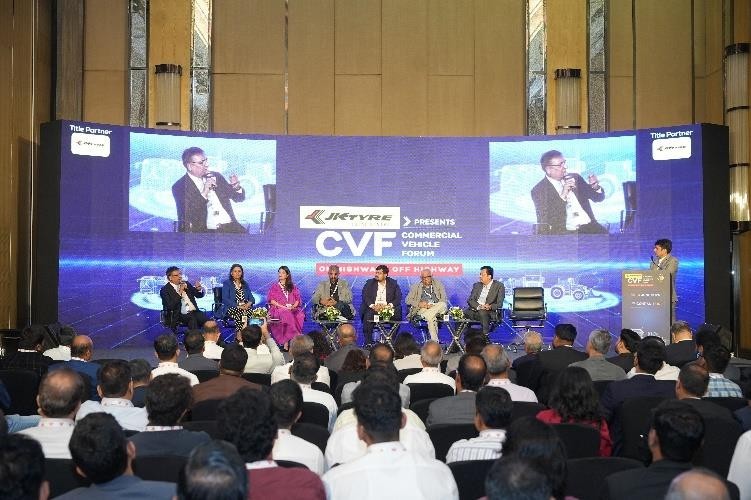
Setting the tone for the day, the forum opened with a compelling research presentation by Jinal Shah, Founder & CEO of Expandus Consulting, on India’s Freight Transformation Decade – Reimagining Commercial Mobility for Viksit Bharat. Shah painted an ambitious picture of India’s economic trajectory, projecting GDP growth from $4 trillion to nearly $30 trillion, urbanisation rising from 37% to 65%, and citing NITI Aayog estimates that 70% of the country’s infrastructure is yet to be built. He highlighted that heavy commercial vehicles, while accounting for only a quarter of industry volumes, carry 83% of India’s freight. He also noted that replacement demand is now outpacing fresh capacity expansion and projected that alternate fuels could grow from roughly 15% of the market today to 42% over the next decade.
Delivering the Chairman’s Address on accelerating India’s transition to green and digital commercial mobility, Aniruddha Kulkarni, Vice President & Head – Engineering, Tata Motors, outlined four key pillars for the decade ahead: decarbonisation, safety, software-defined vehicles, and value creation. Noting that commercial vehicles account for over 40% of global road transport emissions, he reaffirmed Tata Motors’ commitment to achieving net zero by 2045. He also pointed to over-the-air software updates—now numbering in the hundreds per vehicle—as evidence that the era of the software-defined truck has already arrived.
Sanjeev Sharma of JK Tyre, the forum’s title partner, highlighted the company’s series of industry-first innovations, including India’s first EV-specific tyre, a cashless AI-assisted roadside puncture service now serving 25,000 trucks, trailers and buses, and a free Fleet Connect platform for transporters. He described the industry’s transition towards a “tyre-as-a-service” model, noting that over 90% of India’s top 100 transport companies now pay per kilometre rather than purchasing tyres outright. This shift is supported by nearly two lakh RFID-enabled smart tyres operating across the country’s highways and JK Tyre’s 70% share of the EV bus tyre segment.
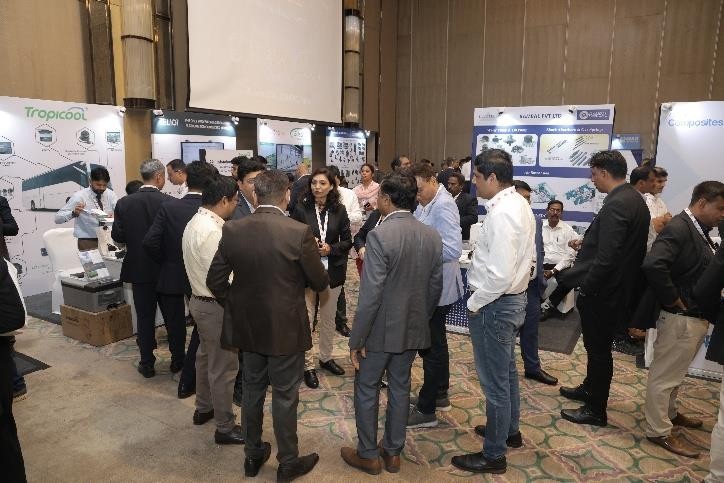
During the panel discussion on the next decade of the industry, Daimler Trucks Asia’s Rajiv Chaturvedi cautioned that India’s ambitions can only be realised if infrastructure and industry readiness keep pace with the rapid influx of new technologies and data. The subsequent powertrain discussion focused on the realities of a multi-fuel future. Volvo Trucks’ Vinayak Thalange urged the industry to move beyond conventional total cost of ownership and instead focus on “vehicle lifetime productivity”, observing that hydrogen still lags diesel in terms of cost, safety and scalability. ARAI’s Dr. S.S. Thipse described India’s hydrogen regulatory framework as a “regulatory soup” spread across multiple ministries, while the Bureau of Indian Standards noted that it has already published more than 50 hydrogen-related Indian standards, several of which are harmonised with global ISO benchmarks.
The safety and emissions panel featured a candid discussion, with panellists challenging the industry to demonstrate that expensive safety features such as panic buttons and fire suppression systems genuinely reduce risk. They also advocated India-specific real-world emissions testing ahead of the BS VII transition. Volvo’s Dr. Sanjoy Biswas added that driver training remains a critical gap, as warning systems are often switched off rather than understood. On data and connected fleets, Daimler Truck Innovation Center India’s Lakshmi Rao noted that technology developed at its Bengaluru centre is now deployed in Daimler trucks worldwide. Meanwhile, Volvo Group’s Rwittick Kumar pointed to Europe’s new Data Act, which mandates OEMs to share repair data with third parties, as a potential model for India.
The case study sessions showcased several noteworthy innovations. LightMetrics presented its Zero False Positive video safety platform, currently deployed on more than 160,000 vehicles globally and designed to meet India’s upcoming AIS mandate for advanced driver assistance systems. Hindustan Petroleum highlighted its Bazaar Lubricants franchise network comprising 25,000 retail outlets, while Bharat Petroleum discussed its ₹1.7 lakh crore five-year capital expenditure plan and its newly commissioned hydrogen fuelling station at Kochi Airport. Schaltbau India also presented the advantages of air-insulated DC switchgear over gas-insulated alternatives for electric vehicle battery systems.
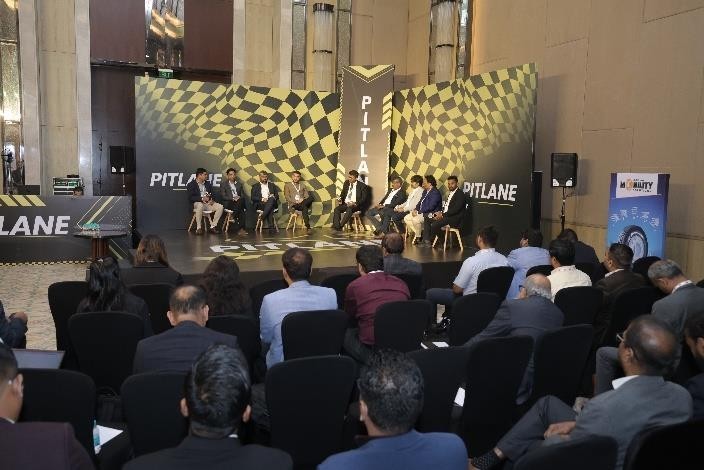
At The Pitlane, panellists observed that trailers now account for 25–30% of heavy commercial vehicle volumes, compared to just 10–15% a few years ago. Suppliers, including ZF Commercial Vehicle Solutions, reported that telematics-driven uptime improvements can deliver returns on safety investments within six months. Discussing electric vehicle adoption, representatives from Piaggio Vehicles and Olectra Greentech agreed that electric three-wheelers have already crossed the total cost of ownership threshold, achieving approximately 30% market penetration. Government-backed city bus tenders have also helped electric buses capture around 25% of that segment, although adoption among private and school bus operators remains close to zero.
A separate supply chain discussion featuring representatives from Mahindra’s SML Mahindra business, Ford Motor Company, Cummins and Volvo Group revealed that conventional ICE vehicles have achieved localisation levels of around 90%, with the remaining gap primarily involving electronics sourced from China and Germany. Panellists added that EV localisation could realistically reach around 80%, excluding battery cells.
The day concluded with the Commercial Vehicle & Fleet Awards 2026, recognising excellence across the commercial vehicle and road transport ecosystem.
Award Winners
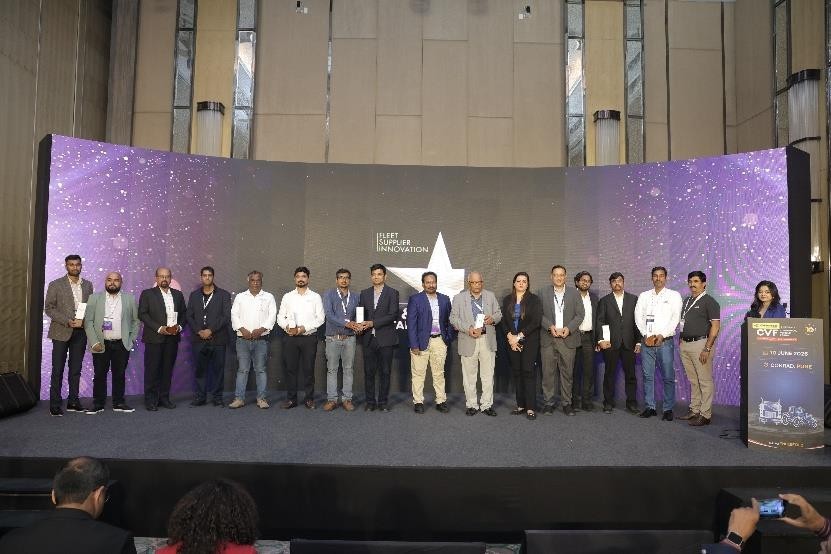
• CVF Most Admired Auto Supplier for CV – SPAL
• CVF Most Admired Alternative Fuel Fleet Trailblazer of the Year – Blue Energy Motors
• CVF Most Admired Operational Efficiency Star of the Year – Allcargo Gati Limited
• CVF Most Admired Pioneer in Software Solutions for CV – ZF Commercial Vehicle Solutions
• CVF Most Admired Connected Technology for CV – LightMetrics
• CVF Most Admired Telematics Solution of the Year – Accolade Electronics
• CVF Most Admired Leading Private Fleet of the Year – Chetak Logistics
• CVF Most Admired Company “In It for the Long Haul” – Let’s Transport
As the industry moves towards a future defined by sustainability, digitalisation, connectivity and intelligent mobility, CVF 2026 once again demonstrated the importance of collaboration among OEMs, fleet operators, suppliers, technology providers and policymakers. The landmark 10th edition not only celebrated the industry’s achievements but also reinforced the shared vision shaping the future of commercial vehicles in India.