With AI, vehicles won’t just run; they’ll adapt, anticipate and amplify, marking the dawn of truly intelligent mobility.
At the recently concluded Automotive AI Summit, organised by the Technology Division of CII, Dr. Kanakasabapathi Subramanian, Sr. Vice President – Product Development, Ashok Leyland, compared the rise of automotive AI to the transformation of the old feature-phone into today’s smartphone. Just as phones evolved far beyond calling and texting, he believed that AI in vehicles “will grow into something much bigger than the limited ideas we hold today,” he said. But he insists on one guiding rule: AI must be built around what customers truly need, not simply because the technology exists.
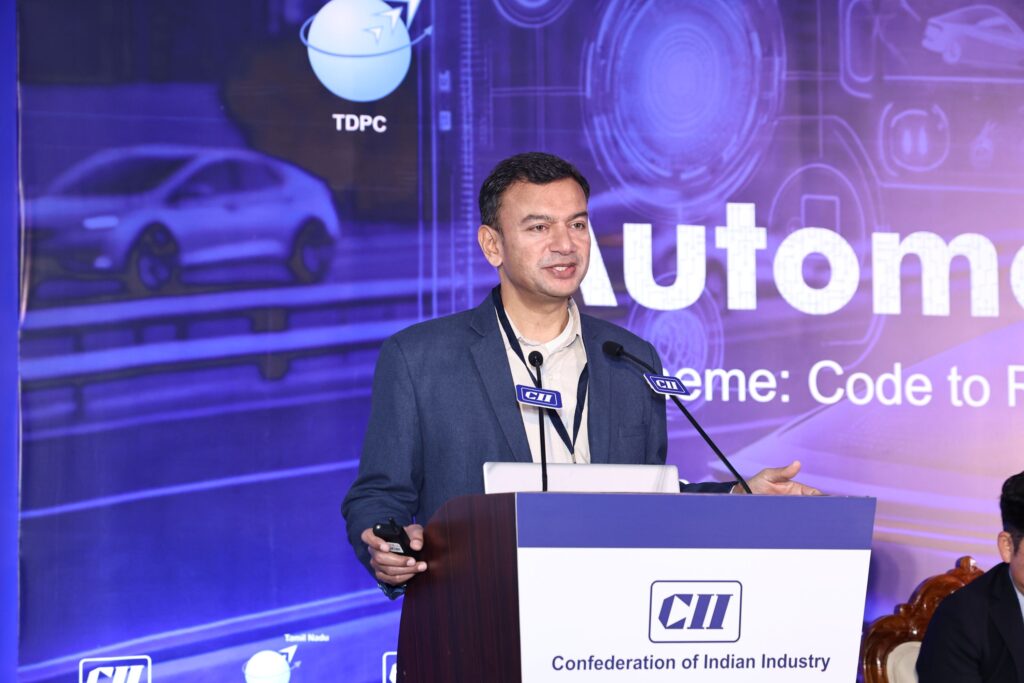
To explain this, he used a monsoon analogy. India may build canals and waterways, he said, but unless water is intelligently predicted, stored and released, the system won’t work. Similarly, cars today already have the connectivity and sensors; what they lack is intelligent allocation and decision-making. That is where AI steps in, he pointed out.
Traffic Management
One of the biggest opportunities lies in traffic management. If vehicles share their real-time movement data, AI can analyse intent on a city-wide scale and reassign routes dynamically. This would reduce stops, smoothen flow, cut idling and create cleaner, faster urban mobility.
AI can also help conventional engines go greener. Since fuel burn depends more on how often a vehicle brakes and accelerates than on distance, AI-powered systems that coordinate ADAS, V2V and V2X could someday guide drivers through “low-brake” or “no-brake” routes. Even small improvements here can make a huge difference in fuel savings and emissions, he observed.
Vehicle maintenance is another area ready for change. Instead of simple error codes or mechanics guessing from sound, AI can analyse engine noise through microphones, understand symptoms, and diagnose problems with the accuracy of an expert. It can even predict failures—like a clutch or 12V battery—before they happen, reducing breakdowns and downtime. Over-the-air updates can keep improving these systems through real-world data.
Strategic Design Partner
Looking ahead, he sees AI becoming a true design partner. By absorbing decades of engineering knowledge, AI can help create entirely new concepts—like flexible, dent-proof body materials or modular skateboard platforms where different bodies can be swapped to create buses, trucks or personalised cabin layouts.
At the heart of this future is the software-defined vehicle (SDVs). Dr Subramanian compared it to a newborn child: the hardware is the body, but the personality grows over time through software. Cars will launch with a strong physical base, then evolve constantly as OEMs, startups and universities add new apps and intelligence. No two vehicles will have the same “personality, he mentioned.
In his vision, AI will not just change cars—it will reshape how they move, how they are built, how they are maintained and how they learn. It marks the beginning of cars that adapt, think and grow with the people who drive them.