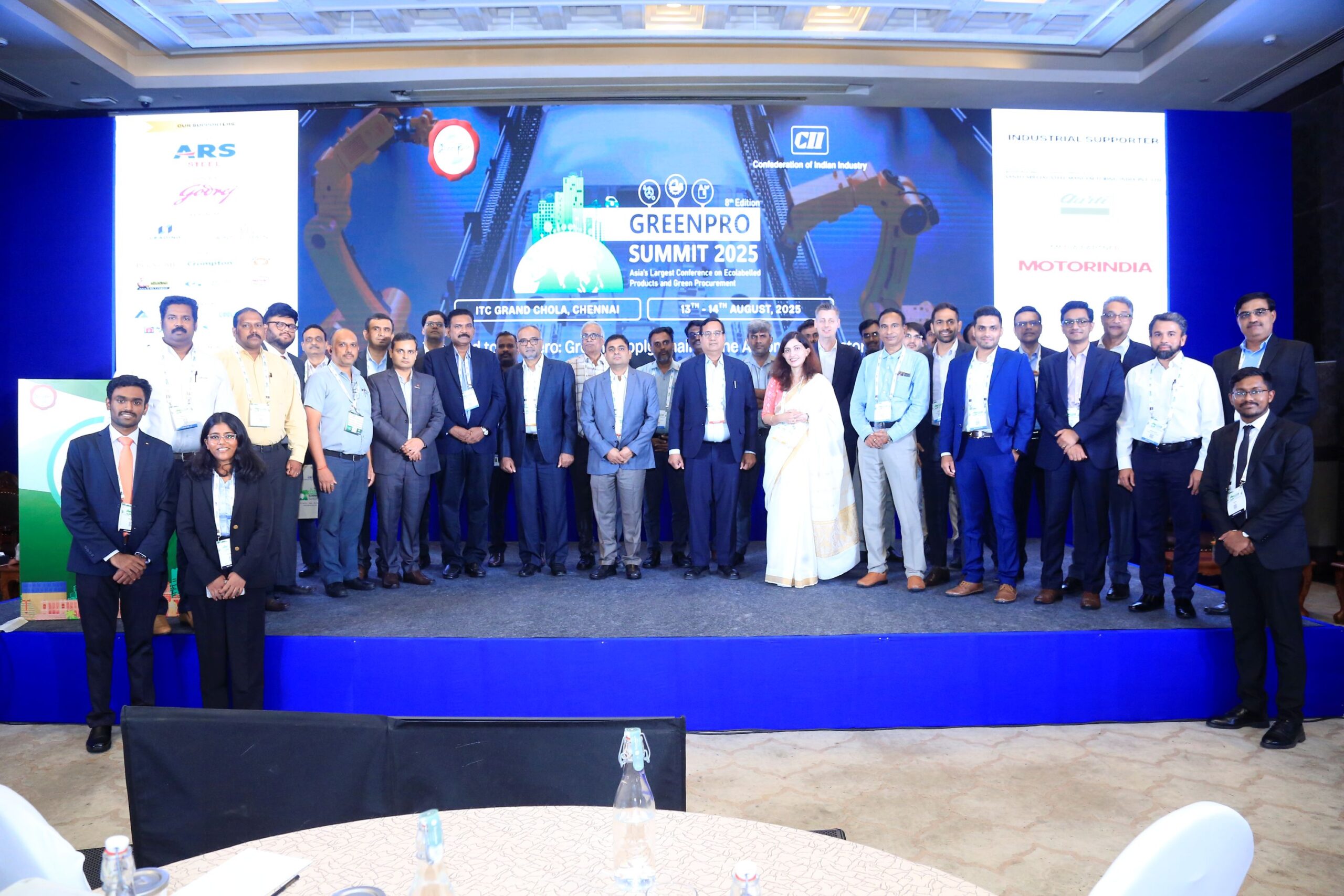
The GreenPro Summit 2025, held on 13 August at ITC Grand Chola, Chennai, opened with a strong focus on advancing the automotive sector’s transition towards net zero. Themed “The Road to Net Zero: Green Supply Chain in the Automotive Sector,” the summit served as a platform for senior industry leaders, sustainability practitioners, and technology providers to deliberate on strategies for embedding sustainability across the automotive value chain.
As a major contributor to global greenhouse gas emissions, the automotive industry faces increasing pressure to decarbonize not only its manufacturing processes but also its extensive supply chains, which account for over 85% of total emissions. With OEMs committing to achieve net zero by 2050, the need for greater transparency, accountability, and measurable action has become critical. In this context, the Confederation of Indian Industry (CII) has introduced GreenPro, a Type-1 Ecolabel, to enable manufacturers to monitor and reduce the carbon footprint of vehicles and components. This ecolabelling framework acts as a strategic tool to drive sustainable practices, advance net zero objectives, and guide stakeholders in making environmentally responsible purchasing decisions.
Discussions at the summit highlighted the pivotal role of Life Cycle Assessments (LCA), ecolabelling, and standardized sustainability practices in advancing decarbonization efforts. Leading automotive manufacturers and suppliers shared practical insights and case studies on green manufacturing, process optimization, and sustainable component design, while addressing both opportunities and operational challenges associated with transitioning to a low-carbon future.
Sessions further explored strategies for scaling green steel production, implementing energy-efficient manufacturing practices, and optimizing material use in automotive components and equipment manufacturing. In addition, the summit showcased the role of technology and digital platforms in driving sustainability, with presentations on AI-based carbon emissions measurement tools and guidance on ESG and BRSR reporting frameworks, reinforcing the growing importance of robust data systems and regulatory compliance.
The summit concluded with a clear call for industry-wide commitment to embed sustainability principles into every aspect of design, manufacturing, and supply chain operations, emphasizing leadership’s critical role in shaping a long-term transformation roadmap for a sustainable automotive ecosystem.