The Department of Automobile Engineering at the Faculty of Engineering and Technology, SRM Institute of Science and Technology (SRMIST), Kattankulathur, in collaboration with BAJA SAEINDIA, organised a two-day national workshop on H-BAJA (Hydrogen BAJA) on 13 and 14 December 2025. The event brought together more than 250 students from across the country, offering an immersive learning platform focused on hydrogen-based mobility and emerging sustainable fuel technologies.
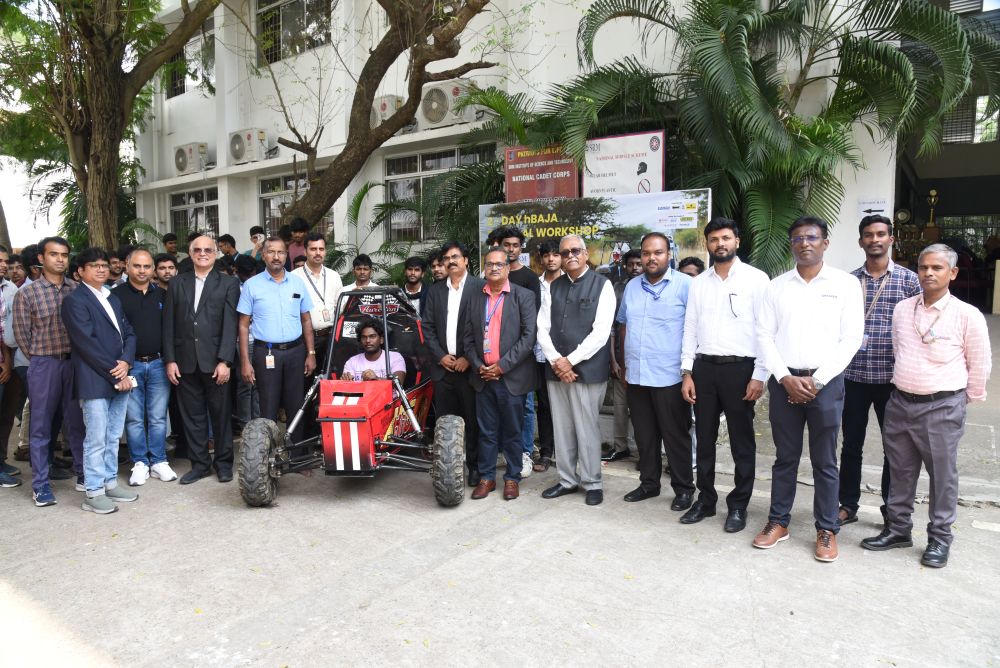
The workshop delivered intensive, highly informative sessions on hCNG (hydrogen-enriched compressed natural gas), a fuel gaining momentum in India’s shift towards cleaner transportation. Through expert-led discussions, participants were introduced to alternative fuel systems, safety requirements, integrated vehicle design approaches, and the technical expectations of the H-BAJA category.
BAJA SAEINDIA, one of India’s most influential student engineering platforms, continues to inspire young talent to conceptualise, design, build, and validate all-terrain vehicles using real-world engineering methods. The workshop has been structured to strengthen student preparedness for the BAJA SAEINDIA 2026 Physical Round, scheduled for January 2026.
The inauguration ceremony saw participation from senior leaders in the automotive and academic communities. Chief Guest Dr. Anand Lakshmanan, Senior Project Advisor, Centre of Excellence for Advanced Automotive Research (CAAR), highlighted the industry’s ongoing transition towards electric and alternative fuels. “Reducing dependence on fossil fuels is essential for sustainable mobility, and India is increasingly focusing on hydrogen-based solutions. To realise this potential, we need strong R&D capabilities and skilled engineers, and platforms like BAJA SAEINDIA along with institutions such as CAAR play a vital role in bridging academic research with industry-ready technologies,” he said.
Dr. Subramani Sellamani, General Manager, Renault Nissan Technology & Business Centre India (RNTBCI), underscored the role of industry in supporting innovation-driven learning and urged future engineers to stay aligned with sustainability goals and emerging technologies. He noted that BAJA SAEINDIA, which began in 2007 with just 27 teams, has now grown to four categories including H-BAJA—a reflection of the platform’s evolution and the increasing enthusiasm of student teams.
Organising Committee Chairman Mr. S. Balraj shared his pride in the platform’s journey, remarking on how BAJA SAEINDIA has transformed over 19 years into one of India’s most influential avenues for nurturing mobility engineers.
Welcoming participants, Dr. K. Kamalakannan, Professor and Head of the Department of Automobile Engineering at SRMIST, reaffirmed the institution’s commitment to supporting initiatives that blend academic depth with practical, hands-on learning.
The workshop schedule includes technical sessions by experts from Greaves Cotton, Atul Auto, and Renault Nissan Technology & Business Centre India (RNTBCI). These sessions are providing students with valuable industry perspectives on powertrain technologies, alternative fuels, system integration, and real-world engineering challenges, greatly enhancing the relevance and depth of the H-BAJA programme.
With hydrogen mobility gaining global attention, SRMIST’s workshop marks a timely effort to equip India’s future engineers with the skills and knowledge needed to contribute to the next wave of clean, efficient, and advanced automotive technologies.