In a major step toward strengthening road safety and professionalising the transport ecosystem, the Indian Institute of Technology Madras (IIT Madras) has signed an MoU with Daimler India Commercial Vehicles (DICV) to develop India’s first-of-its-kind Commercial Driver Rating System. This initiative aims to become a national benchmark for driver assessment, insurance validation, and background verification, forming the foundation for a digital public infrastructure dedicated to commercial mobility.
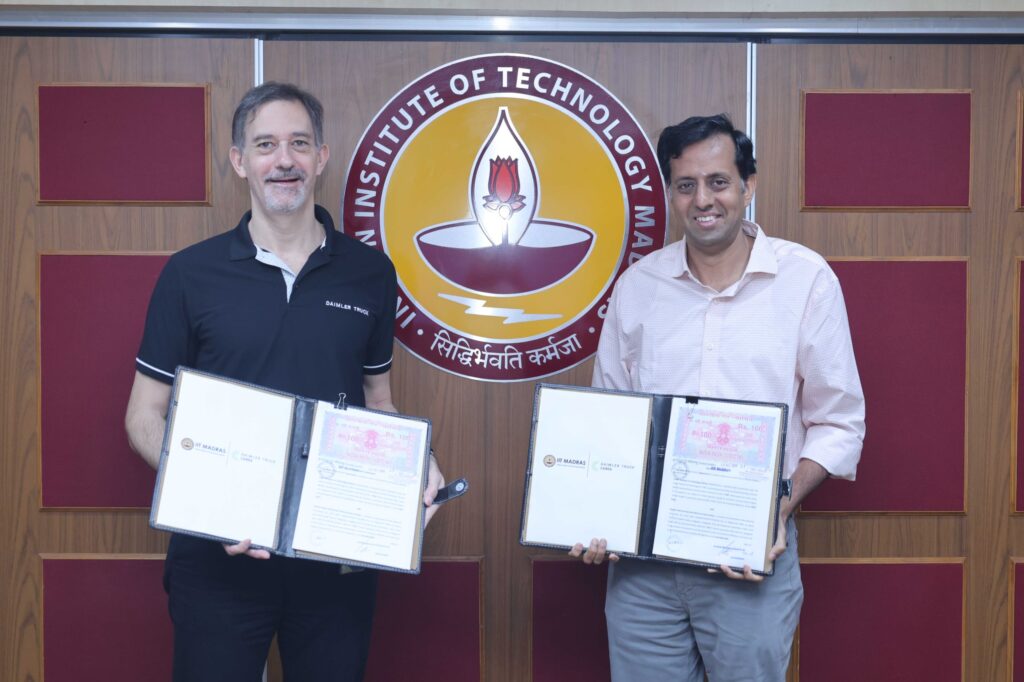
The need for such a system has grown urgent as monitoring driver performance, safety behaviour and well-being has become increasingly challenging. With fragmented regulations and weak enforcement, the commercial driving sector often struggles with inconsistent standards and limited accountability.
Project Coordinator Prof. Gitakrishnan Ramadurai of IIT Madras said the initiative would finally give India’s commercial drivers the recognition they deserve. “Trucks and truck drivers are the backbone of our country. This project provides them an Aadhaar for their good work. The system rewards safe driving and helps correct risky behaviour, saving lives, money and time for all stakeholders.”
The collaboration will leverage smartphone-based data and sensor technology to build an advanced, scalable and transparent rating mechanism that addresses long-standing gaps in monitoring and safety.
Highlighting the importance of academic–industry collaborations in national mobility reforms, Prof. Ashwin Mahalingam, Dean of Alumni and Corporate Relations, IIT Madras, said the institute has consistently worked to improve outcomes for drivers and commuters. “Our partnership with Daimler reflects a shared commitment to converting research into impactful, ready-to-deploy solutions that improve road safety at scale.”
From the industry side, Mr. Alexander Schoen, Chief Financial Officer, DICV, said the partnership is a natural extension of the company’s commitment to responsible mobility. “This collaboration aligns with our sustainability goals by using technology and data-driven innovation to enhance driver safety, professionalism and well-being across the commercial transport ecosystem.”
A universal driver rating system promises wide-ranging benefits — helping drivers build stronger career profiles, enabling fleet operators to monitor driver behaviour in real time, assisting shippers with dependable delivery timelines, supporting training institutes in certifying drivers, and giving policymakers data-backed insights to improve road safety.