Built around three core product lines—rotary joints, rotary actuators, and electric slip rings—the company sees these as the foundation for almost limitless growth.
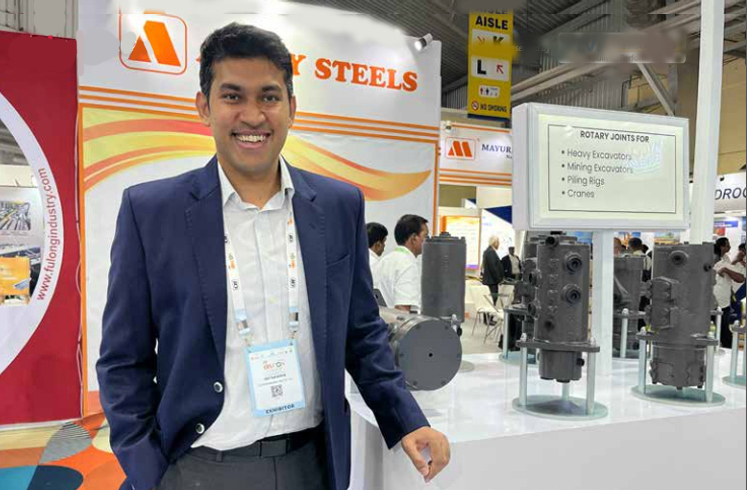
From its modest manufacturing base in Bengaluru, HYCOM Engineering has grown into a trusted supplier for global OEMs across construction, mining, material handling, and defence—and is now quietly preparing for its next big leap. The precision engineering company, known for its expertise in hydraulic components and its growing focus on electrical solutions, is planning a new, large manufacturing facility about 70 km from Bengaluru, near the Narsapur industrial belt in Karnataka.
Speaking to this publication, Mr. Sarat Ram Mudium, Executive Director, HYCOM Engineering, said, construction is expected to begin in 2027, with operations likely to start by 2028. The project will involve an investment of ₹100 crore. Once ready, the new plant will become HYCOM’s sole manufacturing hub, with all machinery and operations moving from its current Peenya facility. The shift is driven by one clear objective – scale. For the company, growth in the coming years will depend on expanding capacity, sharpening focus, and serving both domestic and global markets from a single, world-class base.
Core Products
HYCOM designs and manufactures precision motion and control components, including rotary joints, hydraulic rotary actuators, and electrical slip rings for demanding applications. Together, these offer what the company believes is almost unlimited growth potential. Large parts of the Indian market remain untapped, while global demand is steadily opening up despite current geopolitical uncertainties, he observed. The company is confident that global markets will stabilise, creating fresh opportunities for suppliers who can deliver global-quality components at competitive prices. This is where the new facility will support catering to the emerging opportunities, he said.
Globally Benchmarked Components
India, Mr. Mudium believes, offers a strong advantage—skilled labour, cost efficiency, and the ability to adopt semi-automation smartly. The company’s ambition is to make not “Indian quality” parts, but globally benchmarked components, made in India and competitive anywhere in the world.
Capacity expansion is already mapped out through a five-to-seven-year plan. At present, HYCOM can produce around 50,000 rotary joints, 18,000 rotary actuators, and 12,000 slip rings annually. Over the next five to six years, this is expected to grow sharply—to about 200,000 rotary joints, 50,000 actuators, and up to 150,000 slip rings, he said.
The company’s journey began in the construction and mining sectors, but it has since expanded into aerial work platforms, cranes, shipping, marine applications, and more. From Bengaluru, it already supplies customers across the globe and even operates a warehouse in the U.S. for one of its customers. Events like EXCON are helping it explore deeper domestic penetration and wider international reach. The company works with some of the biggest OEMs in the industry. Often, relationships built in India lead to global opportunities, he mentioned.
On the product front, HYCOM’s rotary joints have steadily evolved. What started with solutions for 20-tonne excavators has expanded both downward and upward—from mini excavators as small as 0.8 tonnes to machines weighing 55–60 tonnes. The same approach applies to aerial work platforms, where HYCOM supports boom lifts ranging from 45 ft to 135 ft, and even high-flow crane applications.

A major highlight at EXCON was the showcase of electric slip rings, a new product that marks HYCOM’s entry into electrification. Initially developed to support sensors and electrical systems on hydraulic equipment, slip rings are now finding wide applications—from wind energy systems, where they transmit power from rotating turbine blades, to surveillance cameras requiring continuous 360-degree rotation.
The company is also seeing strong potential in the EV charging ecosystem, particularly in automated cable retraction systems. Here, electric slip rings allow uninterrupted power flow between rotating and stationary parts, preventing cable damage and improving reliability, he explained.
Looking ahead, the company plans to stay sharply focused on its three core product lines. The goal is not just to supply parts, but to partner with customers, helping them improve machine design, performance, and reliability. With scale, specialisation, and electrification at the centre of its strategy, HYCOM is steadily positioning itself as a global player—built in India, ready for the world.