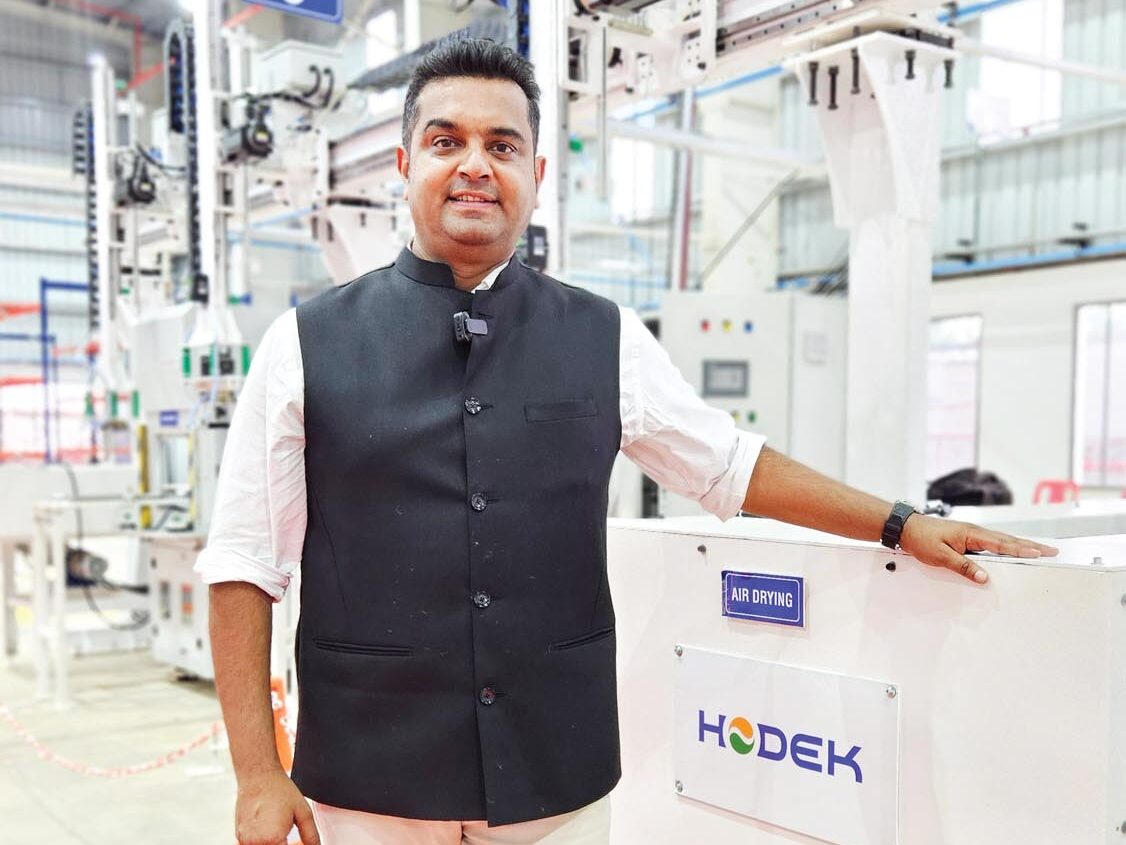
Hodek Vibration Technologies is charting a bold new course with the launch of its third manufacturing facility in Dharwad, Karnataka; an expansion that combines automation, scale, and a forward-looking vision to meet the evolving needs of the mobility industry. At the heart of this transformation is Abhijeet Khanvilkar, Executive Director, who spoke candidly to Rajesh Rajgor at the facility launch.
With the automotive world rapidly transitioning, Hodek’s new plant reflects its commitment to staying ahead of the curve. “We’ve been making dampers for the last 45 plus years, and while we’re experts in the conventional way, the world has moved on. We must move ahead of it,” Khanvilkar said.
The new unit is built to Factory 4.0 standards, featuring robotic systems, advanced sensors, and precision lines that enable high-quality production with minimal human intervention. “Everything is automated. Manpower is just there to ensure the lines move smoothly. Even with half the workforce, this new line can produce at rated capacity of 65,000 rubber dampers a month,” he noted.
Strategic Expansion for Global Growth
The new Dharwad plant isn’t just about adding capacity; it’s a strategic step toward increasing exports and acquiring untapped OEM accounts. While Hodek already supplies most major Indian OEMs, the company is targeting new volumes from Europe and North America, where demand is more robust.
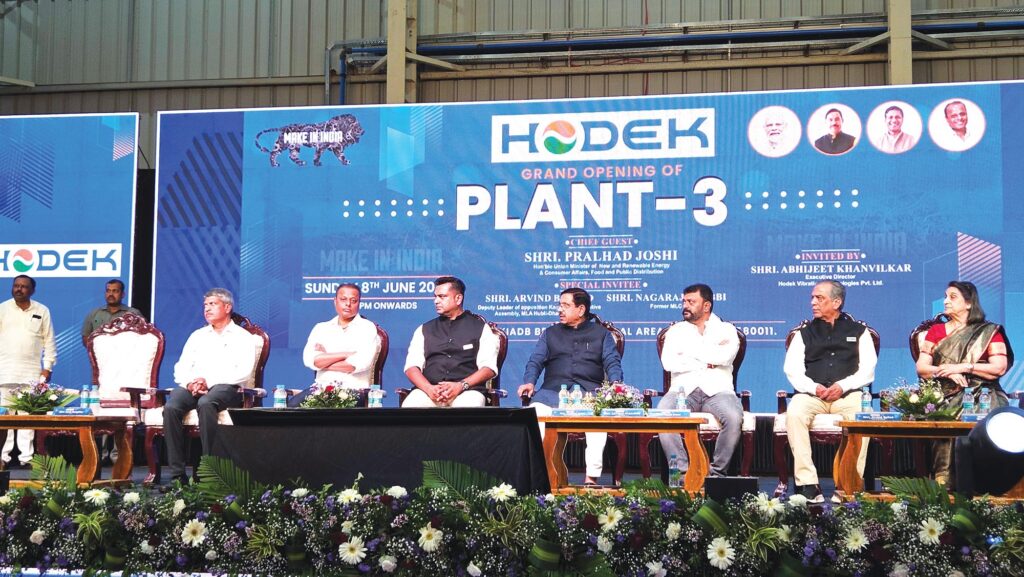
“These new lines help us build capacity fast, sometimes in just three months. If we get a purchase order, we can commission production within 90 days,” said Khanvilkar.
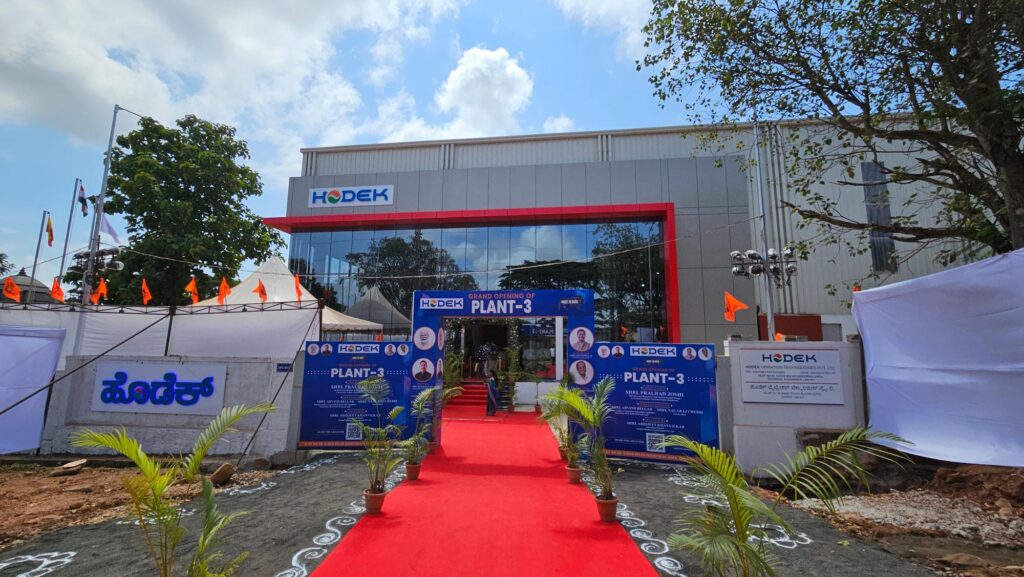
With three plants now operational; one in Pune and two in Dharwad; along with a foundry and R&D center, the company is better positioned to serve both domestic and international clients with agility.
Choosing Dharwad was a strategic move driven by access to skilled talent and proximity to their foundry. “We didn’t plan Dharwad. It happened when we acquired a foundry here. But it’s worked out perfectly,” Khanvilkar shared.
With seven engineering colleges, an IIT, and multiple ITIs in the area, nearly 98% of the workforce at the new plant is local. “There’s a strong ecosystem here. Manpower will never be a problem,” he added.
Innovation-Led Product Development
Alongside expanding production, Hodek is doubling down on R&D. As OEMs seek lighter and higher-performance components, the company is developing next-generation dampers with novel materials and media.
“We’ve already invested in R&D to boost our design capabilities. Today’s customers want superior performance and lighter weight; this requires completely new material thinking,” he said.
A key area of focus is sensor-based dampers that provide real-time performance data; a potential game-changer for high-end vehicles. “That’s the future. Dampers will soon tell how well they’re working in real time, and that data will directly influence engine efficiency,” Khanvilkar explained.
CVs: A Balanced Growth Strategy
While passenger vehicles currently form the volume base for Hodek, the company sees commercial vehicles (CVs) as a major growth opportunity; especially in terms of value.
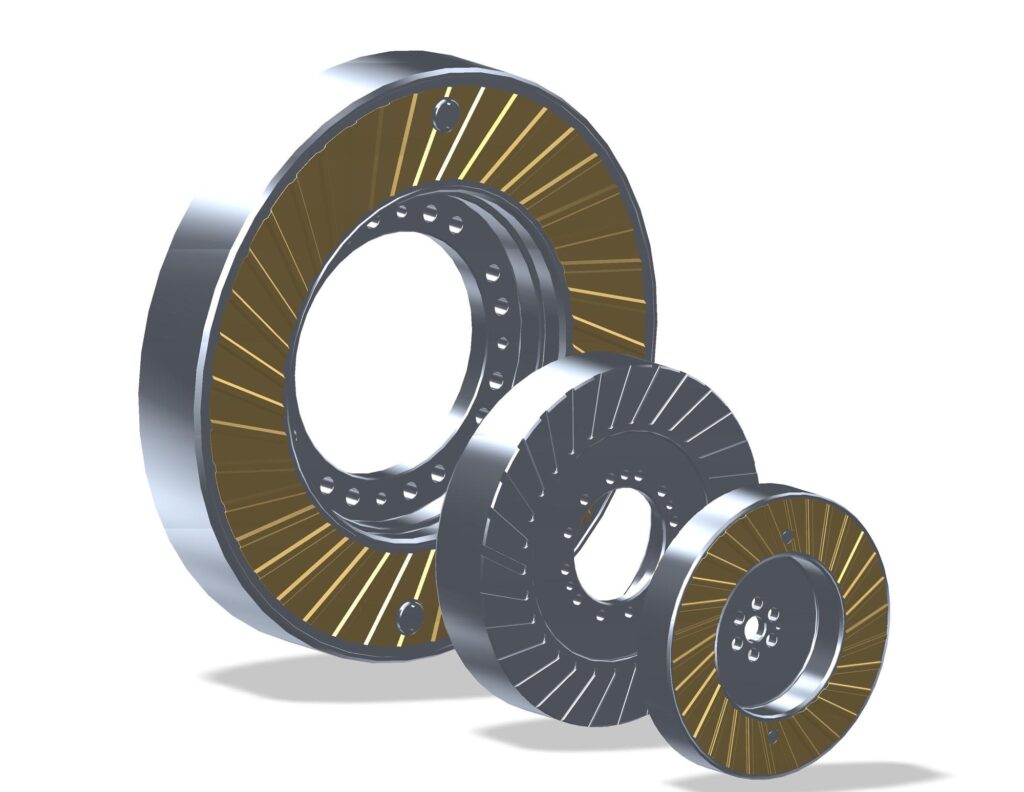
“The line behind me is being set up for high-output viscous dampers, critical for heavy-duty CVs, gensets, and marine engines. We’re already in talks with European customers for these solutions,” he said highlighting the role of Laser beam welding and Electron Beam Welding (EBM) technology for high-precision joining process.
Viscous damper for CVs can cost up to three to four times more than rubber dampers used for passenger cars engines, making this segment a key profitability driver. “CV applications are more lucrative and technically demanding. That’s why we’re building specific lines for them,” he noted.
Hodek currently derives 70% of its revenue from the domestic market, with the remaining 30% from exports. The goal, however, is to achieve a 50:50 balance over the next 2–3 years. “India is like Europe; each state has its own dynamics. We don’t need to look outside to grow. But exports give us scale and technology exposure,” he said.
Today, Hodek exports to 18 countries across five continents, with North America and the UK as key destinations. “Our partnerships with global experts are helping us deliver products that rival or even exceed European standards,” Khanvilkar added.
Adapting to Powertrain Shifts
Khanvilkar acknowledges that electric vehicles will eventually reduce the need for traditional dampers in some areas, but he sees opportunities in alternate technologies like hydrogen and hybrids. “Hydrogen engines still need dampers; it’s just cleaner fuel. The core mechanical needs remain,” he pointed out.
The company is proactively developing products for emerging powertrains to future-proof its portfolio. “We’re not underestimating the shift. Our R&D team is actively working on solutions that will be relevant in the coming decade,” he said.
In addition to engine components, Hodek is branching into comfort and digital tech. Under its new venture, Hodek Innovations, the company is working on products like an ergonomic sun visor to enhance driver comfort.
Meanwhile, Hodek Edge, a digital subsidiary, has launched Ispick; an app that lets users rent idle household items. “You might have a tennis racket lying around or a guitar. Someone rents it for a day, and you earn ₹100. That’s the idea,” Khanvilkar explained, pointing to a larger push into tech-enabled, asset-light ventures.
IPO and Long-Term Vision
With revenue goals of ₹1,000 crore in the next 4–5 years, Khanvilkar confirmed that Hodek plans to go public. “We will go public 100%. Growth of that scale needs funding. And transparency isn’t a challenge when your house is in order,” he affirmed.
In the short term, however, his focus is on fully operationalizing the new plant. “My immediate goal is to see all these lines running at full throttle. That’s how you create wealth; not just earn it, but build it sustainably,” he said.
Since its founding in 1976, when it began supplying machined components to Cummins India, Hodek has evolved into a global supplier of torsional vibration dampers, serving top automotive OEMs and expanding into new domains.
The third plant, more than just an expansion, represents the company’s intent to shape the next era of mobility with intelligence, adaptability, and precision. “We can’t depend on dampers alone anymore. We are growing thoughtfully; investing in people, in innovation, and making sure we’re aligned with every market shift,” Khanvilkar concluded.