
At Busworld 2025, Christian Schnierle, CEO of Hermann Schnierle GmbH, shared how the family-run German company continues to build on its reputation for precision, safety, and innovation in mobility seating and wheelchair restraint systems.
Founded in Germany in 1966, Hermann Schnierle GmbH specializes in seating systems for minibuses with up to nine seats, covering a broad range of applications. “We are a seat manufacturer for minibuses up to nine seats; for wheelchair transport, passenger transport, camper vans, authority vehicles, ambulances, and even some military transport vans,” said Christian. The company also produces seatbelts and wheelchair restraint systems in-house and functions as a vehicle bodybuilder, giving it full control over design and quality.
A Diversified yet Focused Portfolio
Christian explained that the business mix shifts slightly from year to year, depending on market demand, but all product lines contribute significantly to overall revenue. Schnierle Seating Systems core remains its M1 bus and mobility transport segment, a space where European competition is intense, especially from countries like Turkey. Yet, the company stands out through consistency and craftsmanship.
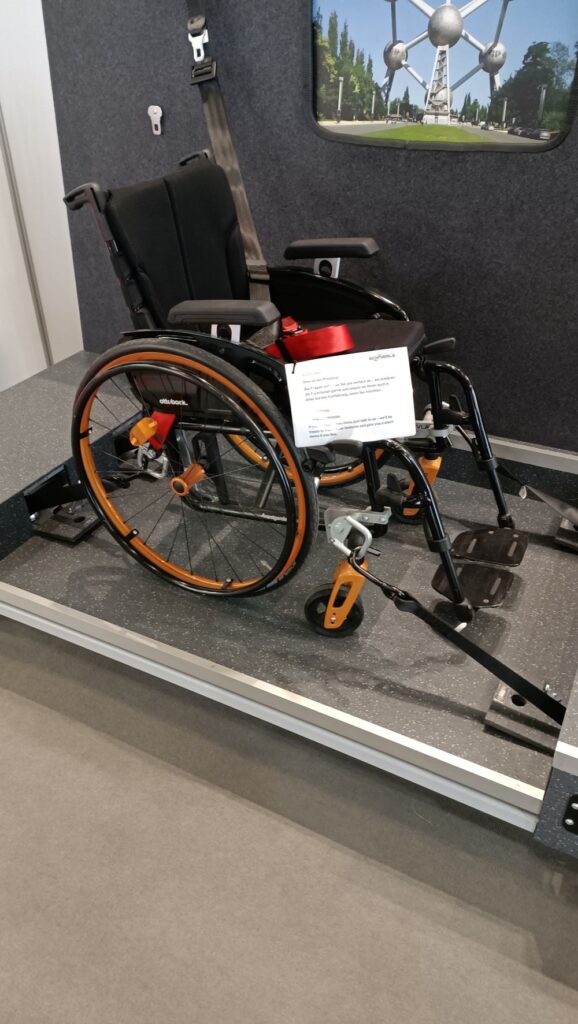
At Schnierle, our customers invest in measurable value: certified safety, robust quality, and genuine innovation. A team of around 16 engineers ensures every solution proves itself in the field — technically, in regulatory compliance, and economically.
At Busworld, the company showcased several new products designed to enhance comfort and safety for passengers with diverse mobility needs. This emphasis on innovation and quality remains central to its identity.
Integrating Seatbelt Manufacturing
A major turning point came in 2015, when Hermann Schnierle GmbH acquired one of its key suppliers which specialized in seatbelt production. “Every seat which you see here now has an integrated 3-point-belt,” said Christian. “It’s very good for us to produce our own belts; and we also supply for example other seat manufacturers and OEMs.”
Producing seatbelts in-house ensures higher safety standards and seamless integration between the seat and restraint systems; a crucial advantage in a segment where reliability is non-negotiable. “We are a medium-sized seatbelt company, not small but stable,” Christian noted, highlighting the strategic scale of operations that allows for flexibility and consistency in production.
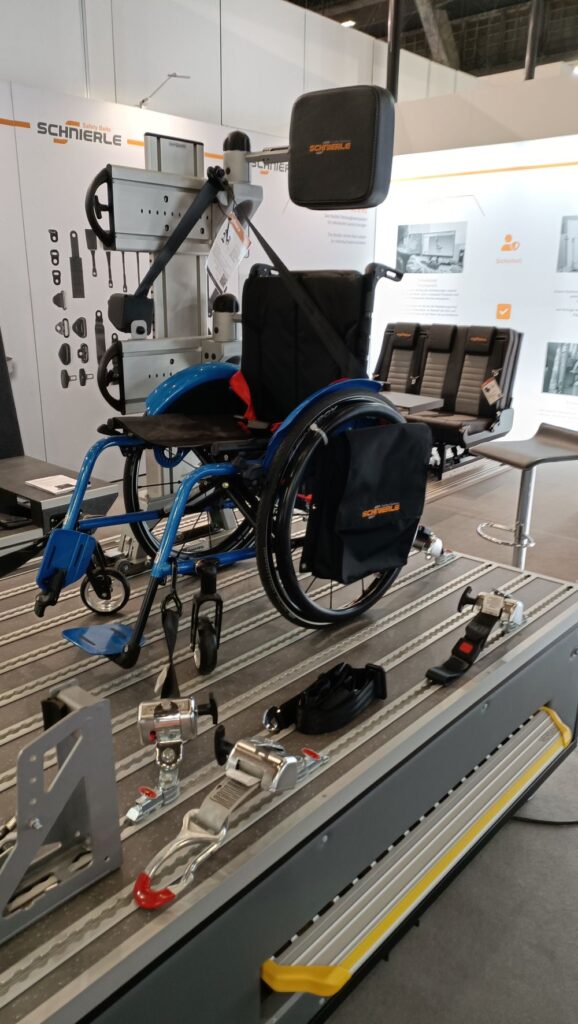
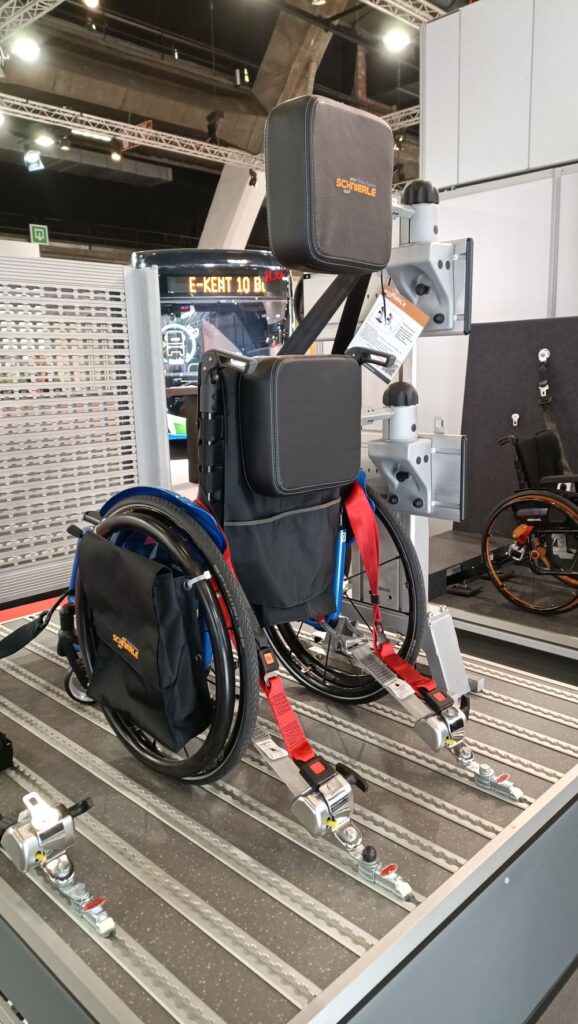
The company currently produces around 70,000 seats annually, many featuring integrated restraint systems, as well as a wide range of wheelchair restraint mechanisms.
Expanding Global Footprint
While the company’s main market remains Europe, Hermann Schnierle’s reach extends well beyond the continent. “We have customers in Japan, India, and Korea,” Christian shared. Europe still accounts for about 80 – 90% of total business, but international interest is steadily growing.
India, in particular, has emerged as a promising partner market. “We supply restraint systems to India; one of our biggest customers is Ashok Leyland,” he said. The company provides wheelchair restraint systems for buses, reinforcing its niche expertise in accessible mobility.
Although India is not yet a major part of its strategic focus, Christian remains open to expansion: “If there are opportunities for high-quality and safe systems, we are open for business.”
Navigating Challenges, Seeking Stability
Discussing market trends, Christian acknowledged that 2025 has been a year of consolidation for many European players. “It’s a difficult time in Europe because of the war in Ukraine and the political situation in America,” he said. “But we calculate a little growth this year compared to last year.”
Despite these headwinds, the company’s diversified presence across multiple market segments provides resilience. “We have a lot of branches, so we are somewhat independent,” Christian remarked, adding that this multi-segment strategy cushions the business against regional slowdowns.
Strategic Acquisitions and Future Plans
“In 2024, we took a strategic equity stake in one of our customers — a body builder based in Hanover. This partnership extends our footprint across northern and southern Germany and allows us to integrate our own products directly into the builds — delivering advantages in quality, availability, and lead times.”
The move positions the company to cater to the growing custom mobility and specialized vehicle segment, complementing its established seating and restraint systems business.
Looking ahead, Christian emphasized the brand’s continued focus on engineering excellence, innovation, and steady expansion into new mobility categories. “We are focused this year on making more seats, more conversions in the German market,” he said, underlining a pragmatic, growth-oriented approach grounded in technical mastery rather than aggressive scaling.
Engineering Trust through Innovation
Throughout the conversation, Christian repeatedly returned to the themes of trust and quality – the foundations of the company’s enduring success. “We have built a reputation for perfect quality,” he said. “We innovate continuously but never compromise on safety.”
With its strong engineering team, vertically integrated seatbelt production, and growing international presence, Hermann Schnierle GmbH is set to continue leading the specialized mobility seating market. As Christian put it succinctly, “We may not be the biggest, but our focus on quality and innovation keeps us ahead.”