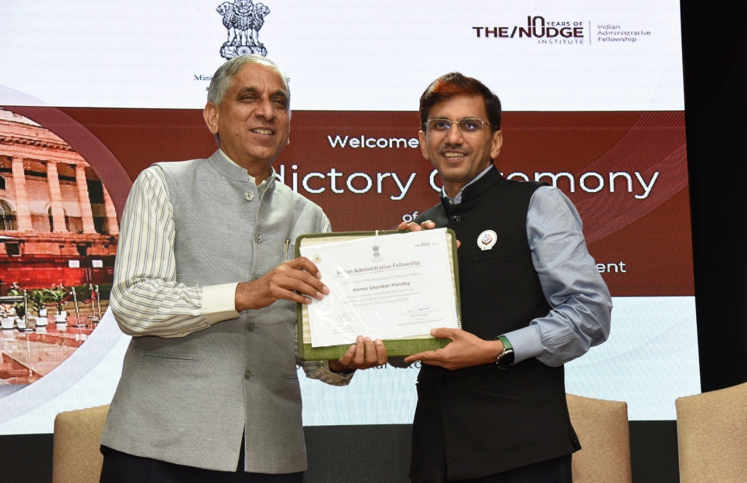
When Rama Shankar Pandey, former CEO of Tata Green Batteries, Former MD of Hella India Lighting Ltd. and a veteran of India’s auto component industry, chose to step away from corporate leadership last year to serve as a Social Defence Fellow (SDF) of the Ministry of Social Justice & Empowerment (MoSJE) under the Indian Administrative Fellowship (IAF), it marked a bold shift from boardrooms to the heart of public policy.
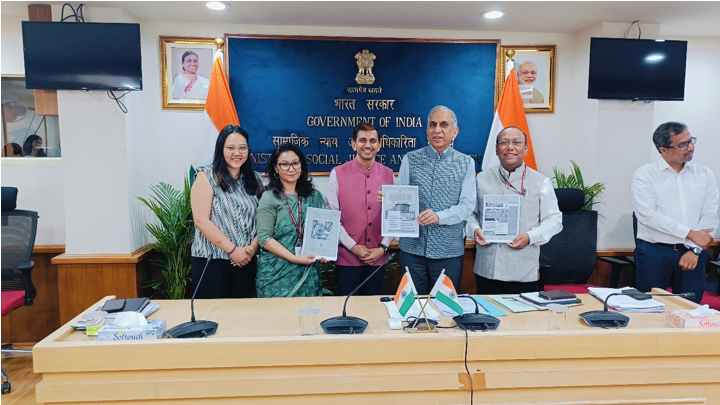
At the recently held Valedictory Function of the MoSJE Cohort 2024-25 in New Delhi, that journey came full circle in the presence of the Secretary and all senior officers of the Ministry at Dr. Ambedkar Internation Centre New Delhi, final outcomes of the fellowship was presented for all the 4 SDF’S (Selected through a rigorous process from 840 CXO applicants last year to work full time with Ministry of Social Justice & Empowerment, Government of India), which has been described as a “game-changing experiment in collaborative governance”.
Reimagining Social Defence Delivery
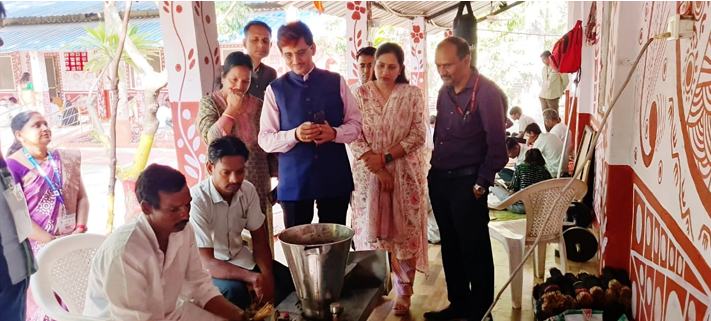
Over the past 18 months, Mr. Pandey worked alongside senior IAS officers, NGOs, and ground-level institutions to reform three critical programmes under MoSJE.
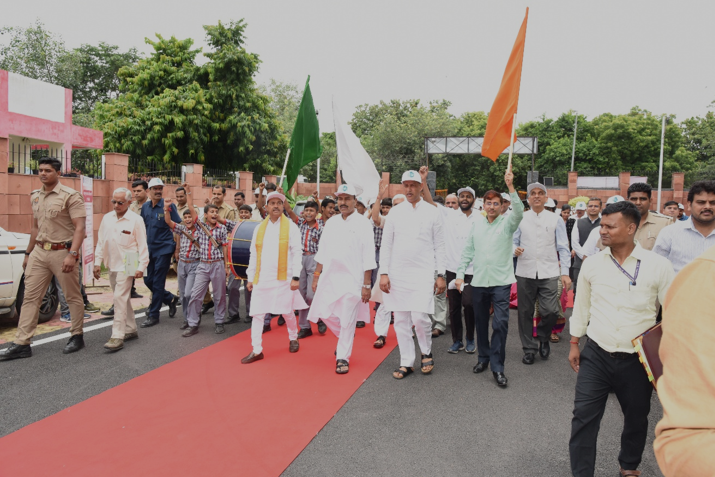
SMILE (Support for Marginalised Individuals for Livelihood and Enterprise) Mission Beggary-Free India: The newly launched scheme got field implementation in 31 cities in phase 1 & its success led to expanding it in 50 more cities, Identifying over 22,410 individuals engaged in the act of begging and rehabilitating 3,400 persons (including 728 children). This year beginning the City of Indore declared as India’s 1st Beggary Free City and many more are under pipeline. His main work included grass root capacity building, motivating, collaborating and brining convergence (concept of whole of government) to comprehensively rehabilitate persons engaged in begging. His private sector expertise came gandy in prototyping & institutionalisation of SOP Processes, RACI charts, SMILE-Beggary Handbook & its dissemination at grass root level to ensure sustainability. His lasting contribution remains New Guidelines for the Year 2025-26 approved by Hon’ble Minister and Nationwide Consultation document for the Concept Paper of FY’26-31.
PM-SURAJ: Helped make the credit empowerment portal dynamic and accessible to general public for direct application, integrating all MoSJE finance corporations and enabling transparent delivery of loans to nano entrepreneur. This was launched last year by Hon’ble Prime Minister for the economic inclusion efforts of Government of India for the marginalised population of our country. Also piloted an Integrated Cluster Development Scheme and proposed NAMAH (Nano-Entrepreneur Assistance on Marketing & Handholding) to empower 1 lakh nano-entrepreneurs in 3-5 Years.
NAPDDR (National Action Plan for Drug Demand Reduction): Developed a Model State Action Plan, standardised cost norms, introduced a real-time monitoring dashboard, and spearheaded youth mobilisation under Nasha Mukt Bharat Abhiyaan, including mega mass-pledge campaigns across universities, workplaces, and communities.
Voices of Change
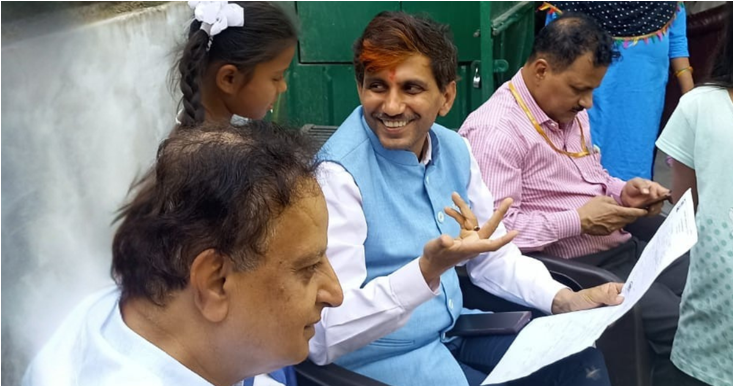
Impact was not limited to policy and portals, it was human. Stories like Sunil Mahawar from Indore, who moved from addiction and street begging to becoming a supervisor at a garment unit, or Jayalakshmi from Chennai, once homeless and mentally ill, now working as a trainer for special children, became symbols of the fellowship’s mission: “From Don’t Give Alms to Dignity Through Livelihood.”
A Fellowship that Blends Sarkaar, Samaaj, and Bazaar
Reflecting on his journey, Pandey said: “I learnt that true transformation requires breaking silos between Sarkaar (government), Samaaj (society) and Bazaar (markets). Collaboration is the real game-changer – no single entity can create large-scale social impact alone.”
Senior MoSJE officials credited the fellowship with strengthening convergence frameworks, digitisation, and evidence-based policymaking. A dedicated PMU (Programme Management Unit) is now institutionalised to carry the reforms forward.
Beyond the Fellowship: From Automotive Leadership to Nation Building with a Business Case
Mr. Pandey, who continues to champion Road Safety (FICCI, CII) & consumer rights in the Automotive Aftermarket Industry (ACMA) including empowerment of technicians through Skill India Movement (ASDC, MEPSC), has hinted that this fellowship is not an endpoint but a launchpad. His focus now is on scaling public-private partnerships that link livelihood, safety, and dignity – for both Viksit Bharat 2047 and for saving lives on Indian roads. His mission is now to create Business Case for Social Good to give Purpose & Meaning to the lives of working class & business builders in the Industry. Given his battery of energy, as next milestone for his career journey, he hinted to be back to Automotive Industry in multiple leadership roles soon, including the possibility of an entrepreneurial stint.
The Road Ahead
As the curtains came down at Bharat Sarkaar, one thing was clear: this was not just a fellowship graduation, but a marker of how India’s corporate leaders can embed themselves in governance to deliver systemic impact.
Or as Pandey summed it up: “I came to serve, I leave with even greater responsibility to continue bridging boardrooms and Bharat for the dignity, safety, and empowerment of our most marginalised citizens, achieving the Antyodaya meaning the upliftment of the last person”.
Pandey, a Mechanical Engineering degree holder from NIT, Calicut & Management from IIM Bangalore has 26 Years of experience in Auto component Industry with Hella, The Timken Company and Bosch India where he started his career. Currently he also serves as Chairman, Road Safety Sub-Committee at FICCI, a member of the Executive Committee of ACMA and a Governing Council member of ASDC.