At EXCON 2025, SCHWING Stetter India delivered what Mr. V.G. Sakthikumar, Chairman & Managing Director, described as its most enterprising showcase to date. Spread across more than 7,500 sq. m and featuring close to 30 machines, the company unveiled over 20 new products, including multiple India-firsts aimed squarely at decarbonisation, productivity and vertical infrastructure growth. The exhibits ranged from India’s first 56-metre boom pump engineered and built locally to the country’s first full electric truck mixer, first CNG mixer variant and first hybrid boom pump with dual diesel and electric operation.
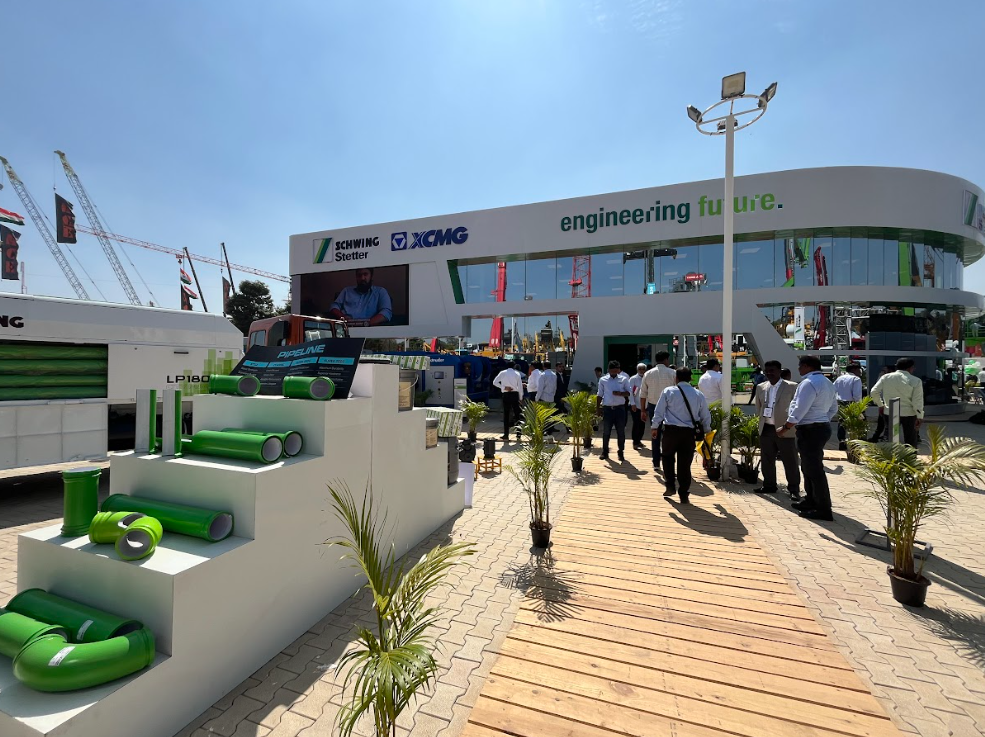
The launches addressed some of the most pressing challenges facing India’s construction sector; project delays, urban congestion, rising fuel costs and mounting sustainability expectations from regulators and corporates alike. High-reach pumps such as the S56SXF were positioned as enablers for taller structures and large infrastructure pours, while compact and re-engineered machines focused on reducing fuel consumption, traffic footprint and total cost of ownership.
“We are answering not only India’s call for Viksit Bharat and Atmanirbhar infrastructure development, but a global call for taller, faster and greener infrastructure,” said Mr. Sakthikumar. “This is our most enterprising Excon ever, with multiple India-first launches that directly address inefficiencies, delays and sustainability challenges in construction.”
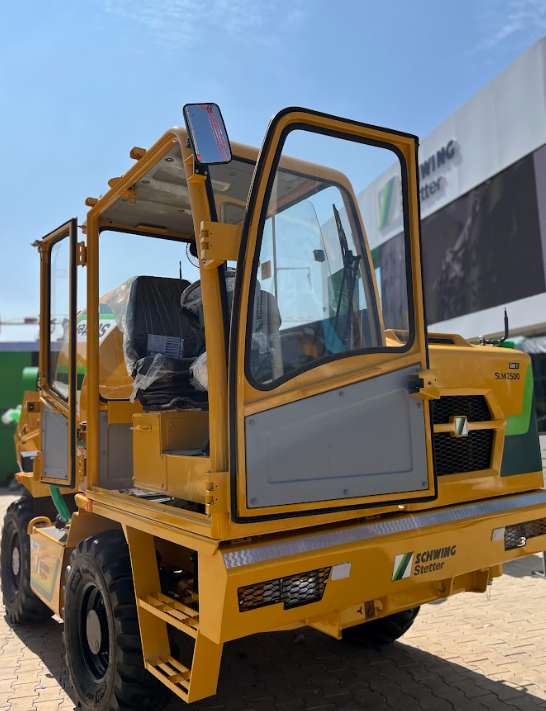
Among the clean-energy highlights was India’s first CNG-powered truck mixer, developed in partnership with Kirloskar Oil Engines. Both the truck and the mixer operate on CNG, offering at least a 25 percent reduction in emissions compared to conventional diesel variants, without compromising mixing performance or torque delivery.
“If performance criteria are not met, then green energy is not an option,” Mr. Sakthikumar said. “That is why we ensured there is no compromise on output while cutting emissions significantly.”
Clean Energy, Hybrid Drives and Smarter Machine Architecture
Another key exhibit was the hybrid boom pump, which allows the machine to operate either on the truck’s internal combustion engine or directly on grid power once it reaches the site. This solution is particularly relevant for precast yards, tunnels, airports and dense urban environments where grid power is available and emissions need to be minimised. Electric operation not only eliminates local emissions but also delivers up to 15 percent energy savings compared to diesel pumping.
“You can travel on the road with the engine and once you reach a site with grid power, switch to electric operation,” Mr. Sakthikumar explained. “That means lower noise, zero on-site emissions and direct power savings.”
SCHWING Stetter India also previewed a fully electric truck mixer, underlining its long-term roadmap towards zero-emission logistics. While battery-electric solutions are still emerging, the company sees strong potential in applications such as mining, cement, steel and large infrastructure projects, where corporate ESG commitments are accelerating adoption.
“More customers are realising that electric drives give them not just environmental benefits but also accounting and ESG advantages,” Mr. Sakthikumar noted.
Beyond powertrains, the company showcased how smarter machine architecture can deliver sustainability gains. A 31-metre boom pump mounted on a two-axle chassis replaces earlier three-axle configurations, reducing vehicle weight, fuel consumption and acquisition cost while remaining regulation-compliant. Similarly, integrated mixer-boom combinations reduce the need for multiple vehicles travelling to a site, cutting tyres, engines, manpower and emissions in one stroke.
Trailer pumps were another focus area. Traditionally diesel-driven, these machines are now available with electric motors and VFD drives, lowering power consumption and operating costs. The additional investment typically pays back within about two years, after which customers can save nearly Rs. 2 lakh annually. “Sustainability has to make business sense,” said Mr. Sakthikumar. “When customers see a clear payback, adoption becomes much faster.”
Precast Technology, Recycling and Digital Construction
A major strategic announcement at EXCON 2025 was the introduction of advanced precast technology for India, in collaboration with MAXtruder GmbH. Precast construction reduces material usage, improves quality consistency and significantly shortens project timelines. Mr. Sakthikumar explained that solutions such as hollow-core slabs achieve required structural strength with far less concrete through pre-stressed reinforcement.
“You reduce material consumption without compromising strength, and at the same time construction becomes much faster,” he said. “That itself is a strong sustainability lever.”
Precast methods also address the economic realities of modern construction, where developers cannot afford long gestation periods. Buildings that once took years can now be completed in months, enabling quicker revenue generation and faster return on investment. SCHWING Stetter India is localising these machines to make precast adoption easier and more cost-effective for Indian customers.
The company’s sustainability narrative was further reinforced through its crusher range for aggregates and C&D waste recycling, concrete recycling plants and containerised mobile batching solutions. By closing the materials loop, these systems reduce dependence on virgin aggregates and ease pressure on landfills, aligning with emerging circular economy policies.
Anchoring the entire showcase was the SCHWING Innovation Booth, designed as an experiential technology lab rather than a static display. Visitors interacted with AI-enabled automation, smart mixer simulators and digital command interfaces that demonstrated how future-ready plants and machines will operate.“If you visit a typical ready-mix plant today, you will see productivity lost just in vehicle positioning and coordination,” Mr. Sakthikumar said. “We have automated these processes using AI, so there is no person standing outside directing trucks.”
Digitalisation extended to mobile-based concrete ordering, quality clearance, production scheduling and even spare parts procurement through an e-commerce-style portal. All these systems are developed in-house, reducing manual intervention, errors and delays.
Market Outlook and Responsible Leadership
Despite a largely flat concrete market nationwide, SCHWING Stetter India expects to close the year with around seven percent growth, translating into market share gains. Mr. Sakthikumar attributed this performance to innovation, customisation and the company’s willingness to lead the market towards newer technologies rather than wait for regulations to force change.
“If we, as a responsible and dominant player, do not move in this direction and guide the market, who else will?” he asked.
Diesel-powered equipment will continue to dominate in the near term, but electric, hybrid and alternate-fuel solutions are steadily moving closer to price parity, especially where grid power replaces batteries. As large corporates and rental companies begin insisting on greener fleets, adoption is expected to accelerate across the value chain.
Through its EXCON 2025 showcase, SCHWING Stetter India made a clear statement; sustainability, productivity and profitability are no longer competing priorities. With India-first technologies, local engineering and a systems-level approach to construction, the company is positioning itself as a key enabler of India’s next phase of infrastructure growth.