Basic HTML Version


MOTORINDIA
l
June 2012
95
Federal-Mogul’s
new piston design
ensures big reduction in emissions
The development of a novel two-dimensional (2D)
ultrasonic analysis system allows Federal-Mogul Cor-
poration to create a new generation of high performance
pistons that enable a substantial further step in diesel
engine downsizing. In its first application, the greatly
improved cooling capability of the company’s “raised
gallery” piston allowed a Federal-Mogul customer to
achieve a CO
2
reduction of up to 30 per cent compared
with the previous generation engine without raised gal-
lery pistons.
“Diesel downsizing increases specific power output
in order to improve fuel economy and CO
2
emissions
and also increases the thermal and mechanical loads
that diesel pistons must withstand,” said Gian Maria Ol-
ivetti, Federal-Mogul’s Vice President for Technology
and Innovation, Powertrain Energy. “With the develop-
ment of new highly-loaded engines, the risk of piston
failure has increased substantially as past improvements
in materials, design and cooling concepts have reached
their physical limits. Federal-Mogul’s innovation in
advanced testing techniques, materials science and
manufacturing processes greatly reduces the limitations
placed on diesel downsizing strategies.”
Modern diesel pistons have a cooling gallery, through
which oil flows continuously. The position and design
of the gallery have a significant impact on the compo-
nent’s operating temperature and durability. The closer
the gallery is to the piston bowl, the more heat that can
be removed, allowing engine manufacturers to increase
combustion temperatures and pressures to improve fuel
economy and CO
2
emissions.
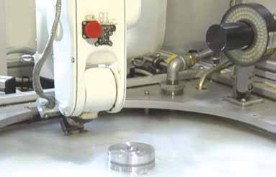
Standard, one-dimensional ultrasonic testing can iden-
tify defects but cannot quantify their size and position.
Federal-Mogul’s 2D ultrasonic process, however, pro-
vides 125,000 data points in 30 seconds. The technique
enables Federal-Mogul engineers to accurately deter-
mine the size and position of defects, providing valu-
able data for casting process development. The detailed
information provided also ensures consistent quality in
the finished high-precision components.
“In the past, it has been very difficult to cast a piston
with optimal size and location of the cooling gallery,”
said Dr. Frank T.H. Doernenburg, Federal-Mogul direc-
tor of technology, pistons and pins. Federal-Mogul’s
new 2D ultrasonic test has removed that barrier.
Federal-Mogul validated its 2D ultrasonic technology
by dissecting and sampling hundreds of pistons, cor-
relating the ultrasonic images against destructive test-
ing methods. The research resulted in the development
of software tools as well as a number of key physical
parameters such as probe geometry, wavelength, beam
geometry and focus.
Piston performance can be increased significantly
through Federal-Mogul’s 2D ultrasonic testing and
analysis process, which is quickly becoming an ena-
bling technology for more efficient powertrains.
w
component zone
The first production application of Federal-Mo-
gul’s raised gallery piston also delivers a specific
power increase of 25 per cent, keeping the piston
at temperatures much lower than the acceptable
limit of 400°C. In the same conditions, a standard
piston’s bowl rim stresses are 43 per cent higher
and its temperature reaches 440°C.