
By Mugundhan Deenadayalan, Research Manager, Connected Fleet, Mobility Growth Analytics & Shyam Sundar, Program Manager, Commercial Mobility Growth Analytics, Frost & Sullivan
Indian CV Connectivity Ecosystem
Even as the global commercial vehicle (CV) industry confronts intensifying international trade tensions and subdued capital expenditure flows, innovation remains strong. The industry is evolving rapidly as it embraces digitalization and connectivity as critical enablers of performance, safety, and profitability. At the core of this shift are telematics, artificial intelligence (AI), and software-defined vehicles (SDVs).
While developed markets such as North America and Europe are leading the adoption curve, largely driven by productivity and ROI goals, emerging regions like India, Latin America, and Southeast Asia are exhibiting strong potential for higher adoption rates. As vehicle connectivity becomes more mainstream, fleet telematics is emerging as a strategic enabler, with industry stakeholders set to leverage new business models and value-added services.

Digitalization and connectivity address major challenges faced by commercial fleets such as siloed operations, limited visibility, and the widespread deployment of manual systems. In this pre- digitization landscape, fleet operators have struggled with poor asset utilization and unplanned downtimes compounded by time, cost, and operational inefficiencies. Today, the growing integration of digital platforms and intelligent, connected technologies with commercial fleet operations is optimizing processes and streamlining overall fleet performance, while enabling better planning and reduced costs across the board.
India is rapidly emerging as a key market in the connected truck telematics ecosystem. Government mandates such as AIS-140, which require GPS tracking and emergency response systems in CVs, are encouraging rapid adoption. Additionally, the rollout of GPS-based tolling infrastructure, growing customer awareness of ROI benefits, and a vibrant tech startup ecosystem are fueling interest in fleet digitization.
Digitalization & Connectivity Transformation
Redefining Fleet Operations- Smart Technologies
Today, connectivity and telematics are the digital backbone of the global CV industry. These technologies are transforming fleet operations from reactive and manual to predictive and intelligent. By providing real-time insights into vehicle location, driver behavior, and engine health, telematics is enhancing decision-making capabilities and management of fleets. AI is taking this a step further by enabling predictive maintenance, route optimization, and dynamic cost modeling.
Software Defined Vehicles are gradually making their way out from research phase and onto the roads. Unlike traditional hardware-centric trucks, SDVs use software to control core functionalities, enabling over-the-air (OTA) updates, performance upgrades, and remote diagnostics. These trucks allow fleet operators to adapt vehicle features based on evolving needs, thereby reducing lifecycle costs and making them future-proof.
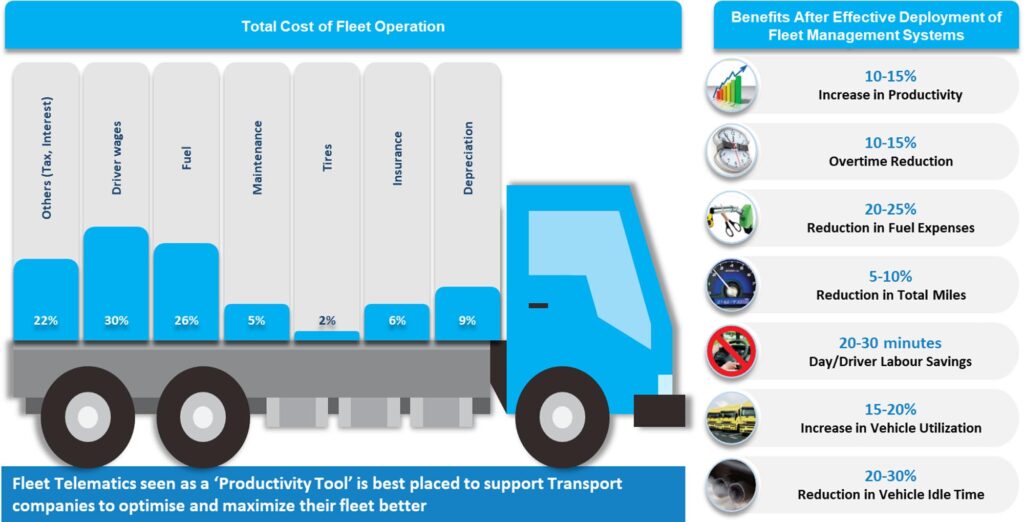
Telematics is increasingly being viewed as a strategic tool for maximizing performance of fleets. When deployed effectively, it has the potential to reduce fuel costs by 20%-25% and asset idle time by 20%-30%, while significantly improving asset utilization. These outcomes highlight the growing perception of telematics as a core productivity enabler rather than just a compliance tool.
Catalyst for CV Telematics Adoption – Regulations & Tech Start-up Investments
Government involvement has always proved to be one of the crucial factors in driving new tech adoptions in the global mobility ecosystem. This holds true for India as well, which is on track to become the world’s fastest-growing CV telematics market. Frost & Sullivan estimates a 46.1% annual growth in connected truck telematics over 2024–2025, outpacing regions like China, Japan, and the Middle East.
India’s CV telematics market is highly dynamic, featuring established local players, emerging startups and global legacy TSPs looking to expand their geographic footprint. OEMs are increasingly standardizing telematics in new models and forming partnerships with large fleet operators. Foreign investments from Europe and the US are accelerating growth, with several Indian CV telematics companies having received foreign investments.
Growth Forecasts and Market Potential
India’s connected truck telematics market is poised for robust growth. Frost & Sullivan forecasts a compound annual growth rate (CAGR) of 35.4% between 2024 and 2030 in installed telematics systems. Under favorable conditions such as increased TSP-OEM collaborations and broader AIS- 140 compliance, growth could even accelerate to 45.2%, positioning India as a global growth engine for connected fleet technologies.
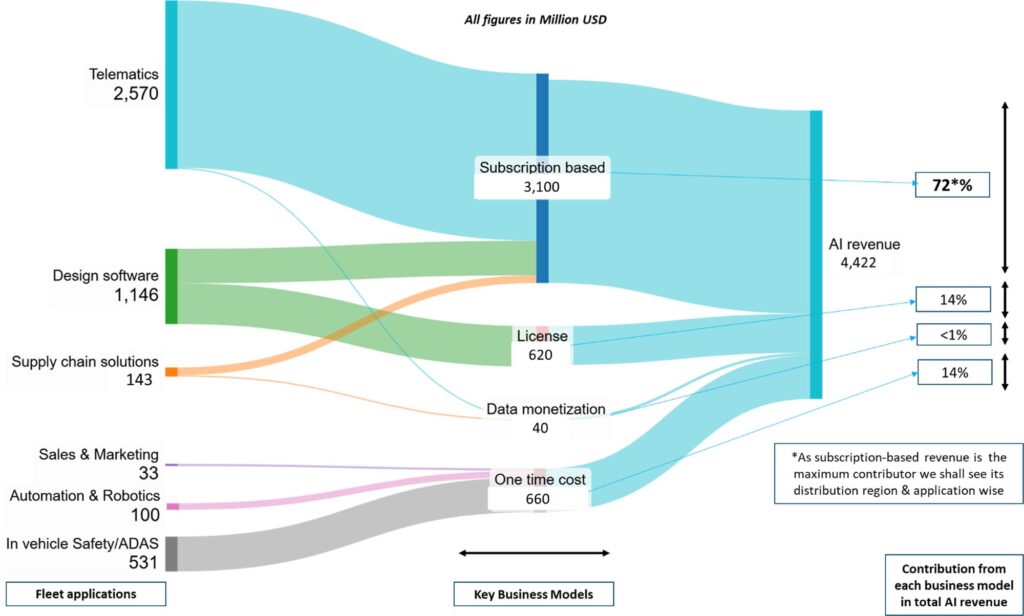
Simultaneously, revenue generation is keeping pace with unit expansion. The telematics services market is projected to grow at a CAGR of 48% through 2030, spurred by subscription-based models for tracking, diagnostics, and safety features. By 2030, India’s market could reach $900 million, with adoption projected to exceed 35% of the country’s total CV fleet.
1. Future Outlook for CV Fleet Operations in India
SDVs and the AI Shift
The future of CVs will be software-defined and AI-optimized. Globally, OEMs are exploring three models for software development: in-house systems, joint ventures, and partnerships with Tier 1 vendors. While joint ventures are emerging as the preferred approach for balancing innovation with manageable risk, in-house development remains limited due to high costs and lengthy development timelines. AI is increasingly being embedded in fleet solutions, from collision detection to design simulation. While North America and China lead in AI integration, India is advancing steadily. Notwithstanding infrastructure and data challenges, targeted investments and
strategic plans are seeking to close the gap. AI in India’s CV industry will likely find its strongest near-term applications in fleet management, safety, and supply chain visibility.
Looking Ahead
India’s CV industry is on the cusp of a digitally connected future. Telematics is emerging as the most immediate and impactful driver of change, driven by compliance mandates and operational demands. More disruptive applications like autonomous driving remain years away and will require stronger infrastructure, data integration, and regulatory support. Although Indian OEMs have begun integrating AI into their systems, widespread adoption will depend on continued investment in digital infrastructure and talent development. AI adoption will deepen gradually with SDVs, meanwhile, representing a long-term play for the next decade. Together, the degree and impact of these technologies that will come to define the future of Indian CV operations are still unfolding and remain to be seen.