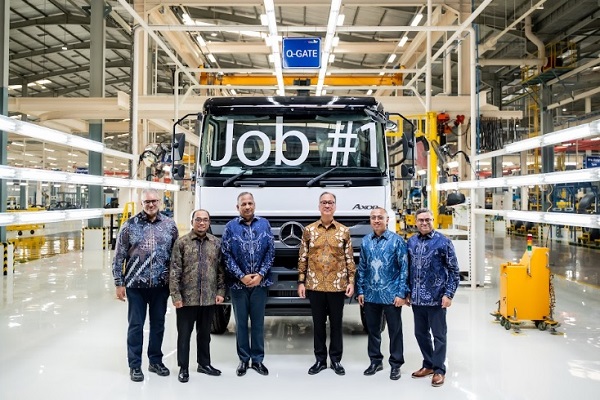
Daimler Truck has marked a significant milestone in its regional expansion with the inauguration of Daimler Commercial Vehicles Manufacturing Indonesia (DCVMI), a state-of-the-art greenfield manufacturing facility located in the Cikarang Industrial Area, Indonesia. This strategic investment reinforces Daimler Truck’s long-term commitment to Southeast Asia, catering to the region’s evolving mobility landscape.
Spread across 15 hectares, the new DCVMI plant has an annual production capacity of 5,000 Mercedes-Benz trucks and buses. With a total investment of IDR 500 billion, the facility underscores Daimler Truck’s intent to strengthen the commercial vehicle industry in Indonesia and serves as a cornerstone of the company’s regional growth strategy. It is positioned as a hub for vehicle assembly and distribution across key Southeast Asian markets. The initiative stands out for its collaborative framework—built on German engineering precision, Indian manufacturing expertise, and deep Indonesian market insights.
India plays a pivotal role in this regional integration. The Indonesian facility will be seamlessly supported by Daimler India Commercial Vehicles (DICV), based in Chennai, which will supply high-quality Completely Knocked Down (CKD) kits. DICV’s reputation for world-class, cost-efficient manufacturing enhances operational efficiency, supply chain resilience, and localisation potential.
Satyakam Arya, Managing Director and CEO of Daimler India Commercial Vehicles, highlighted the plant’s significance as part of Daimler Truck’s broader strategy for Southeast Asia. “India remains a cornerstone of our global export strategy. Leveraging Indonesia for the ASEAN region is about expanding our reach, not shifting our focus. As DICV becomes further integrated into Daimler Truck’s global manufacturing network, we will play a key role in building capabilities in Indonesia—transferring knowledge, developing talent, and strengthening the regional ecosystem.”
The launch of DCVMI’s new plant is a tangible realisation of its “Bigger and Better” vision. More than a scale-up of operations, it enhances agility, streamlines workflows, and boosts solution resilience for customers in Indonesia. The initiative underscores the company’s commitment to delivering commercial vehicles tailored to local market needs—combining production efficiency, service dependability, and continued innovation. The synergy between Daimler’s global technology and Indonesia’s local talent provides a strong foundation for supporting customer growth across the country.
“The integration of India’s advanced manufacturing capabilities into our Southeast Asian operations highlights our unified global approach,” Satyakam added. “By combining German engineering excellence with India’s production strength and Indonesia’s market understanding, we are establishing a robust platform for sustained regional success.”
The plant will continue producing key models tailored for the Indonesian market, including the Mercedes-Benz Axor truck variants: 2528 CH, 4928 T, 4028 T, 4023 T, 2528 RMC, 2528 CX, and 2528 C, as well as bus chassis models OH 1626 L and OH 1626 S.
Sankaranarayanan Ramamurthi, President Director of DCVMI, described the inauguration as a new chapter in DCVMI’s journey. “This plant is not just an addition to our infrastructure—it embodies our vision to contribute meaningfully to Indonesia’s economy, empower local communities, and strengthen the industrial ecosystem. Every unit produced here reflects engineering excellence, collaborative spirit, and our deep confidence in Indonesia’s future. We are committed to generating employment, driving innovation, and contributing to inclusive national growth.”
The Cikarang facility follows an integrated manufacturing model under one roof, facilitating efficient and streamlined production. It features a test track replicating diverse road conditions and a high-spec paint booth aligned with Mercedes-Benz’s global manufacturing standards.
This tri-nation collaboration not only deepens Daimler Truck’s footprint in Asia but also accelerates innovation, enhances operational flexibility, and sharpens customer orientation—delivering vehicles that meet local needs while upholding global benchmarks of quality and performance.