India must rethink how it sees Artificial Intelligence (AI) in vehicles; instead of focusing only on driverless cars, the auto industry should use technology to solve everyday problems on Indian roads, especially those linked to safety, Mr Brajendra Navnit, Principal Sectary to Government, Dept of IT & Digital Services, Govt of Tamil Nadu, has said.
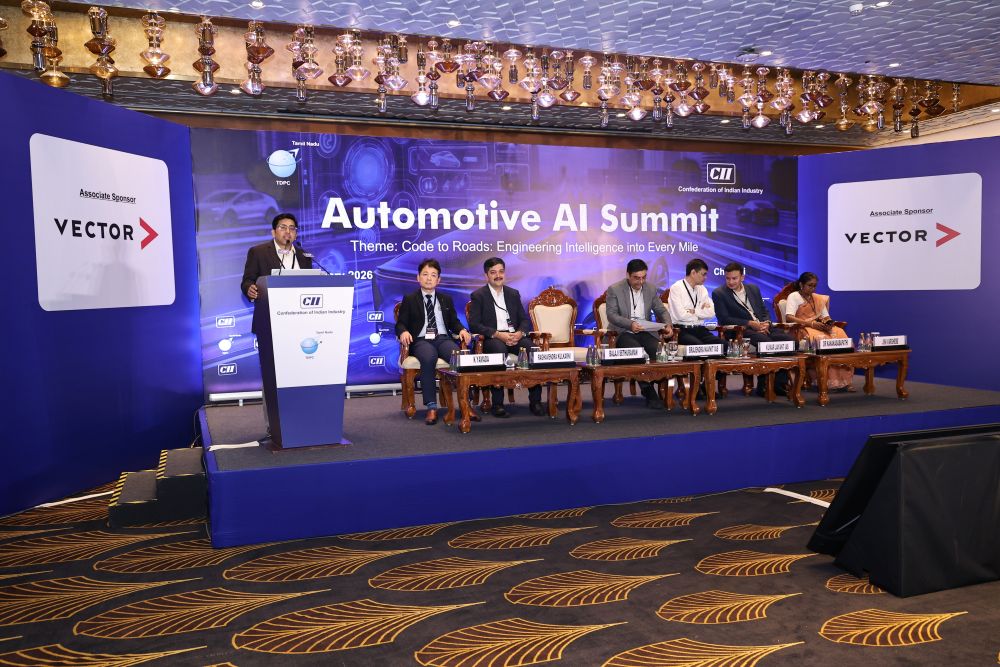
Delivering the special address the Automotive AI Summit, organised by the Technology Division of CII, he suggested for mapping issues across 2Ws, passenger vehicles, city roads and highways to find where small interventions can make a big difference. Even a simple dashboard alert reminding a driver to take a break during late-night fatigue hours could prevent accidents. Accidents cost India huge economic losses—up to 1.5% of GDP—and many cases aren’t even reported. Reducing these losses by just 20% could unlock a massive market worth over $125 billion across a vehicle’s lifetime. But the industry hasn’t yet created a strong “felt need” for safety technology, even though people would pay for features that keep their families safe.
The government is backing this push. Tamil Nadu has launched India’s first Deep Tech Startup Policy, naming automobiles and EVs as priority areas, and is setting up AI Centres of Excellence in Chennai and Coimbatore. Mr. Navnit urges automakers and startups to use these opportunities to build practical, India-focused solutions that make roads safer and mobility smarter.
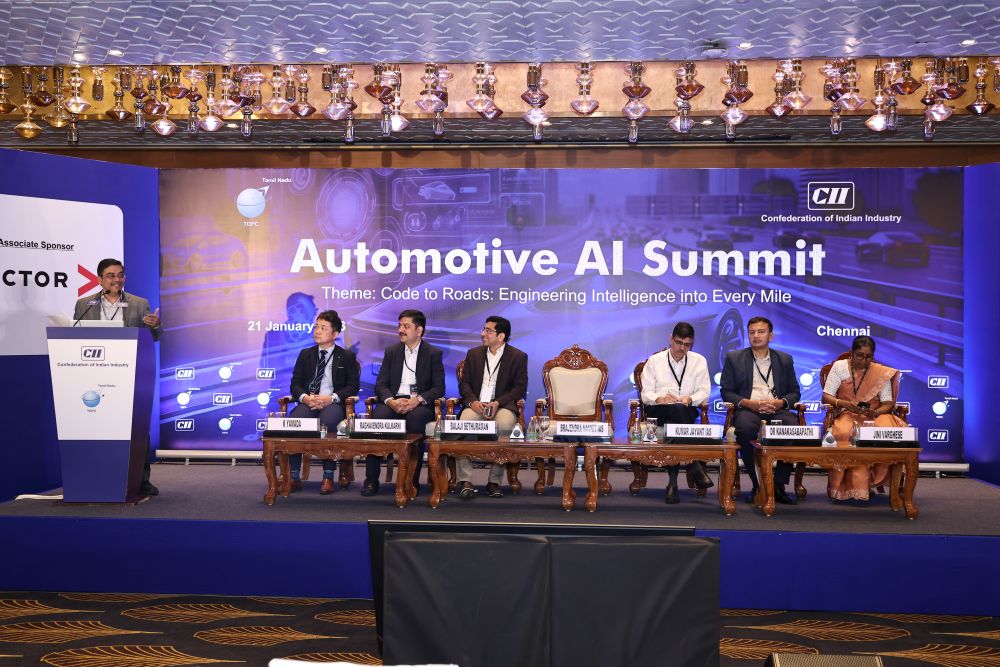
Mr. K. Yamada,Vice President & Head – R&D, Aisin Automotive Haryana Pvt. Ltd. believed that AI is reshaping India’s economic and mobility landscape faster than most people realise. With global AI investments rising sharply and nearly $500 billion expected to be added to India’s economy by the end of the decade, he said companies must treat AI as a responsibility of today, not a distant future. For Aisin, India plays a central role in this shift. The company already localises almost 80% of its products here, helping it respond quicker to customer needs and design solutions that fit Indian conditions. It even became the first to locally manufacture an E-Axle for EV passenger vehicles, supporting the country’s Make in India push.
AI now powers three major areas of Aisin’s work in India. First, it strengthens mobility and infrastructure solutions. AI-driven road monitoring tools can detect potholes and cracks with more than 90% accuracy, cutting manual inspections by half and helping design safer vehicles for Indian roads. Second, it improves quality control inside R&D. By analysing years of test and field data, AI helps Aisin spot risks earlier, reducing rework by up to 25%. And third, the company is building India into a major AI innovation hub by developing engineers who blend core automotive knowledge with AI and data-science skills.AI will drive India’s next wave of industrial growth, and Aisin wants to help shape this future by turning big ideas into practical, real-world solutions in partnership with the industry, he added.
Addressing the event, Mr. Raghavendra Kulkarni, Partner-Advisory, PwC, said the automotive industry in India is standing at a rare moment—one where AI can reshape how vehicles are designed, engineered and experienced. He says the biggest opportunity is to bring the “human element” back into mobility. Cars are not just connected devices; people live inside them, and AI should make these machines more intelligent without taking away human intuition.
According to him, AI is no longer hype. It is now disrupting every layer of the automotive world—from hardware design and software development to massive data analysis and autonomous driving. It is changing how parts are engineered, how code is generated and how vehicles make decisions on the road.
This shift demands a new kind of R&D. Traditional methods that depend only on individual expertise must evolve into digital-first systems. Kulkarni envisions a digital framework that uses cognitive intelligence to automate repetitive engineering tasks, so teams can focus on innovation instead of routine work.
India, he said, is uniquely positioned to lead this change. With strong talent, growing investment and supportive policies, the country can aim for the best of both worlds: Japanese or German-quality engineering delivered with China-like speed. The challenge—and the opportunity—is to use AI to disrupt business models, build products faster and help Indian OEMs innovate at global scale.
Dr. Kanakasabapathi Subramanian, Sr. Vice President – Product Development, Ashok Leyland, described the rise of automotive AI as a journey similar to how mobile phones evolved—from basic tools into powerful, multi-purpose devices. He believed that AI in cars will follow the same path, expanding far beyond today’s early ideas and touching every part of mobility. But he stressed that this evolution must be guided by customer needs, not technology for its own sake. Only when AI clearly adds value will it find a ready and meaningful market.
In his vision, AI will not only optimise traffic and improve fuel efficiency; it will transform maintenance, speed up design cycles and lay the foundation for a new class of intelligent, customisable vehicles. It is a future where cars continuously learn, improve and adapt—shaped as much by software updates as by customer expectations.
Mr Kumar Jayant, CMD, TIIC, said AI as a technology growing faster than anything we’ve seen before. With the internet, smartphones and social media already in place, he said AI adoption in India will move at extraordinary speed. He pointed out how speech-to-text improved from barely usable two decades ago to nearly perfect today, even helping an IAS officer issue an emergency statement in Tamil within minutes.
But for him, the real power of AI lies in understanding human behaviour—especially on India’s roads. He highlights how rule-breaking remains common, from low seatbelt use to drivers ignoring railway barriers. He argued that AI should be used to “nudge” people towards safer habits, whether through smart alerts or stricter interventions. He contrasted India with countries like Sri Lanka, where drivers stop even at unmanned crossings, or Indonesia, where cautious driving is the norm, and said technology must help India build a similar safety culture.
Jayant also stressed the need to bring MSMEs into the AI wave. Tamil Nadu has a strong startup ecosystem, and the goal is to spread this innovation mindset across suppliers so they can keep pace with the AI-driven demands of large automotive companies.
However, he cautioned that AI is only as good as the data it learns from. Models trained on the western road behaviour cannot understand Indian traffic patterns. Without India-specific data, AI systems may make mistakes or reinforce unsafe habits. He urged the industry to develop local datasets to ensure AI truly fits Indian realities.
In the end, he said AI should be seen through a wider social lens—not just as a technical milestone, but as a tool that can reshape behaviour, support small businesses and ultimately make Indian roads and industries safer and smarter.
Earlier, Mr. Balaji Sethuraman, Summit Chairman and VP- R&D, MBRDI, welcomed the gathering and also delivered concluding remarks.
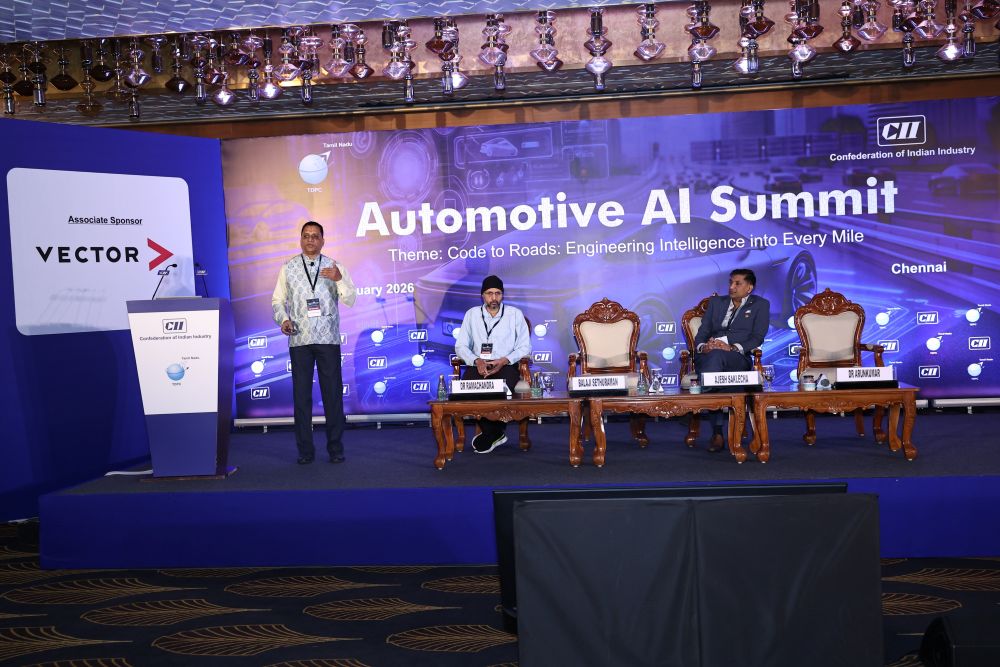
Setting the context for the first plenary session on ‘Building High-Performance AI Systems for Next-Gen Vehicles’ was Mr. Balaji Sethuraman. The session was participated by Dr. Arunkumar Sampath, Principal Consultant & Global Head, SDV & eVTOL, Aircraft, TCS; Mr. Ajesh Saklecha, Chief Client Advisor, SAK Solutions Advisory & Director – Ozone Motors EV and Dr. Ramachandra Budihal, GM & Global Head – Autonomous Systems and Robotics, IES Chief Architect WiPod, Wipro Autonomous Vehicle Programme.
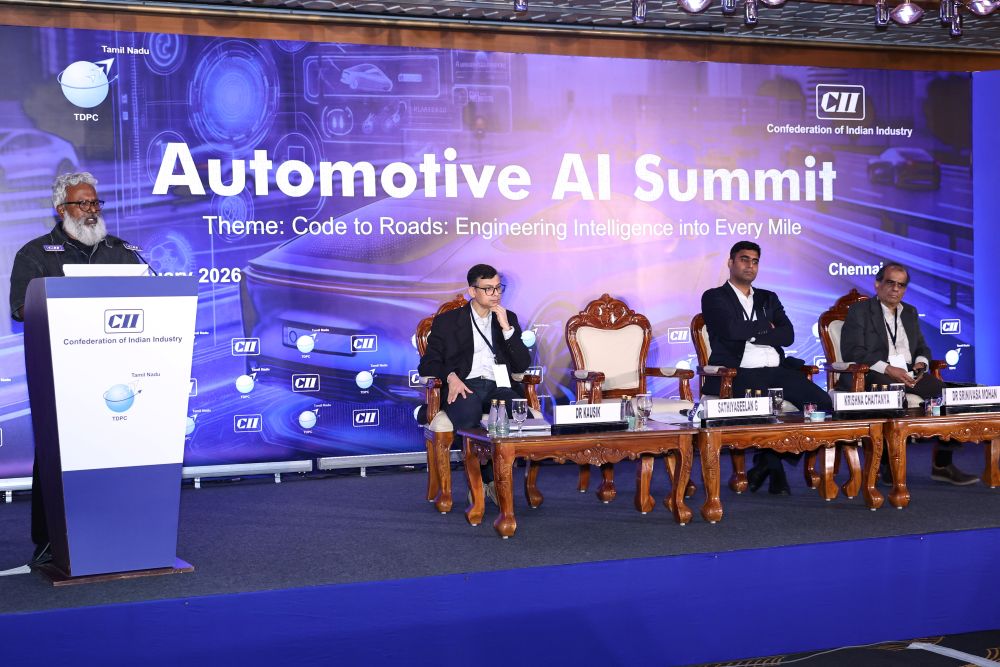
The second plenary session on ‘AI for Automotive Design & Engineering’ was participated by Mr. Sathiyaseelan G,Vice President & Head – Styling, Ashok Leylane; Mr. Krishna Chaitanya – AGM, Aisin Automotive Haryana and Mr. Kausik Bhattacharya, Sr Manager and Head of Requirement Definition AI CoE, Industrial Design & Visualisation Business Unit, Tata Elxsi.
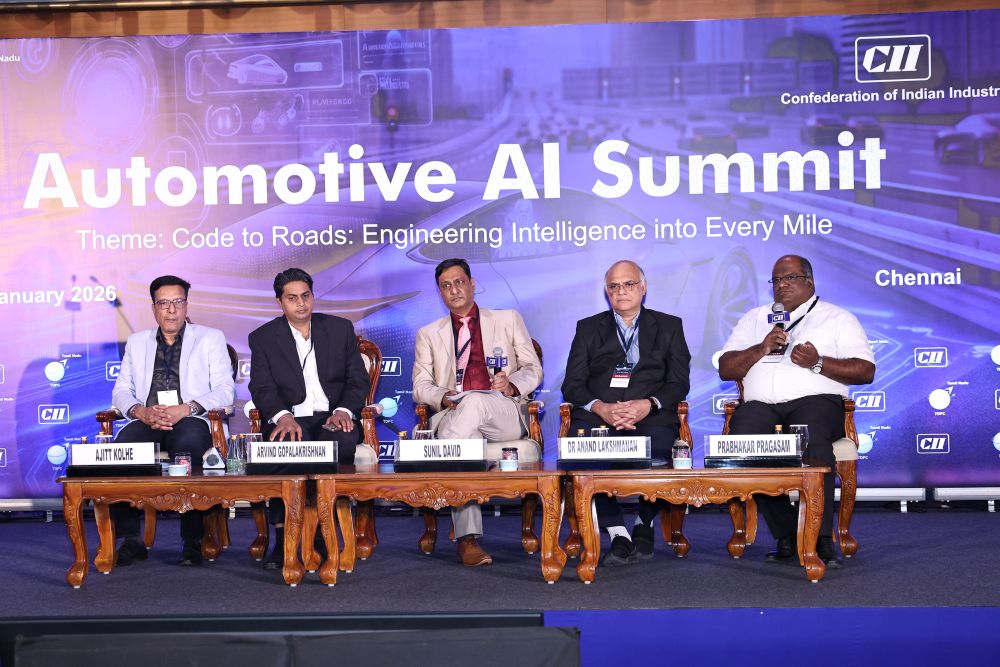
This was followed by a panel discussion on ‘From Edge to Cloud – Intelligent Data Orchestration for Connected Vehicles.’ Mr. Prabhakar Pragasam, Business Development Manager & Product Expert, Vector Informatik India, Mr. Ajit Kolhe, Vice President & Global Head – IT, Carborundum Universal, Dr. Anand Lakshmanan, Advisor, CoE for Advanced Automotive Research and Mr Arvind Gopalakrishnan, CTO & CIO, SUN Mobility participated in the panel discussion, moderated by Mr. Sunil David, Member, CII TNTDPC CTO Forum.
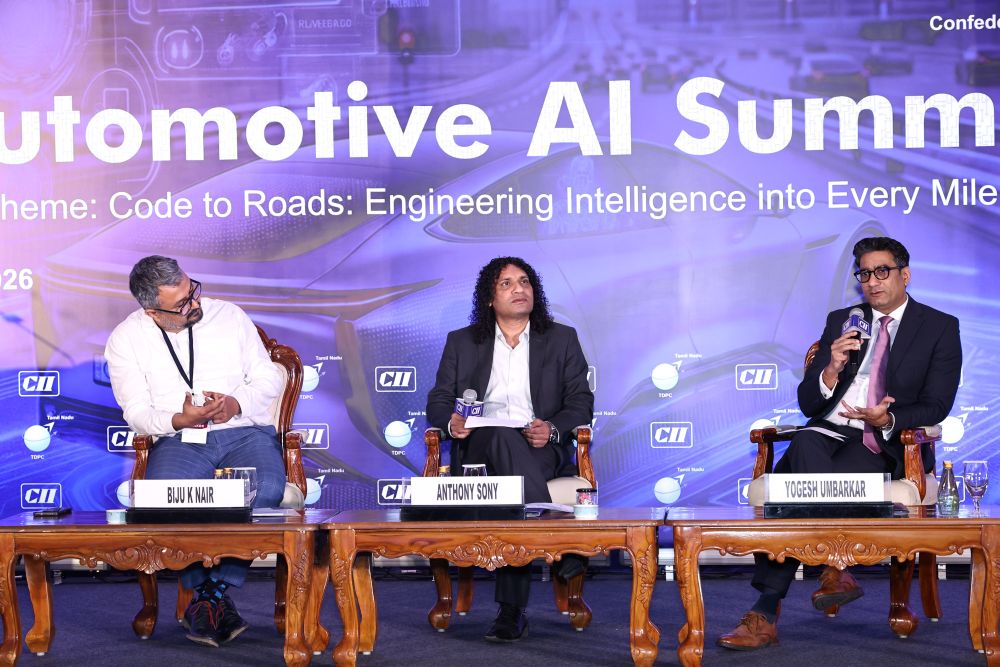
The last panel discussion was on ‘Privacy, Cybersecurity and Safety Regulations for In-Cabin and Vehicle-External AI Systems and was participated by Mr. Yogesh Umbarkar, Vice President, Valtech and Mr Biju K Nair, OpenChain India Work Group Chair, Open Invention Network and moderated by Mr. Anthony Sony, Sr Partner-Cyber Security, KPMG.
The summit brought together thought leaders from the automotive, EV and technology ecosystem to reflect on how AI is reshaping the future of mobility and setting the direction for the next generation of vehicles.