The Confederation of Indian Industry (CII) Southern Region organised a Technology Summit and Exposition on “Technology, Innovation and Infrastructure for Accelerating India’s Green Mobility Transition” in Chennai, bringing together policymakers, industry leaders, technology providers and mobility stakeholders to deliberate on the roadmap for India’s sustainable mobility future. The summit focused on the role of innovation, policy support and ecosystem collaboration in accelerating the adoption of electric mobility and other clean transport solutions across the country.
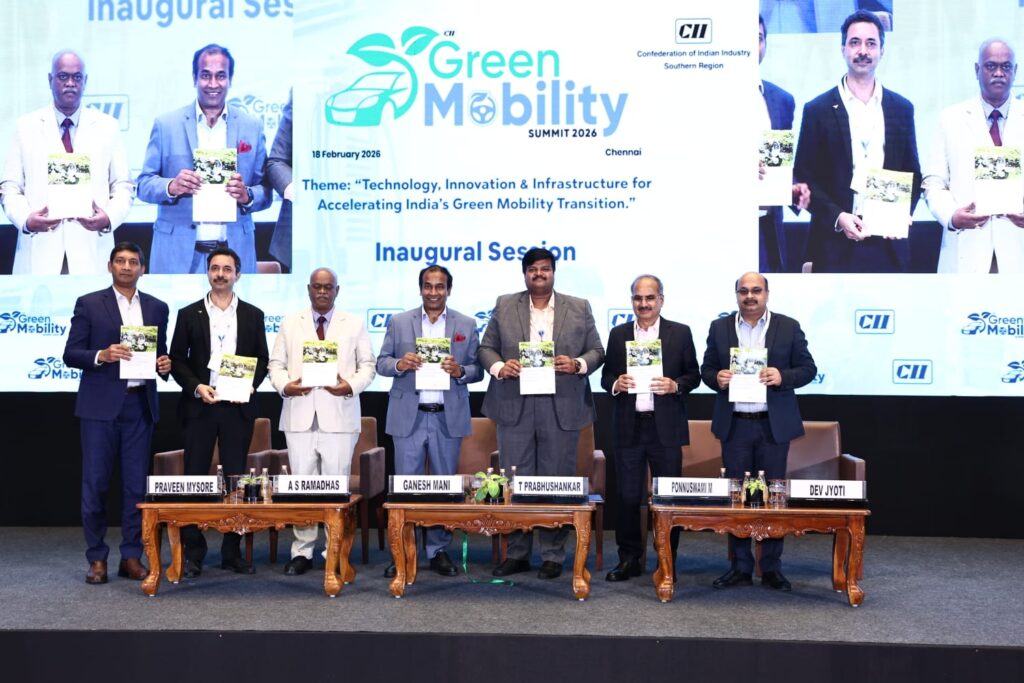
“When the public transport system adopts electric mobility, it creates a lighthouse effect for the entire ecosystem. If a system like MTC transitions to electric buses, it gives confidence to citizens to adopt electric two-wheelers and cars,” said Dr T. Prabhushankar, IAS, Managing Director, Metropolitan Transport Corporation (Chennai) Ltd., Government of Tamil Nadu, at the Technology Summit and Exposition organised by CII Southern Region.
“Tamil Nadu’s approach to electric mobility has been deliberate and sustainability-focused, with an emphasis on building robust, scalable and financially viable public transport systems. Chennai’s electric bus rollout and broader public transport reforms have received national recognition and are drawing global interest as the state prepares for the next phase of green mobility expansion,” Mr Prabhushankar stated.
“The summit reflects CII’s commitment to supporting India’s journey towards a sustainable and future-ready mobility ecosystem. Collaboration between industry, government and technology providers will be essential to accelerate electric mobility adoption across segments,” said Mr Ganesh Mani S., Chairman, CII SR Green Mobility Task Force 2025–26 and CEO, Switch Mobility; COO, Ashok Leyland Ltd., in his theme address.
Dr A. S. Ramadhas, Director, Global Automotive Research Centre (NATRiP), Ministry of Heavy Industries, Government of India, in his special address said, “India’s green mobility push is being supported by a range of policy and incentive frameworks. The government’s core objective is to reduce oil imports, lower emissions and create high-value manufacturing jobs. Schemes such as FAME, PLI, advanced chemistry battery incentives and hydrogen missions are designed to support industry investments and accelerate domestic manufacturing.”
He added that the emerging clean mobility landscape presents opportunities for start-ups, MSMEs and large manufacturers alike to take global leadership through innovation.
As part of his theme address, Mr Praveen Mysore, Senior Director, Dassault Systèmes India, pointed out, “The green mobility transition requires a system-level approach that integrates vehicles, energy, infrastructure, manufacturing and digital technologies. The future of mobility will depend on collaboration across urban planners, manufacturers, energy providers and technology firms. Virtual engineering, battery traceability and integrated system design will play a critical role in scaling electric mobility.”
Mr Ponnuswami M., Past Chairman, CII Tamil Nadu and Founder and Chairman, Pon Pure Chemicals Group, emphasised in his welcome address that green mobility would play a central role in reducing emissions, improving public health and creating new opportunities across manufacturing, infrastructure and services.
The summit featured leadership dialogues and panel discussions on electric mobility platforms, advanced batteries, hydrogen technologies, charging infrastructure, smart mobility ecosystems, and the policy roadmap to 2030 and beyond.