At IAA Mobility 2025 in Munich, BorgWarner showcased its next-generation technologies spanning electric, hybrid and combustion vehicles. The line-up included range extenders, next-gen inverters, eTurbo and eBooster systems, alongside advanced thermal solutions such as high-voltage heaters, integrated thermal modules, battery and power electronics eCoolers, and high-voltage eFans. The company also highlighted its torque management systems. Some solutions are versatile enough to be used in smaller trucks.
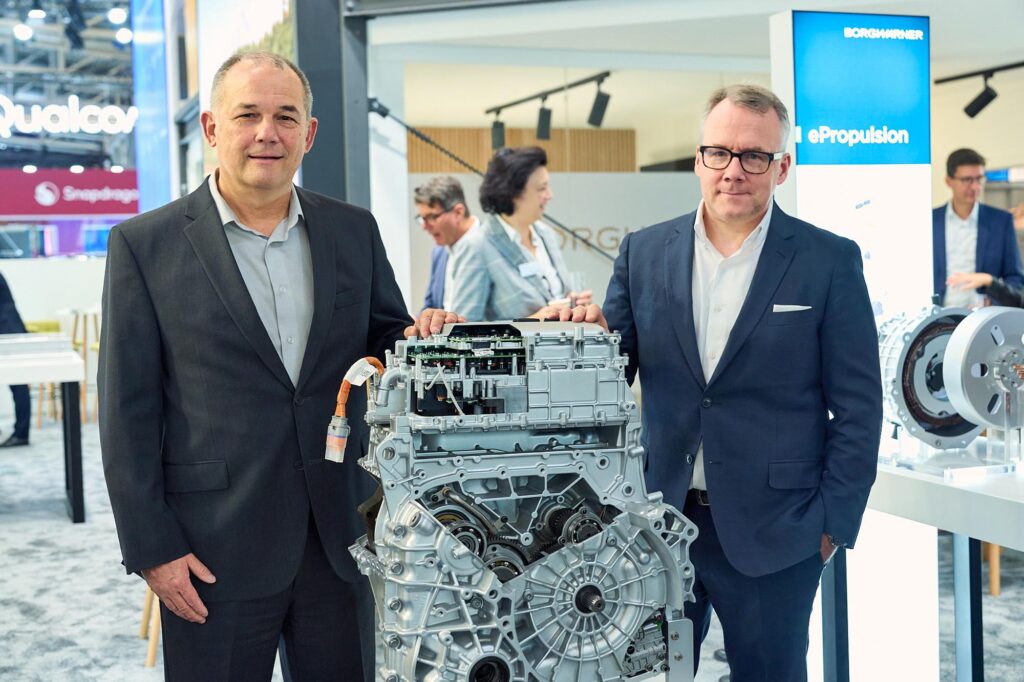
Speaking to Motorindia, Dr Paul Farrell, Chief Strategy Officer at BorgWarner, said, the road ahead begins by looking back. Over the past decade, the company built a strong portfolio that spans combustion engines, hybrids, and now a deep line-up of electric vehicles. That foundation, he says, is what enables the next phase of growth.
The challenge now is not about adding more products but about applying this portfolio wisely across regions that are moving at different speeds. According to him, China is racing towards electrification, Europe is a step behind, and North America is progressing more cautiously. This means tailoring solutions to meet local needs, staying nimble, and refining technologies along the way.

In Farrell’s words, the focus is on agility and resilience – qualities that will help BorgWarner adapt to shifting markets and keep its global transformation on track.
Cracking the Range Extender Puzzle
When it comes to range extenders, the rules are still unclear, but BorgWarner is already in the game. The company has built a portfolio over the past decade that covers every propulsion type, giving it the flexibility to deliver solutions wherever OEMs see demand – especially in markets like China, where this technology is gaining traction.
Chief Technology Officer of the company Harry Husted, pitches in stating that the real challenge lies in balancing battery size with the added engine, fuel tank, and exhaust system – all within the tight packaging of modern cars. These decisions rest with the OEMs, but the company plays a critical role in guiding them with the right technologies. Its edge comes from engineering compact, power-dense products that fit even in constrained spaces. This ability to adapt to OEM needs is what allows the company to stay ahead in a segment still finding its shape, he mentioned.
Range Extenders: A Bridge, Not Yet a Sunset
As battery chemistries evolve and charging networks expand, some believe range extenders may soon lose relevance. But BorgWarner sees the story differently. According to Husted, the technology is still in its early stages outside China and has room to grow before it declines.
For now, range extenders serve as a practical bridge – especially in regions where fast-charging infrastructure is limited. They also hold promise in specific use cases, like towing, where extra power and endurance matter. “We’re still in the ramp-up phase, not the peak,” he adds.
Torque Management
For Husted, torque management is about more than numbers – it’s about giving drivers confidence and control. One key solution is axle disconnect technology. In EVs with a secondary axle, disconnecting it when not in use can cut energy losses from the permanent magnet motor, improving efficiency by 3–5% depending on the application.
But efficiency is only part of the story. Torque management also improves traction and stability. Features like torque vectoring, which balances power between wheels, and differential locks that prevent wheel spin, deliver safer handling and better grip. OEMs see strong value in these features, and costs remain within reach, making them attractive additions to modern vehicles.
Thermal Edge
Husted describes thermal management as one of BorgWarner’s strongest areas of innovation. He highlights the company’s high-voltage coolant heaters as a core product– compact units that transfer heat from the battery pack into the coolant. This helps warm the cabin or prepare the battery for faster charging, boosting efficiency and convenience. Customers value the flexibility, with solutions that work across 400-volt and 800-volt systems, and power levels ranging from 3kW to 10kW, all in a small, dense package.
The company is also making strides with its battery e-cooler line, where cooling plates are placed directly against battery cells for more effective temperature control. Both these products grew out of the company’s earlier expertise in exhaust gas recirculation (EGR) coolers, showing how combustion-era know-how has been cleverly adapted for the electric age. It’s this ability to evolve existing skills into new solutions, Husted says, that makes the company trusted partner for OEMs.
Finding New Sweet Spots Beyond Propulsion
Husted explains that while propulsion remains the core, capabilities built over decades – in thermal management, hydraulics, and rotating machines – give the company an edge to branch out. Thermal systems, for example, started as an offshoot but are now a strong growth area.
Farrell adds that the expansion is a natural step, applying existing skills in new ways, with many showcased products absent from the portfolio just five years ago. They have emerged by reimagining proven technologies for new markets, turning adjacencies into growth engines.
Chasing the Moving Target of AI
Artificial Intelligence and Machine Learning are fast becoming part of the company’s innovation toolkit. Early work includes embedding machine learning into products, testing where deep learning can add real value. What excites Husted most is also what makes AI challenging – it keeps evolving. “It’s a moving target,” he says, noting that the goal is to keep pace with the latest breakthroughs and apply them quickly.