Ashok Leyland, the flagship company of the Hinduja Group, reported a strong financial performance in the second quarter, recording a profit (before exceptional items and tax) of ₹1,083 crore — a 23% increase over the same period last year ₹878 crore). The company’s EBITDA stood at 12.1% (₹1,162 crore), up from 11.6% (₹1,017 crore) in the corresponding quarter of the previous year.
The commercial vehicle industry witnessed positive momentum during the quarter, with both the Medium & Heavy Commercial Vehicle (MHCV) and Light Commercial Vehicle (LCV) segments showing growth. Ashok Leyland’s MHCV volumes rose 3% year-on-year to 26,307 units, while LCV volumes increased 6% to 17,697 units. The bus segment continued its strong run, marking its 18th consecutive quarter of growth. The company retained a domestic MHCV market share of over 30% and continued to lead the bus segment. In LCVs, the company also improved market share in its addressable categories.
Exports were a standout performer, rising 45% year-on-year to 4,784 units. Defence, Power Solutions and Aftermarket divisions also performed well and are expected to continue their growth trajectory through the fiscal year. Ashok Leyland launched new products across its Tipper, Bus, Haulage and LCV range and reported faster-than-planned expansion of its dealer network.
Reflecting confidence in the company’s performance and outlook, the Board announced a 100% interim dividend of ₹1 per share.
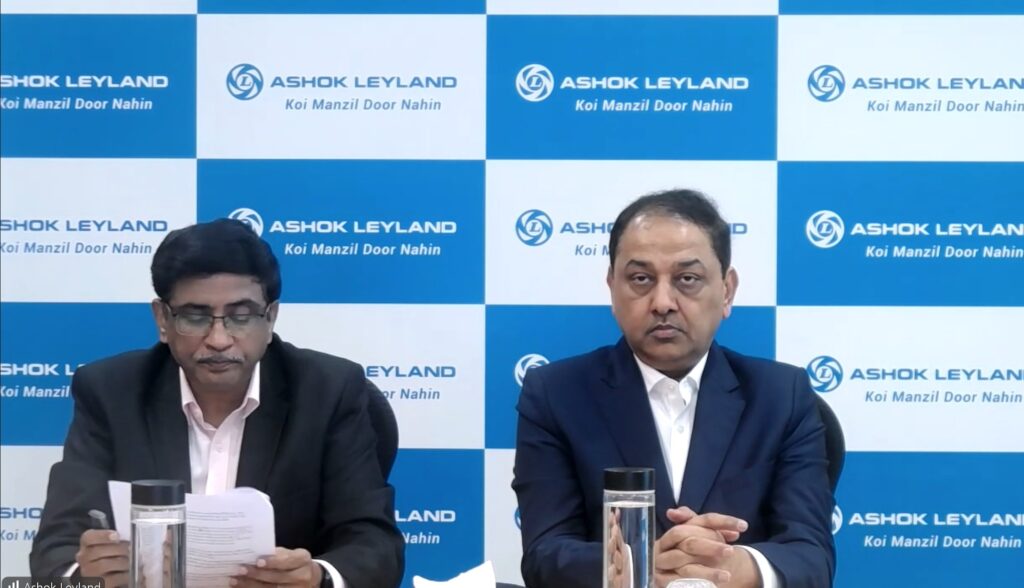
Commenting on the results, Mr. Dheeraj Hinduja, Chairman, said the company continues to deliver profitable growth driven by strong demand. “Our robust all-round performance reflects the competitiveness of our products and customer focus. We are also intensifying our international expansion in the Middle East, Africa and SAARC regions,” he said.
Mr. Shenu Agarwal, Managing Director and CEO, added that demand is stable across trucks and buses, and better growth is expected in the second half of the year. “Ashok Leyland has delivered its eleventh consecutive quarter of double-digit EBITDA. Our focus on profitability is reflected in record PAT and margin expansion. We are well positioned to achieve our mid-teen EBITDA target in the medium term and remain cash positive,” he said.
Significant Chapter
For Ashok Leyland, H1FY26 has not been just another reporting period but a significant chapter in the company’s transformation journey — one that brings together strong financial performance, new product development, sharper customer focus, and bold steps into new markets and technologies.
Industry tailwinds, smart execution
The commercial vehicle industry has been on an upward curve, and Ashok Leyland has used this momentum well. In Medium and Heavy Commercial Vehicles (MHCVs), the company not only kept pace with demand but outperformed the industry. In H1FY26, its volume grew 3% while the industry grew 1%, lifting its market share to 31%. The Q2 saw a further push, helped by policy changes such as the AC mandate for trucks and GST rationalisation, Mr Agarwal said.
The bus segment continued its strong run, marking its 18th consecutive quarter of growth. The company retained a domestic MHCV market share of over 30% and continued to lead the bus segment.
In Light Commercial Vehicles (LCVs), the company’s performance was even stronger. New launches, including a premium 2.2-tonne SCV, expanded its presence into fresh segments. LCV volumes grew 8% in H1, while the industry grew less than 1%. Market share improved steadily to 13.2%.
Exports: widening the global footprint
Beyond India, the company’s strategy is equally aggressive. Export volumes grew a sharp 45% in Q2 and 38% in H1, thanks to stronger presence in focus markets and products designed specifically for export needs. The company remains confident of crossing its mid-term goal of 25,000+ units.
Innovation at the centre
The real fuel behind the growth is innovation. “Project VEGAM,” a company-wide initiative, aims to speed up new product development by 50%. The company has already migrated MHCVs to the AC mandate and introduced Intelligent Vehicle Acceleration Control for better mileage. New launches in ICV and MDV buses and India’s first 320 hp tipper signal that the company is preparing for a premiumisation shift.
Even more powerful machines are on the way. Within the next few quarters, Ashok Leyland will launch a new line of high-horsepower trucks — including a mining tipper with 360 hp and 1,600 Nm torque, significantly higher than the current industry benchmark. Faster turnaround time in mining means more productivity, and that is where the new range will make a difference.
A future powered by cleaner fuels
The company’s shift towards cleaner fuel options continues. Its upcoming biofuel product — a hybrid configuration pairing CNG with diesel backup — is expected to launch within this fiscal year, giving fleet operators an option that combines greener operation with practicality.
Meanwhile, the Saathi — positioned as a premium upgrade over sub-2-tonne products — has already surpassed internal volume expectations. Customers are choosing it not just for more power and torque, but for better comfort, cabin space, and features. Saathi is catching a wave of buyers moving up due to higher load requirements and changing freight dynamics.
New Plant
A new multipurpose bus plant in Lucknow is in the final stages. Designed to produce diesel, electric, or alternative fuel buses, the plant will play a key role in the electric bus strategy. Pilot production is already underway, machines are being calibrated, and workforce training is in progress. The inauguration is expected within 30–60 days.
The company is preparing for a multi-phase localisation plan — starting with battery pack assembly and progressing to cell manufacturing in the coming years.
Ashok Leyland enters the second half of FY26 with strong order books, new products lined up, global markets expanding, and new manufacturing capability ready to come on stream. The company currently has an order book of 2,500 ICE buses and 1,500 e-buses.
Mr. Agarwal summed it up stating that growth is no longer just about selling more vehicles. It’s about premiumising the portfolio, innovating faster, becoming global, and preparing for new fuels.