Alkraft used EXCON 2025 as a platform to underline its growing role as a technology-led cooling solutions provider rather than a catalogue-based component supplier. At the exhibition, the company showcased five technology-focused products spanning construction equipment, specialised industrial applications, EV traction cooling, water pool and oil pool systems, and a new agricultural solution developed for engine suppliers catering to harvester applications. According to Mr. Basil Siddeeqi, Managing Director, Alkraft, the intent behind the display was clear. “All five products are technology demonstrators. They reflect our ability to solve complex cooling challenges across very different applications rather than just show standard products,” he said.
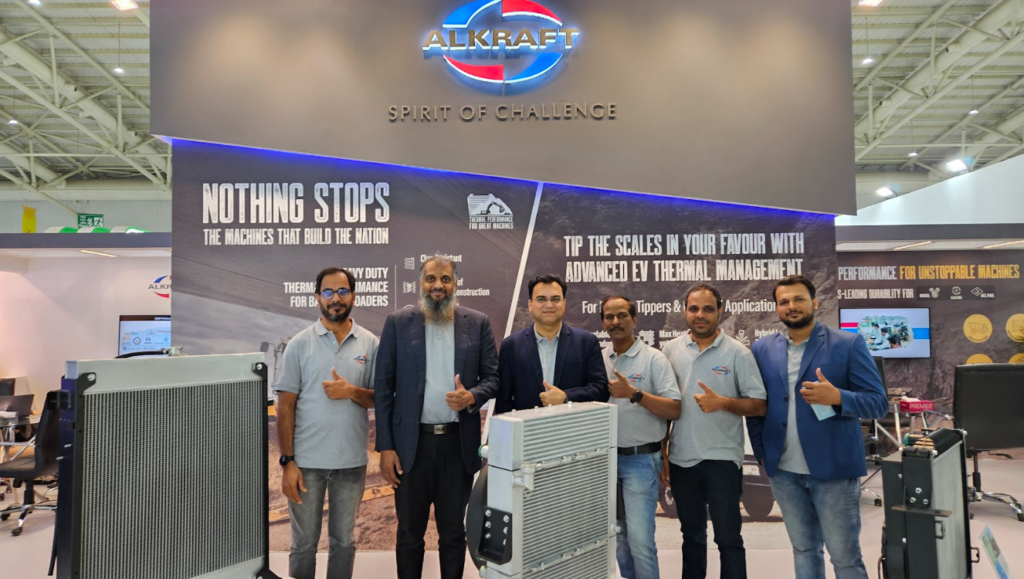
A notable highlight among the exhibits was a water-cooled transmission system and a large power genset cooling solution, both developed for export customers. These were not incremental upgrades but programmes that required Alkraft to set up entirely new manufacturing lines. Mr. Siddeeqi explained that convincing global customers demanded more than design intent. “It was not enough to present a strong design. We had to demonstrate that our manufacturing processes, testing capability, and delivery systems could consistently support high volumes and demanding applications,” he noted.
These export-led projects also pushed Alkraft to upgrade its internal infrastructure. Large industrial and genset applications, including engines as big as 33.9 litres, required enhanced testing rigs and validation processes beyond typical automotive requirements. “We upgraded our test facilities to handle higher flows and larger sizes. Only after validating the products in-house did we move to customer supplies. That was critical to establishing confidence,” Mr. Siddeeqi added.
Design-led partnerships and a diversified growth strategy
Beyond exports, Alkraft’s engagement with construction equipment OEMs has deepened in recent years, particularly during regulatory transitions such as the move to CEV Stage V norms. In several cases, Alkraft engineers worked alongside customer teams during on-site testing and validation. “Our teams were present during trials, supporting customers directly at their facilities. In many instances, issues were resolved through better packaging and fine-tuning of the cooling system rather than major design changes,” Mr. Siddeeqi said. This hands-on approach, he believes, creates tangible value beyond component supply.
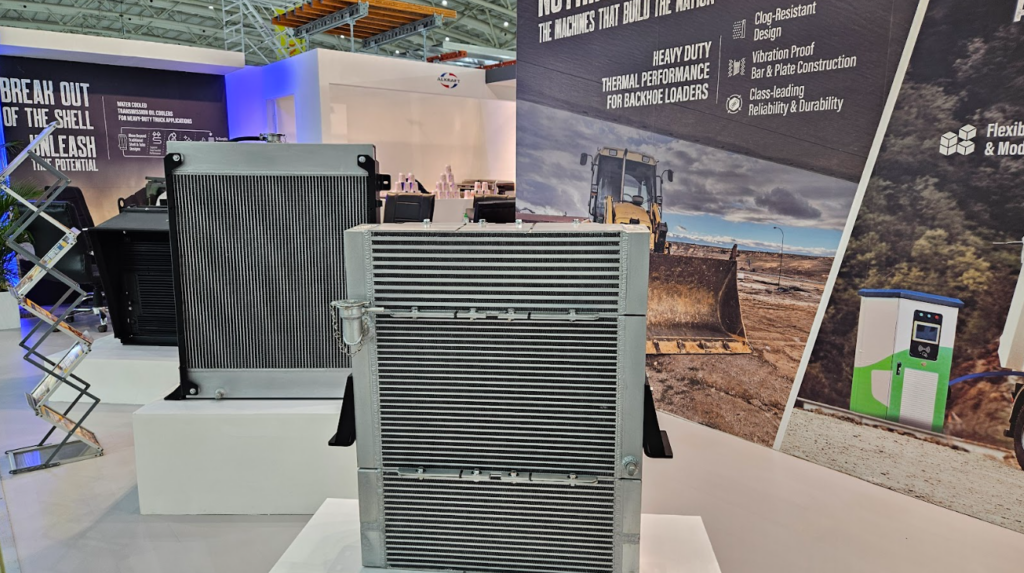
Alkraft’s competitive positioning rests on its willingness to challenge established technologies. A case in point is a newly developed water pool oil cooler that replaces conventional shell-and-tube designs and is currently under patent filing across multiple countries. “We never go to a customer claiming we know everything. We go in saying we have the ability to learn, challenge existing solutions, and solve problems from first principles,” Mr. Siddeeqi explained. He added that customers are increasingly willing to walk this path when traditional approaches fail to deliver results.
Balancing Auto, Non-Auto and Exports While Building for the Next Phase
Strategically, Alkraft is working towards a more balanced business mix. While nearly 50 percent of its revenue still comes from traditional automotive customers, the company aims to distribute its business evenly between exports, automotive, and domestic non-automotive segments over the medium term. “Our goal is to have one-third of the business from exports, one-third from automotive, and one-third from domestic non-auto customers. This diversification helps spread risk and builds long-term resilience,” Mr. Siddeeqi said.
Exports currently contribute around 17 percent of revenue, and Alkraft expects this share to rise significantly over the next 18 to 24 months, driven largely by non-automotive and industrial applications. The company is also preparing internally by reorganising production systems, upgrading TOC-based planning, and building focused teams across design and supply chain functions. “The bigger challenge today is not technical capability. It is aligning operations, people, and systems to serve very different customer expectations effectively,” Mr. Siddeeqi observed.
On electrification, Alkraft is already supplying traction cooling systems for EV tipper applications and developing cold plate solutions. While adoption in heavy trucks remains limited, Mr. Siddeeqi remains pragmatic. “Where the operating perimeter is well defined, such as city buses, last-mile vehicles, or construction EVs, we see traction. We are prepared with solutions, but the market will need time to mature,” he concluded.